Like every previous edition, this World Cup has been great at producing stories. The most uplifting was the one about the shrinking gap between soccer's established powers and the rest of the world, as told by the group-stage success of the African teams, and most memorably by Cape Verde. You also had the tactical story of the tournament, in how the teams with the most fluid and attractive attacking play achieved it by eschewing the sport's dominant strategic meta—the spread-'em-wide-and-pin-'em-high positional gambit, which has grown boring to watch and increasingly easy for defenses to counteract—to instead bring players closer together, looking to create space through spontaneous movement, collaboration, and deception, producing unpredictable moves full of technical inventiveness that baffled opponents and dazzled spectators. The exemplars of this refreshing brand of free-flowing soccer were Morocco and Colombia (honorable mentions go to the group-stage versions of Argentina and the United States), and in particular the brief but extraordinary cameos of Colombian cult favorite, Juan Fernando Quintero.
Then there was the anti-VAR story. It doesn't require belief in the more fanciful conspiracies about FIFA rigging the tournament in favor of Argentina to appreciate all the ways VAR has made the game worse. To wit, it has dulled the emotional impact of what should be moments of explosive sentiment, has made it so that the key replays after goals are no longer the best angles of amazing strikes but rather freeze-frames of back lines so that you can guess whether review will deem someone offside by an eyebrow, and overall has created conditions that only exacerbate the sense of inconsistency, suspicion, and unfairness that the replay system was meant to eliminate. Breel Embolo's red card against Argentina was the nadir, a call that by the letter of the new, confusing law may have been correct, but that violated any conceivable notion of justice.
So yes, over the course of a long tournament, especially during the early, most entertaining stage, the World Cup offers a rich variety of stories, all of them worthwhile in their own right. But as the competition winds toward its conclusion, the World Cup always returns to its principal theme: that the only thing that truly matters in soccer is having the best of the best.
The Final Four of the 2026 World Cup was arguably the best demonstration of that maxim the competition has ever produced. France, Spain, Argentina, and England entered the tournament as the four favorites to win it. All four made it to the semifinals. On top of that, all four got there thanks to heroic performances from their superstars. At various points this summer, each of Kylian Mbappé, Michael Olise, Jude Bellingham, Harry Kane, Lionel Messi, and Rodri could credibly claim to have been the most outstanding player of this World Cup. It was no surprise that those performances helped carry those four teams to the semifinals, nor that the semifinals themselves were both primarily determined by the two finalists' best players showing why they are the best.
In terms of sheer quality of play, Spain was the standout team of the semifinal round. France hadn't been seriously troubled all tournament, and had all the makings of an era-defining champion-in-waiting, and yet Spain completely played them off the park. It was staggering—not so much for the outcome itself, as it had long felt like Spain was best positioned to exploit France's few flaws, but because of the decisiveness of it. From the first minute to the last, Spain was obviously, enormously better than the team that until then had been the best one in the competition.
Because of the holistic nature of Spain's game, it's tempting to take the wrong conclusion from the win. It is true that soccer is a team game, and it was the choral nature of Spain's play against France that made it so phenomenal. But the pat narrative of the superstar-reliant Bleus getting bested by the individually weaker but collectively stronger Roja risks misunderstanding the nature of the match and, in a way, the sport itself. Spain, like most great sides, was the better team because it had the better individuals, put in a context that better amplified both their separate and shared abilities.
His showing wasn't the sexiest since it don't include any goals, but Rodri was clearly the best player on the pitch on Tuesday. He is a titan of a player, the personification of how the midfield position, when played at the highest level, can dominate an entire game both offensively and defensively, all without so much as stepping into either of the penalty boxes. What he does in the moments immediately following when Spain either loses or recovers the ball dictates the direction of the whole match. The way he's played all tournament—especially as Spain has transitioned from its initial attempts to recapture the wild and wingy verve of Euro 2024 to instead pivot to the more patient, possessive, erosive game of the older iconic Spain teams—has cemented him as his generation's finest midfielder, has once again validated his 2024 Ballon d'Or, and should make him one of the favorites to win the next one.
And it's not even like Rodri is the only Spanish player currently balling out. Several other Spaniards have played lights-out for the past month, but I'll stick to praising just one. Though Olise's eagle-eyed dimes may have made him the darling of the group stage, for the World Cup on the whole it's Dani Olmo who best represents excellence at the no. 10 position. If Olmo finds it bothersome that his lack of name recognition has him going a little under the radar, that annoyance must be tempered by the fact that the very genius of his play lies in his undetectability, the way he slips into the defense's most vulnerable spaces and daggers them before anyone even realizes he's there.
Spain ran rings around France's pressure attempts all game, and if Rodri was the matador with the red cape, then Olmo was the picador with the lance, pricking the opponent with his deft touches between the lines, guiding Spain toward the killing blow. It was fitting that, on the goal that served as the shiny jewel the team's crowning performance deserved, it was Rodri who played the ball that let all the steam out of France's press, Olmo who received the pass in the acres of space that made clear the danger France was in, and then Olmo again who played the ingenious first-time flick that teed Pedro Porro up for the finish. Soaring team play, yes, but the kind that requires brilliant individuals. Against France, Spain simply had more great players, playing in a setup that helped them be their best.
Spain manager Luis de la Fuente deserves a lot of credit for designing the setup that allowed his team to crush France. Alternatively, in the other semifinal, probably no single person did more to put Argentina's players in position to defeat England than England manager Thomas Tuchel. That semifinal was a far cagier affair, which for the first 55 minutes had little in it other than fouls, fury, and ugly play. All the argy-bargy made for gripping viewing, which proved that the beautiful game isn't necessarily less so when it is also brutal. More so than any star player, what sat center stage during the opening parts of that semifinal was the two countries' shared history, most directly the 1982 Falklands War and the 1986 World Cup quarterfinal that was, for Argentina at least, treated something like a weaponless sequel. (Before getting dragged too deep into the internet's always ongoing, never enlightening "let's make grand proclamations about history we don't really understand!" thing, it would worth knowing that the Falklands situation is much more complex than is usually granted.) Still, soccer is about the players, and that game had lots of great ones, so it was a shame that hardly any of them could get going for so long.
The lack of fluidity on both sides reflected the two managers' tournament-long struggles to get their teams to click. Argentina coach Lionel Scaloni's decisions have been the more defensible. The hallmark of the revitalized national team Scaloni has overseen for the past eight years has been how he has surrounded Messi with a complimentary cast that helped augment, rather than merely depend on, Messi's unparalleled talents. The cast, the manager's open-hearted and player-empowering approach, and the team's culturally rooted style of play all were crucial in delivering the Albiceleste the kind of success the country had anxiously awaited ever since the magnitude of Messi's talent became clear. However, rather than retool that machine even as it has begun to sputter over the past year or so, Scaloni appears dead set on giving this group the chance to ride until the wheels fall off. While frustrated Argentina fans like myself may have preferred to see more minutes from the likes of Nico Paz and Thiago Almada to maybe reinvigorate this aging bunch, I can't fault Scaloni too much for continuing to dance with the ones that brought him.
Tuchel, meanwhile, has had an unforgivable tenure. The German coach has a well-established reputation for being a magnificent strategist and also something of a nightmare. He has burned bridges at every stop along his career, mostly for being an insufferable character. He is one of those coaches who prioritizes his own ideas and instructions over the particular skills of his players, as if the arrows he draws on the locker-room whiteboard were what really win games. Coming into this World Cup, the major example of his egocentrism was his decision to leave Trent Alexander-Arnold home. Alexander-Arnold is a unicorn of a player, a true artist at a position usually helmed by workmen. Rather than try to design a strategy around one of England's most exceptional talents, or even just having him around in case of emergency, Tuchel thought it better to not even bring Alexander-Arnold to the tournament, favoring more limited, traditional right-back options who wouldn't force Tuchel to alter his pre-established vision.
For most of the tournament, England seemed at odds with itself, Tuchel's sideline interventionism constraining the expansive potential of the players' own abilities. Really, that England made it all the way to the semis testifies to the overriding power of players in general and England's star players specifically. Even without looking particularly helped by what happened around them, Jude Bellingham and Harry Kane dragged the team along. Unfortunately, that heroic hauling came to an abrupt halt during the last half hour of the Argentina game.
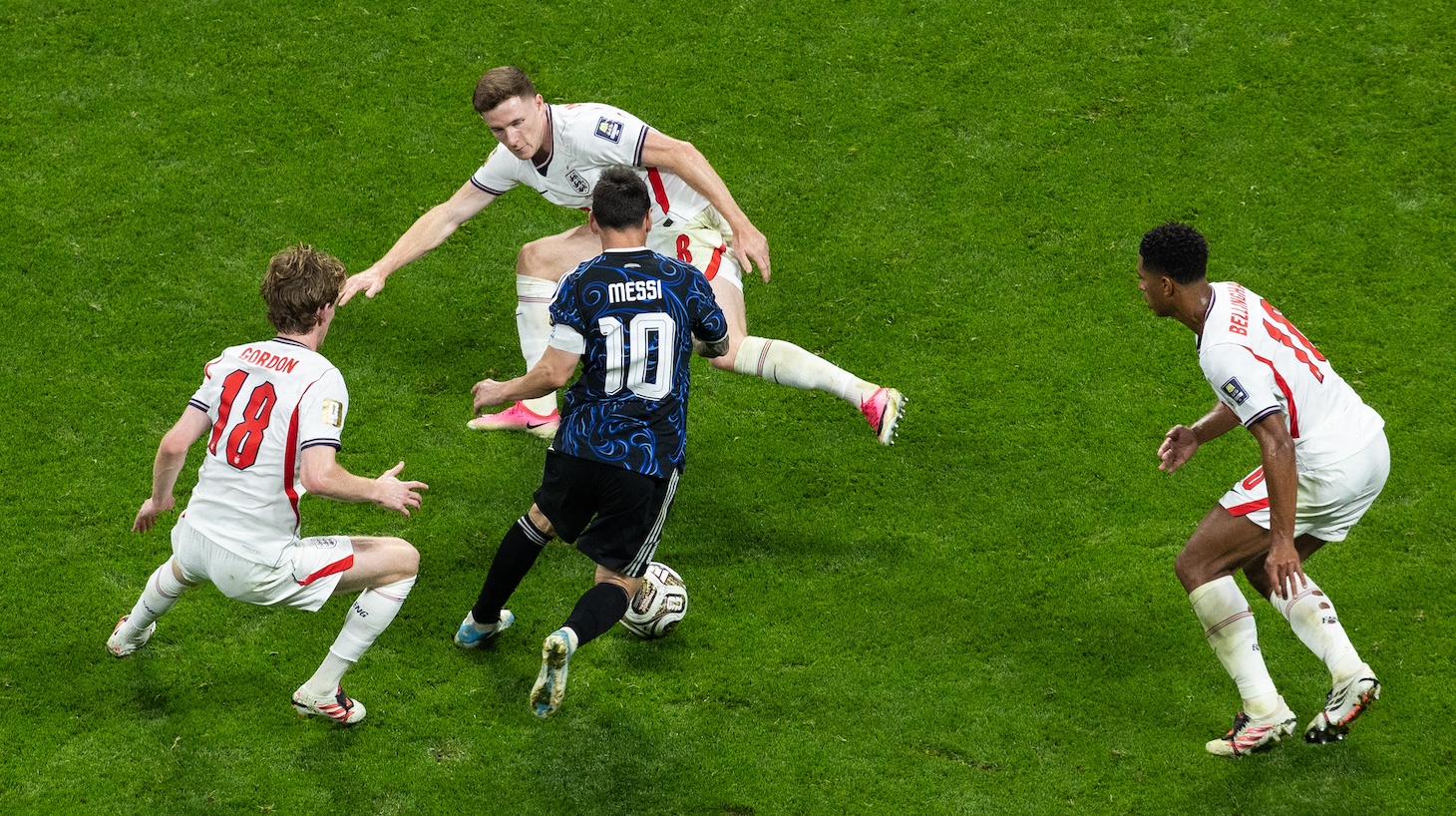
Goals always change games, and Anthony Gordon's strike that put England 1-0 up on Argentina in the 55th minute of Wednesday's match decisively changed that one. Up to that point, England's star duo had been relatively quiet, and Argentina's star had done little more than remind everyone that, though Messi has put up a hell of a fight against Father Time, the battle has nevertheless taken a toll. Messi's World Cup has been fantastic, proof that even at 39 years old, even off in semi-retirement in Miami, he is still arguably the most potent force in the sport. It has been just as evident, though, that the Messi of today is a far cry from the Messi of yore. Along with the explosiveness that left his legs years ago, Messi no longer can maintain for long stretches the energy and intensity his maximum efforts require, and therefore has to dose himself. The bet is that by picking his spots at the right moments, he can still make the difference with bursts of brilliance. The wager had already paid off several times in the knockout rounds, as the clanky Argentina team has relied on Messi to bail them out late on. In the England game, with an assist from Tuchel, Messi really hit the jackpot.
Pretty much the second after Gordon scored, England rushed to assume the infamous turtle-shell position. The Englishmen wholly abandoned everything that had kept the game so tight beforehand, the things that had kept Messi bottled up, and instead retreated way back into their own box to mount essentially a 30-minute defensive stand. Tuchel aided those efforts by making three defensive substitutions to help protect the lead. But as noted by Cesc Fàbregas in an old video clip that has made the rounds again after Wednesday's game, a manager's seemingly sound conservative tweaks can have greater psychological ramifications than intended, which can help the opponent snatch a victory from the jaws of defeat. Those well-known risks are even higher when the one attempting the snatching is Messi.
Every Messi’s touch after Anthony Gordon's goal 🐐 pic.twitter.com/BOKE1Koi2c
— The ANF Club ⚽️ (@adjorNfriends) July 16, 2026
Everybody knows what happened next. England's bunker defense unleashed Messi, freeing him to step into the areas in and around the penalty box where he is still the most deadly player in the world. Without getting harried the way he had been before, and after saving his energy for the right moment, Messi and Argentina played their best soccer of the knockout stage. Argentina was building and building toward a goal so inexorably that even though it took a while for the first one to come, it was no surprise when it did, nor that the second, winning one soon followed.
Both Argentina goals were assisted by Messi. Argentina's already legendary determination and defiance, all of it founded on what its best player has in the past been able to do and still can do to this day, utterly overwhelmed England. Though Tuchel has earned the vitriol he's been subject to in the aftermath of the loss, it should be said that none of his players covered themselves in glory, either. The kind of rebelliousness and resolve the likes of Bellingham and Kane showed in earlier matches was nowhere to be found when it mattered most. Tuchel might have hurt his team's cause by implementing the all-out defense protocols, but he isn't the reason why none of the towering Englishmen could win a header against the likes of Alexis Mac Allister and Lautaro Martínez. You could even argue that Tuchel's defensive substitutions were themselves a response to the players' own self-turtling instinct rather than the trigger for it.
Again, winning in the World Cup is about having the best players, putting them in position to succeed, and seeing them carry the day. England's best players shrank from the challenge, while in the telling moments Argentina's best player roared to life, adding one more piece of evidence to his case to be considered the best player of all time. (Boy, it sure would've been nice to have a brave technician like Alexander-Arnold on hand to help pass the game away instead of capitulating!)
Judging on how things have gone at this tournament so far, we can expect more of the same from the Spain-Argentina final. There are loads of great players on both sides. Nobody has a better argument for being the single best player at this World Cup than Rodri and Messi. In Lamine Yamal and Julián Alvarez, each team has a superstar who, due to entering the tournament banged up, has yet to show the full extent of his powers, and is surely itching to do so in the final. There really are six or seven players you could imagine deciding the game by themselves, or creating the context in which their team thrives and wins. The managers will help, and the tactics will be important, and afterwards there will be lots to say about the state of the sport and each country's place in it. But the most important message of this final is the same as it always is: you win by having the best.