Though the emotional appeal of soccer is immediate and visceral, especially in the shortcut-to-passion context of an international tournament like the World Cup, the real richness of the game is subtle. The uninitiated often find it difficult to access that depth. For better and for worse, the ball hypnotizes the novice eye. This is good, because what happens to the ball is what's most important. But it's also bad, because it's what happens around the ball that determines what happens to it. To paraphrase a famous line, if you watch the ball you'll see the plays, but it's by watching what happens off the ball that you truly see the game.
The World Cup is of course the main conversion event of the world's biggest (semi-)secular religion. As such, it's always good to help the legions of neophytes find their way into the sport's bottomless depth. Our very own Luis did just that before this World Cup started, writing a good guide for where to train your eyes in order to really read the game. I behoove anyone interested in scriptural analysis to read that post and watch a game the way Luis advises. This post, however, is about catching the Holy Ghost. And there's no better way to do that, to really feel the power of soccer, than by watching France play.
What stands out about this particular France team is that there is nothing subtle about it. They are so good in such an obvious way that even a total newcomer to the game can notice. All you have to do is look at the guy who has the ball, and he will do something to blow your mind.
France has been in steamroller mode basically all tournament long, but Tuesday's 3-0 win over Sweden was their most impressive outing yet. Outside of a few isolated incidents, the Swedes hardly ever troubled the French. In the other direction, Les Bleus flattened the Swedish defense into a pancake practically every time they had the ball. Once again Kylian Mbappé was the man in the spotlight. He scored his third brace of this tournament, giving him six goals in the present edition (tied with Lionel Messi for the most) and 18 in World Cups overall (one behind Messi for the most). The performances in these four France games are a testament to just how amazing Mbappé and his team can be when everything is designed around him. Mbappé has always been a player who plays first and foremost for himself, prioritizing the search for his favored actions over what might best serve his team's general play. Usually this is hardly any kind of problem, seeing as his favored actions lead to goals with terrifying consistency. However, you can see in a game like Tuesday's that a fully plugged-in Mbappé is capable of even more, of exerting a more holistic influence on the game that goes beyond his shot attempts themselves. Manager Didier Deschamps has found the perfect synergy: Align the surrounding pieces in a way that allows Mbappé to do exactly what he wants, and Mbappé will return the favor by helping the team help him.
Mbappé is well on his way to becoming the single-most dominant European player in World Cup history (let's not get blasphemous though, he's not even within touching distance of Pelé for the global crown), and there will surely be more than enough opportunities just in the coming weeks to focus on how great he is. Instead, today I want to stick with the Frenchman I think has even been better than Mbappé so far this tournament: Michael Olise.
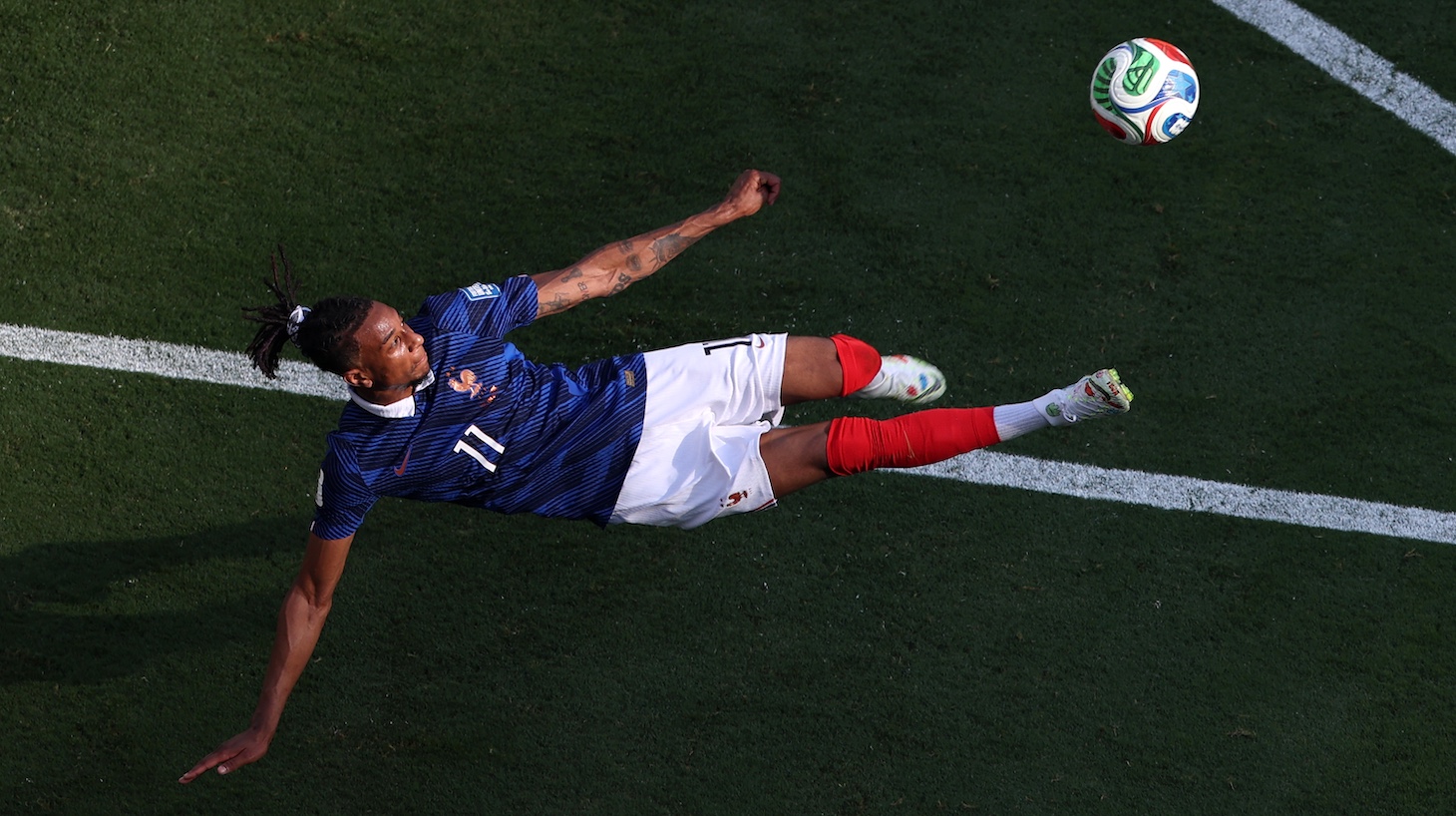
Olise vs Sweden
— Falcon 𓃠 (@Richard93867744) July 1, 2026
Outrageous! pic.twitter.com/8xjGCVUKIK
If this French team stands for the idea that sometimes you really can just watch the guy with the ball and get everything you need to know about a game, then Olise is the main guy you've got to keep your eyes glued to. As Thierry Henry said after Tuesday's game, he really is France's most important player. For most of his outrageously successful managerial tenure, Deschamps has prioritized defensive soundness over attacking flair. France has long possessed an embarrassment of riches on the forward front, but Deschamps has tended to favor cramming an additional hard-working midfield type into the starting lineup over featuring an extra creator. Even if one could have aesthetic qualms with that choice, France's results speak for themselves. But more than anyone else, it's Olise who has convinced Deschamps to eschew conservatism and instead roll with a four-attacker lineup that is built to outscore all comers.
Olise is a rare player who combines world-class creativity and attacking production with a tireless defensive motor. That off-ball work rate is what guarantees Deschamps something of the defensive solidity he so covets, even with what might otherwise appear an attack-heavy XI. (It's worth noting that Ousmane Dembélé contributes to this same dynamic for the same reasons.) And if pressing center backs and tracking midfielders is the price Olise has to pay in order to get onto the pitch in his favored No. 10 position, then the reward for him and everybody watching is the freedom he has when France has the ball.
When France is in possession, there is no question that Olise is the one behind the steering wheel. The foundation of his game is his passing—his vision and his technique. Because he's really the only member of France's typical starting lineup for whom that's true, Les Bleus' entire gameplan with the ball consists of giving it to Olise and letting him lead the way.
The "No. 10 position" is often used as shorthand to describe how a player plays, but in truth it really only refers to a particular place on the field. There's no one way to play as a No. 10. For instance, while some 10s are second strikers, whose interventions are mostly reserved for the final third, Olise plays it as a true midfielder. Over the course of a match, you are likely to see him popping up literally everywhere—deep in midfield just ahead of his center backs, up near the crown of the penalty box just in front of the opposing center backs, out wide on either wing, and everywhere else. At all times, wherever Olise is is where you'll find France's pulse. That's what makes it so rewarding to watch the game by watching Olise. He's always the one who will tell you what's going to happen next. And what happens next is usually something unbelievable.
Olise's World Cup has been an endless geyser of gorgeous passes. Probably only Lionel Messi, Lamine Yamal, and fellow Frenchie Rayan Cherki can rival Olise's gift for the final pass. What's so remarkable is how quickly he both spots and dishes his dimes. It often happens to me that the ball will be coming to Olise and I'll lean forward thinking, OK, yes, now THIS is going to be good—but before my ass even gets to the edge of my couch, he's already threaded the needle. Olise's genius for the through ball makes his combination with Mbappé, the world's foremost genius at off-ball runs, flat-out unfair. In the Sweden game Olise had the assist on Mbappé's second goal and the hockey assist on the first. For the tournament as a whole, the England-born baller has teed up half of Mbappé's goals. With better finishing or offside-evading, he could easily have added a couple more assists to what is already a single-tournament record (he's even just three shy of tying Messi's all-time World Cup assist mark!). Those two, and the trio they form with Dembélé, who is capable of doing plenty of damage even in his secondary role, are playing like one of those attacking combos you otherwise only find in the legendary Brazil teams.
It's still early in the tournament, but at this point there's not a single team in the field that looks close to competing with France. Spain should be their biggest continental rival for global supremacy, but I fear that injuries and bad form have already precluded the Spaniards' chances of hitting the highs of Euro 2024. Brazil is steadily growing into the tournament, but as of now they still look really vulnerable. Argentina is the best bet to stop them the way they did four years ago, but really only Messi has thus far recaptured the spark that made Argentina world champions in Qatar.
France certainly isn't perfect. Every opponent so far has been able to carve out chances against this shaky defense. In that way, this high-variance attacking style might make them a little more susceptible to an upset than the more defense-minded gameplan from 2018 and 2022. It will also be interesting to see how France fares against an opponent that can dominate the midfield and gum up their buildup play. Stylistically, France is a team that overpowers you more with individual plays than stretches of all-encompassing match dominance, making them closer to knockout punchers than ring generals. It's not impossible to imagine France missing on a few haymakers, catching a couple on the chin themselves, and not having the tools to prevent the opponent from escaping to the final bell.
But let's not worry about all that speculation right now. What's most important is that soccer is great, World Cup soccer is the best of it all, and no team in this tournament makes more evident why exactly those statements are true. For someone who just wants to be wowed by this sport, especially if you're relatively new to it, I can give no better advice than to make sure you find yourself in front of a screen when France is playing. Just look for the ball, and you'll likely see something you'll never forget.