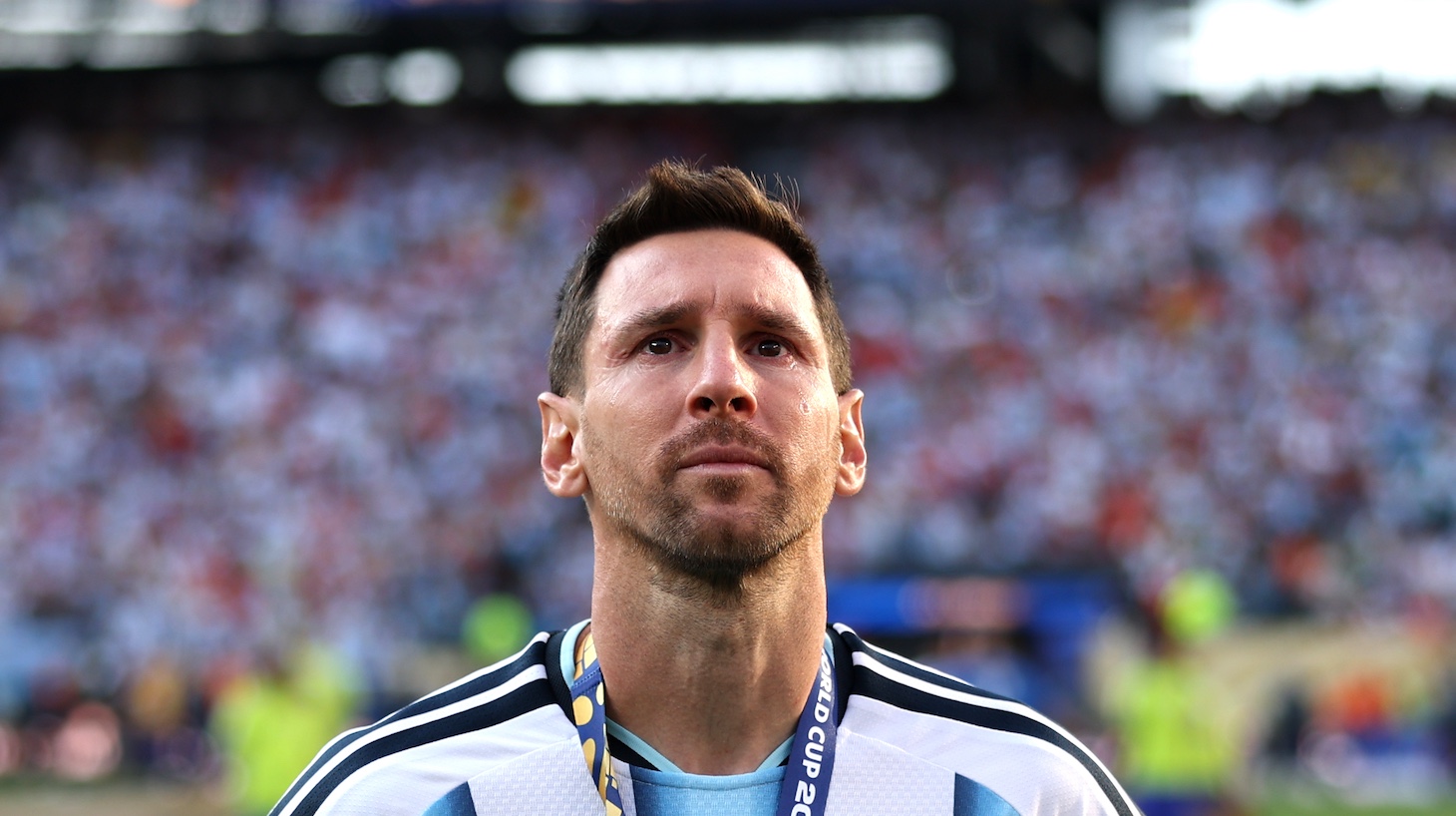
"Everything ends badly, otherwise it wouldn't end." As it is in life and love, so it is in soccer. From the outset, the 2026 World Cup was sure to mark an ending for Lionel Messi—not to his career as a whole, and likely not even to his days with the Argentina national team, but to his time on the sport's center stage, the venue which featured the 20-year unfurling of the exciting, hopeful, heartbreaking, agonizing, inspiring, and triumphant story that has defined one of the greatest tales sports have ever told.
Across its full length, Messi's career at the World Cup was anything but predictable—featuring defeat when it seemed he would win, wins when it seemed victory had passed him by, and, most ridiculous of all, one last final against a teenager he had, unsuspectingly but almost literally, baptized as his heir when that teen was a baby. But being a story about life, this one too would have only one ending: Father Time confirming his undefeated record by at last claiming victory over one of his most stubborn opponents. It's not that Messi's Argentina had to lose to Spain, but Messi did and does have to lose to the inexorable passage of time. The loss on Sunday, and his completely peripheral role in the action therein, just made for a particularly tidy conclusion. I wouldn't exactly call the match's outcome scripted, at least not in the conspiratorial, "FIFA is rigging it!" sense that clouded too much of the conversation around Argentina's tournament, but I wouldn't be surprised if the paranoiacs disagree. After all, Tom Cruise, who first spoke the famous quote that starts this article, took to the field before Sunday's final and gave a speech about the nature of life, love, and soccer.
Throughout the tournament, there has been a duality at the heart of Messi's 2026 World Cup. On one hand, seeing how incredibly he played made you think, Holy shit, Messi is 39 years old and is still the best! On the other, the unmistakable limitations of his aged body, evident even on his best days, made you think, Man, 39-year-old Messi is nowhere near as good as the younger versions. Far from being any kind of criticism, the latter impression only amplified the former. It speaks to how amazing a player he is and was: Even when ambling around the pitch with a cane and creaky knees, Messi can still do things the rest can only dream about. Still, 39 isn't 25, or even 35. The total anonymity Messi displayed in such a one-sided final can only be understood as proof that, for all the skills he has successfully preserved over the years, he has nevertheless lost a lot of what once made him at least omnipresent, and very often omnipotent.
Having already won one of his own, there was nothing that could happen in this World Cup that would qualify as truly tragic from the perspective of Messi's legacy. Nevertheless, there was something ironic and disappointing about how this one went, in how it echoed a past that the team had seemingly put behind it.
Most of the Argentina teams of the first decade-plus of Messi's career were plagued by what was often referred to as Messidependencia. Armed with the most volcanic talent the game had ever seen, many Argentina (and some Barcelona) managers were content to rely solely on Messi's abilities when it came to designing the team's attacking strategies. Messi being Messi, and Argentina being Argentina, that "defend for your life, and when you get the ball give it to Messi and let him figure it out" plan worked pretty well, getting the Albiceleste to tournament final after tournament final after tournament final. At the same time, it lowered the team's ceiling, demanded far too much of the star man, and consistently failed to get the team over the top.
Soccer, and international soccer specifically, exists to a significant extent in the realm of mind and memory, and the mind of Argentine soccer is dominated by memories of Diego Maradona. The mythical and not entirely unfounded conception of Maradona's one-man show at the 1986 World Cup stood as the blueprint, the exemplar of what an Argentina led by a superstar could and should be. The expectation was that Messi, Maradona's heir apparent, should be able to recreate his predecessor's single-handed feat of lifting the World Cup by doing everything himself. Whether conscious or not, the national team setup—from the managers, the players, and even Messi himself—seemed transfixed by the idea that the team should consist of hardworking, subservient pieces that all surrounded an enormous, Maradona-shaped hole, from which Messi would stand and victory would miraculously emerge.
But soccer doesn't usually work like that. Great, winning teams are composed of great individuals with complimentary skill sets, playing in a way that helps get the best out of their biggest talents. Of all the Argentina managers Messi has had, it has been Lionel Scaloni who best understood that. I don't think it's an accident that, under Scaloni, the goal of the national team wasn't so much to recreate the memory of Maradona in '86, but instead to revive the lost tradition of la nuestra, the mythologized playing style upon which Argentina has long founded its national soccer identity. The focus on la nuestra and its combinative play, artistic dribbling, spontaneous movement, technical mastery, and mental toughness reframed the notion of the team, no longer seen as something in service to one individual, but instead as a collection of individuals equally participating in a shared practice. That reconfiguration conceptually raised the importance of the other players, decreased the singular demands on Messi, and reforged the bonds between the national team and the nation, which stopped regarding the Selección as an outside thing to expect something from and started seeing it as an embodied representation of an Argentineness that they too partake in every day.
It was by disappearing into a true team that Messi could then arise as the victorious star everyone in Argentina had always wanted him to be. And what a team it was. It's unfortunate that the Eurocentric worldview is so totalizing that I don't think Scaloni's Argentina teams are revered to the extent they should be. From about 2020 to 2025, Argentina played some of the best, prettiest, most dominant soccer in the world, the kind a fairer era would define itself by. Part of the issue is that Argentina didn't fully get clicking at the 2022 World Cup until the quarterfinals, and the Kylian Mbappé–led France comeback in the final, though consecrating the game as arguably the greatest one in the sport's history, has somewhat overshadowed what was for the first hour a beatdown even topping the one we saw on Sunday. But the tournament successes Argentina has enjoyed over the past five years—Copa América titles in 2021 and 2024, the World Cup in 2022, and now a run to the World Cup final in 2026—were wholly deserved, an accurate reflection of how great a team this has been.
The disappointing thing about this summer is how so much of that went out the window. Very little of the style of play of the best recent Argentine vintages was on display at this tournament. What stayed the same, however, were the names of the players themselves. Ten of the 11 starters in Sunday's final were also on the national team roster in 2022; the 11th only missed out four years ago due to injury. Eight of Sunday's starters also started 2022's final. That is a concerning lack of squad revitalization, especially with how physically demanding Scaloni's ideal style of play is, especially when it requires compensating for a Messi who is even less physically robust than he was four years ago.
The overreliance on that same core from 2022 explains a good part of the team's struggles not just in its terrible final, but throughout the knockout rounds. Scaloni decided against trying to shake things up by committing to young and/or different players, instead, as someone put it in the leadup to the final, letting the stalwarts ride until the wheels fall off. Those wheels wobbled precariously all tournament, returning Messi to the place he spent so much of his pre-champion Argentina career, a lone hero tasked with willing his team to the trophy practically by himself. What was remarkable was how close he came to doing just that, and it should be said that part of that was surely down to the internal brotherhood that was formed by Scaloni sticking with the same group. But the loose wheels were always at risk of falling off at the worst possible moment, which is exactly what happened right at the opening whistle of Sunday's final.
Because humans are inescapably prisoners of the moment, we tend to overrate the importance of endings. Sports discourse tends to obsess about the final, almost necessarily disappointing stage of a great player's career, giving outsized weight to that late-stage disappointment. In truth, it's usually the peaks we remember. The crazy thing about Messi, similar to his basketball counterpart, LeBron James, is just how high his peak reached and how long he kept it there. Messi won his first Ballon d'Or in 2009, at 22 years old. He was probably just one great showing on Sunday away from winning another, but now that that's not going to happen, it's safe to say that his final Ballon d'Or, his eighth, came in 2023, at 36. Even factoring seasonal highs and lows, that's 14 straight years at the absolute pinnacle of the game, a prime that lasted longer than many entire careers.
At club level, Messi will mostly be remembered for what he did over the first half of that prime, scoring unbelievable amounts of goals as the figurehead of the most iconic club team of all time, and a little later as the shining star in the club game's most iconic attacking trio. On the international side, the long procession of mid-career heartbreaks will be condensed into a brief setup sentence that leads into the punchline of his late-career success, centered primarily on 2022. The events of 2026 will be closer to an epilogue, knowledge recalled only by the older generations and the most invested of younger fans. "Yeah, but did you know that after all that, he went ahead and got Argentina to another final four years later?" As an example of the phenomenon, I'd bet lots of even informed soccer fans under 40 don't remember that Maradona got Argentina to the final in '90 too, or that his last international appearance came in the group stage of the '94 World Cup in the U.S., after which he failed a drug test and, in disgrace, never again suited up in Albiceleste. From this tournament, Messi's battle with Mbappé for the Golden Boot might endure in the larger soccer consciousness, and I'm positive his win over England in the semis will stand near the fore of his Argentina's individual victories, just for what it represents symbolically. But for the most part, I think Messi's 2026 World Cup only serves to firm up a legacy that was already all but cemented.
The biggest impact of his career, though, will be felt by those of us who called ourselves fans of his. In Argentina, the effect is incalculable. I remember reading somewhere a long time ago that, in the fallow decades after Maradona's retirement, soccer fandom in Argentina had grown more provincial than national. The phrase as I remember it was that most big-time soccer fans there would prefer to see their favorite club team win the league than see the Albiceleste win something. The sentiment itself isn't terribly strange. As I understand it, it's not uncommon that the most diehard soccer fans in any given country care most fervently about one of the country's big clubs, and intense national-team fandom is more reserved for fans of smaller clubs or those who follow the sport more casually. That provinciality was no doubt behind a good deal of the somewhat chilly reception Messi had in Argentina for many years. Because Messi left the country so young, he never debuted with one of the rabidly supported local clubs, never won himself a dedicated cadre of the club-focused superfans, and therefore only had international tournaments to win the hearts of his compatriots, where he was always competing with the memory of Maradona.
But in Messi's humanizing failures with the national team, followed by his dizzying triumphs, Argentina has once again become a country utterly obsessed with its national team. And not only as a vehicle for idol worship, but as a communion between the people. At least, that's how it seems from afar. During every international tournament in recent years, social media has been awash with jubilant masses of Argentines celebrating their team and themselves. Just the other day I was marveling at the legions of Argentina fans who pulled up to Times Square, grills and all, and proceeded to have an hours-long singing-and-asado party. There is truly nobody doing it like Argentina fans today.
Of course, like in any country, distasteful things often pop up at the nexus of nationalism and typical sports conservatism. Many of the players are tax-evading Milei supporters, and the racist song the national team was singing on the bus in the aftermath of their 2024 Copa América win didn't come from nowhere. Several members of the Albiceleste embarrassed themselves after the Spain game, like Nahuel Molina hitting Rodri, Leandro Paredes attacking Eric García and Gavi, and shit-talking heel Nicolás Otamendi lecturing a baffled Rodri about imagined shit talk. Indeed, much of the conversation about Argentina's run at the 2026 World Cup has featured non-Argentines praying for Argentina's demise. When it's focused on stuff like the post-final fighting, it's certainly been justified. When it has centered on the perceived referee bias, or tough but legal in-game physicality, or other phony concerns about sportsmanship, it's been less fair.
I have found that lots of the talk about Argentina, both the national team and the country, quickly devolves into what would in most other circumstances be acknowledged as gross stereotyping and generalizing, if not outright racism. For some reason—largely, I believe, due to an over-extension of a certain race and class framework that may fit some national contexts but is often treated as a transhistorical fact that applies everywhere in the exact same way—many feel free to engage in talk about thuggery, backwardness, moral decline, intellectual inferiority, and deserved poverty when it comes to South Americans, and in particular Argentines. That's not to say it's Problematic if you hate Enzo Fernández, or if you're unsurprised by unvarnished racism from a Paraguayan politician, or even if you just think it was corny how Messi tried to manufacture a bullshit red card for Marc Cucurella. Partaking in baseless, harmless international hateration is one of the joys of international soccer, and it's perfectly fine to dislike the Argentina national team for how they play or even to think Argentina is a country with lots of jerks—lord knows many of Argentina's Latin American neighbors will agree with you there.
Still, it's been really distasteful to see people with no real understanding of the particular, complex culture and history of Argentina tossing around uninformed opinions about the Falklands Islands, bizarre accusations of nationwide Zionism, and decreeing that some 46 million people are all guilty of racism, corruption, and degeneracy, based on the paltry evidence of what a couple sad soccer players did after a game and what someone "learned" from weird social media campaigns. It's all especially rich coming from soccer fans in the West, when the histories of Spanish colonialism, British economic neocolonialism, and American Monroe Doctrine meddling created the conditions for Argentina to become what it is. Argentine soccer players, largely from working-class backgrounds, largely coming out of a nightmarishly cruel youth development system, are often dickheads who are susceptible to the ugly side of the country's national politics? Boy, I wonder what happened to all the leftists there ...
Then again, I'm not Argentine myself, and I'm hardly an expert on the country writ large. My investment in the place and its history and culture is animated almost entirely by my interest in soccer. But that too is proof of the power of this sport, and of the specific legacy of Messi. It's not really an overstatement to say that Messi changed my life. In 2006, I had absolutely zero idea of what international soccer was. But whiling away the hours in between busboy shifts at Texas Roadhouse during the summer between high school and college, I decided to keep my TV set to its primary channel, ESPN, once this World Cup thing started. I was immediately entranced by the game, and soon after totally hooked by the exploits of this young phenom from Argentina, the team I'd decided to root for just because of their cool jerseys, who was right around my age. Fast-forward 20 years, and I now have dedicated my professional (and to hear my wife tell it, too much of my personal) life to soccer, a sport that as a teen I considered a complete joke, thanks to Messi.
So much of what I have done, thought about, cared about, learned, and felt over the past 20 years has been related, directly or indirectly, to soccer. During his speech at our wedding, my father-in-law likened the union of me and my wife to that of Messi and Neymar at Barcelona (we're planning on lasting longer, though). Twenty years ago I'd never so much as owned a soccer ball, and had probably "played" the game for a collective 15 minutes in my entire life. Now I regularly take my three-year-old son to the local high school soccer field, where we spend an hour or so chasing after one of our soccer balls—usually the one that features the faces of Messi and Maradona kissing the World Cup trophy, a present to my son from his maternal great-uncle, who brought it stateside during one of his annual trips from Argentina, where he lives. Some day in the next couple weeks my wife will give birth to our second child, whose arrival date was specifically planned to give me a chance to watch and work during this World Cup.
If you ask my son who his favorite athlete is, he'll reply "Messi!" without skipping a beat, though I have to respect his foresight when, during a trip to the mall's sports memorabilia store a couple weeks ago, he picked out a Lamine Yamal Spain jersey for himself. He won't remember watching this World Cup, in no small part because "watching" is already a stretch as a description of the hijinks he's gotten up to in our living room while I've had a game on in the background. But I do think that one way or another, soccer in general and Messi in particular will matter to him, if only because of how much they've mattered to me. If that's not a testament to the magic of soccer, to its greatest event, and to its greatest player, then I don't know what is.