

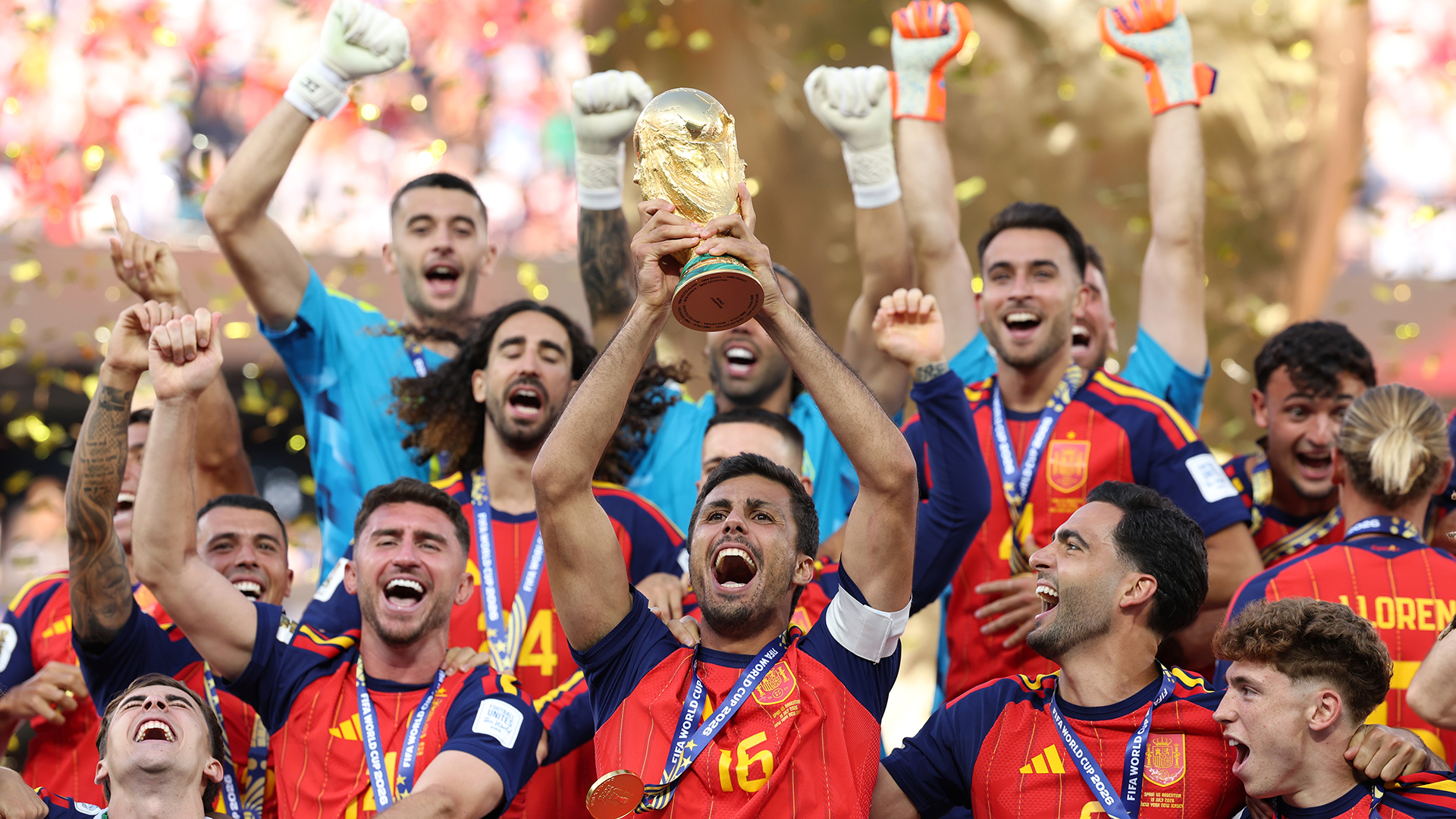
It sure looks like Spain has found the formula for winning World Cup finals. All it takes is a truly hideous game, marked by defensive intensity and borderline tackles, and a late goal from a Barcelona player. In the Wario to the 2010 final, Spain beat 10-man Argentina, 1-0, thanks to Ferran Torres's emphatic 106th-minute winner. But that's not why Spain won the World Cup.
Spain won on Sunday because it played the exact same game it played in every knockout match on its way to a second World Cup title: defending with intelligent and patient possession, and immediately suffocating opponents on the rare occasion the Spanish players lost the ball. This was an ugly World Cup final, the ugliest I've been sentient for, but there's nothing disappointing or unearned about Spain coming out on top. This was the best team in this tournament both by results and efficiency, a murderous machine of tiki-taka and furious counter-pressing. Argentina never had a shot.
Just like the third-place match on Saturday, there's not a lot to speak of in terms of tactics with the final. Argentina was on the back foot the entire match, perhaps a consequence of its failure to put away Cape Verde and Switzerland in regular time, and of its need to manufacture high-intensity comebacks against Egypt and England out of thin air. Injuries requiring the substitutions of both of its excellent starting center backs, Lisandro Martínez and Cristian Romero, surely did not help.
Even at full strength, though, this was always going to be an uphill battle for Argentina, and that's because Spain presents a uniquely difficult challenge for any team that can't punish its possession game and its high-intensity pressing. Argentina has a lot of ballplayers, but not a lot of pace to stretch Spain's defense. On Sunday, it felt like the sequence of every play was the same: Spain would pass, pass, pass, get into the attacking third, send a ball or a shot into the box, Argentina would steal it or block it or tackle it away, and before you could blink, Spain already had one, two, three players charging in on the player with the ball. Even with that swarm, though, the rest of the Spanish players would shift correctly and quickly, and suddenly any idea of a counter was shut down, and Argentina was left to try to get out of pressure with wing backs and central midfielders pushed out wide. Oftentimes, a pass back to the goalie was the only move, as Argentina found itself unable to establish any sort of rhythm with the ball.
While it felt like Spain had about 80 percent possession, the real number was 65 percent, though that includes the final 20 minutes or so when Argentina was looking for the equalizer and had (only) half of the possession. Otherwise, it wasn't just the stat, but the flow of the game, as Spain chained the passes it knows and loves, always probing when the spaces opened up and recycling when they didn't. You could argue Spain should have taken more risks against an exhausted opponent, and you could argue that someone should have told Spain to shoot anywhere but directly at the chest of Emiliano Martínez. Fair critiques, both, but Spanish manager Luis de la Fuente likely saw what everyone at home did: Argentina was barely hanging on, maybe just on the strength of a champion's pride, and there was no need to rush things. Put another way, Argentina had zero shots until the 117th minute, and only managed two in desperation mode; one was blocked, and one was the only half-chance that the South Americans had, a Giuliano Simeone volley that he sent into the stands.
And so, while Spain was gifting Martínez the new record for most saves in a World Cup final (11), there was never any panic in its play. There was no reason to panic, because Spain choked the life out of this game. It was boring at times and excruciating at others, and during various points in the second half, I was begging for the Muppets to come back out and play "Seven Nation Army" again, but it didn't need to be anything but what it was for Spain. Death by a thousand passes (well, 852, to be exact) and just waiting for the right time to strike. The moment took forever to arrive, but it finally happened in the 106th minute.
The buildup to the goal came right after the start of the second half of extra time. Spain took the ball from its own third all the way to the Argentina box with no resistance, and Lamine Yamal found himself with the ball on the right wing. Just as Spain shut Lionel Messi down all game, so did Argentina shut down Lamine, but Lamine had plenty of help. In this case, he laid the ball off to Pedro Perro, who, it shocks me to say, was immense this World Cup, a worthy inclusion in any team of the tournament. One last time, Porro punished a defense that didn't take him to be a serious threat, ripping off a back-post cross to substitute Nico Williams. The cross went long, so Williams headed it back to the center of the box, perhaps seeing a charging Ferran Torres running in. The Barcelona forward was in the right place at the right time, but there was nothing fortuitous about his rocket into the goal. This was unsaveable, unstoppable, and, for Spain, unforgettable, much in the same way that Andrés Iniesta's 2010 winner was.
Argentina woke up, finally, after the goal, but thanks to Enzo Fernández's second yellow sending off, and thanks to having to chase Spain around for so long, the Albiceleste just didn't have enough juice left. Simeone's shot was the best chance, and there was another where Pau Cubarsí, the rightful Young Player of the Tournament winner (he is 19 years old and already one of the best center backs in the world, it's unbelievable), was able to clear a corner away just ahead of Nicolás Tagliafico. Other than that, Messi and his teammates just couldn't do what they did to Egypt and England. (I didn't even mention Messi all that much in this blog; he was a non-factor for almost the entirety of the game, and his inability to press at his age was a detriment for Argentina even before it went down to 10 men. Compared to his last World Cup final, this was not one for the history books.) For the first time in this World Cup, Argentina tasted defeat after conceding first.
As for Spain, this win cements another cycle of dominance for a country that is barely a decade out from a previous cycle of dominance. That earlier team from the 2008-12 run, with all of the Barcelona and Real Madrid legends of that time, won the Euros, then the World Cup, and then the Euros again to boot. This team has now completed two-thirds of that, and it has an advantage in age. Most of Spain's best players are 30 or younger, and only one player over 30 (Aymeric Laporte) played key minutes this time around. Even before smothering Argentina and riding Torres's beautiful goal and even more beautiful hair to the title, Spain, by virtue of its talent and the way that it demolished France in the semifinal, had assumed the mantle of the best team in the world. The World Cup only makes it official, and it's hard to say that there was a more deserving winner in the field (except for Cape Verde, one supposes). Next up is Euro 2028, and just as I did ahead of this tournament, I will be picking Spain to win it all. The Spaniards didn't make me look foolish on Sunday, even if it took a while to deliver the triumph. Spain takes its time, knowing that no one on this planet can hold out against them forever.