Argentina is in the World Cup final for a second straight tournament. Somehow, some way, that is a true statement. After Cape Verde put the fear of god into the reigning champions, after Egypt had a 2-0 lead as late as the 79th minute, after Switzerland equalized and looked on the front foot in the quarterfinal, and after England scored first in Wednesday's semifinal, through it all, Argentina exhibited the kind of survival skills most often associated with crocodiles and Real Madrid in the Champions League.
Many times throughout the knockout rounds, Argentina has looked as good as dead, staring face to face with the end of its hopes of becoming the first repeat champions in 64 years and the close of Lionel Messi's international career (I mean, I assume, but who knows with him; I've been wrong before). But as England found out on Wednesday, on death's door is where Argentina feels most alive. On the brink of elimination, Argentina has consistently conjured magic, and now, after a 2-1 victory that looked impossible until it became reality, Argentina is one match away from immortality.
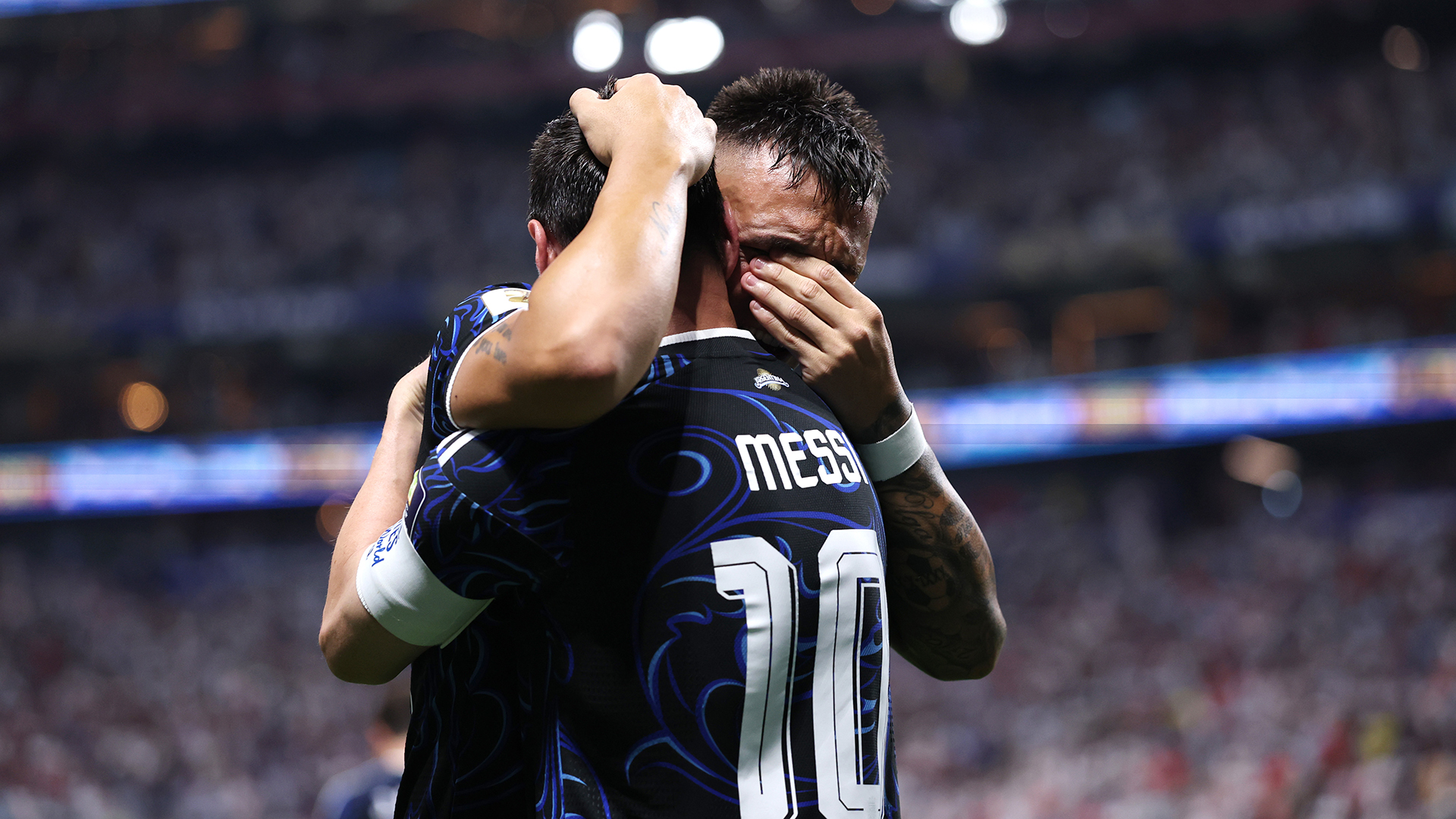
Whatever I have to say about Argentina, and about Wednesday's match, needs to start with Lionel Messi. Though he didn't score, Messi was, as he so often has been, the main man for Argentina. Every time the Argentines got close to the English box, it felt like every eye on the field, in the stands, and at home was focused on Messi. England wisely doubled him most of the game, forcing Messi to try to create his usual heroics in the tightest of spaces. Those heroics hardly looked inevitable. In the first half, it felt like his attempts to turn back the clock would cost Argentina dearly. Each time he lost the ball 30 yards from goal, attempting one of the trademark risky jinks he clearly lacks the juice for now, England would strike on the counter immediately after, forcing Argentina's defensive players into desperate professional fouls. A red card wouldn't have been unlikely.
In a way, it took England scoring to open things up for Argentina. And what a goal it was. In the 55th minute, England moved quickly from its own box, the ball finding Harry Kane in a retreated position. He lobbed a ball forward toward Morgan Rogers, which Nicolás Tagliafico acrobatically though not emphatically cleared. Rogers was able to get it back, and was left with too much space after what seemed like a miscommunication from Tagliafico and Lisandro Martínez, and the Aston Villa man slotted a perfect ball across the Argentina goal. Nahuel Molina somehow both lost Anthony Gordon at the back post and tried to use the wrong foot to intercept the ball, allowing the new Barcelona signing to convert a nifty finish that put England up 1-0 against the run of second-half play.
(A quick aside: The less I say about the first half, the better; it was nasty, with 19 fouls combined against only three shots. The second half was much better.)
Soon after the goal, with Argentina now in desperation mode, England manager Thomas Tuchel began a series of conservative decisions that, as much as Argentina's own efforts at least, contributed to this most painful of English collapses. Having already initiated all-out defense protocols for the last 30 minutes (down a man, thanks to Jarell Quansah's red card) of the Mexico game, Tuchel decided to deploy that plan again. The problem is that Argentina is much better than Mexico, and Messi is something Mexico has never produced. Many smart and handsome experts believed this to be a mistake in the moment, and it played out like a Michael Myers chase scene: Slow, but deadly. (Tuchel himself admitted to some fault after the match.)
From the moment England scored until Argentina went up 2-1 in the second minute of stoppage time, England had—and I triple-checked this—only 12 percent possession. That is a recipe for disaster no matter the teams involved, but giving Argentina that many chances at an equalizer was only going to doom England. And doom them it did. In the 85th minute, Enzo Fernández ripped what felt like his 10th great shot of the game from outside the box (it was actually, by my count, his third) and forced Jordan Pickford into a fingertip save. On the ensuing corner, Messi drew enough of England's defenders to him to open up space in the middle, and a precise pass allowed Fernández to finally score one of those shots, a beautiful long-ranger that just curved away from Pickford's outstretched hands:
This is the problem with giving a team like Argentina so much time and space on the ball around the box. Even not taking Messi into account, the Albiceleste has too many players who are comfortable both delivering crosses and ripping shots off. It took some patience, but Argentina's chances eventually started flooding in even before Fernández's equalizer. Alexis Mac Allister kept getting his head onto crosses despite his 5-foot-9 stature, Rodrigo De Paul put pressure on the right wing with incisive passes and a cross of his own, and in general Argentina was getting exactly what it wanted in the box. It took a moment of true talent to equalize, but it felt like it was always coming.
That was also true of the eventual winner. With England playing about eight defensive players, there was no real threat of a counter-attack, so Argentina—itself bringing on an inordinate number of attackers as it hunted for late goals—could keep besieging the English box in hopes of winning it before going to extra time for a third time in four knockout matches. After Mac Allister hit the post from a zinger of a shot in the 92nd minute, the ball eventually came back out to Messi on the right wing. The legendary left-footed magician did something he rarely does: He created something beautiful with his right. You can blame England's defense for somehow losing Lautaro Martínez in the box, but Messi put the cross directly on the Inter Milan man's head, the easiest World Cup semifinal-winning goal he could've imagined:
Now down 2-1 with an entire battalion of defenders on the field, Tuchel tried to reverse course by subbing on Marcus Rashford and Ivan Toney, but Argentina was sturdy and decisive in its clearances as the clock rolled past the nine minutes allotted for stoppage time and into the 100th minute. Eventually, with exuberance for Argentina and devastation for England, the final whistle blew. Argentina 2, England 1, and it all feels a bit preposterous to think about.
This wasn't the Messi show one might have expected, but he was the catalyst for both goals, converted by two of his more renowned and reliable teammates. England will be in shambles (MATE) for giving up this golden chance to reach its second-ever World Cup final, but this was as much of a self-inflicted collapse as one will ever see. Tuchel trusted that his defense could replicate the Mexico stand, but he perhaps failed to account for the one man everyone always needs to remember. It had to be Messi who created the goals, because he is the ultimate weapon against a team that tries to defend a meager lead for as long as England did. And now, awaiting in the final, is Spain and its incredible possession game and its nearly flawless defense. A loss there would hurt, of course, but as England, Switzerland, Egypt, and Cape Verde learned on the way, Argentina will never accept defeat until the final whistle is blown. Given how this tournament has done, Argentina might not have to accept defeat at all. The team that just won't die only has to survive one more game.