A WELL-KNOWN VENUE IN THE MEADOWLANDS THAT FIFA WOULD THANK YOU TO CALL “NEW YORK NEW JERSEY STADIUM” BECAUSE IT DIDN’T GET PAID BY THAT STADIUM’S CORPORATE SPONSOR — The grass told the entire story.
If given the opportunity, FIFA would have very happily stripped every seat and beam and light fixture out of the venue that hosted Sunday’s World Cup Final and pawned it all off. In keeping with the organization’s best practices, those prices could have been set dynamically, while also being manipulated into an artificial scarcity that didn’t remotely reflect actual market demand. But only the grass sod that had been rolled out over the regular MetLife Stadium turf wasn’t bolted down, and so that would have to do.
That surface was far too dry and slow for high-level soccer, according to the players who contested some of the biggest games of their lives on subpar grass. Even from way up in the press box, you could see the ball bobbling about unprovoked and dying on its way from one player to the next.
But if the grass wasn’t fit to play on, it remained extremely fit to be cut up into clumps and sold off. And so it was. A patch of it could be yours for a price ranging from $450 for the proletarian-friendly “Foundation Edition” up to $3,000 for the “Hero Edition”; that one comes in a chest rather than a box, and includes more auxiliary doodads. And before you ask, yes, of course the acrylic box containing that bit of grass and soil comes with a USB stick that “features an authenticity film.” There will be 2,026 units for sale at each of the four turf tiers, the proceeds from which could net FIFA more than $11.2 million. The state of New Jersey, whose taxpayers bankrolled that deficient grass, has claimed a cut of the proceeds. We can only wish them the best of luck with that.
Also, there will be championship rings. In one sense this is another American sports contrivance that, like the Super Bowl halftime show, FIFA purloined because it spotted a margin. The FIFA of it is in how they managed to cheapen it while simultaneously making it very expensive. Thirty of said rings will be grudgingly set aside for the World Cup winners. Another 1,996—arithmetic aficionados will note that this adds up to 2,026—will be sold to the public, at prices not yet announced. All this comes courtesy of the organization that brought you worthless right-to-buy crypto coins that guaranteed you World Cup tickets at the same inflated prices as everybody else was paying; those earned FIFA at least $10 million for engaging eager fans in a stroke of ticket-buying foreplay.
And then there was the main act in this gaudy profiteering spectacle: the tickets. Exactly 24 hours out from kickoff to this World Cup final, resale tickets started at $8,920 on SeatGeek and $9,415 on StubHub. On FIFA’s own resale platform, they went from $9,775 to as high as $2.3 million, because why not? When those tickets initially went on sale, the cheapest upper-deck seats were priced at $2,790.
If a comparison is even useful here, Super Bowl 58, between the Kansas City Chiefs and San Francisco 49ers, was believed to have the highest-ever get-in prices on the resale markets, starting at $5,700 per ticket on the morning of the game. Average prices for that game were about $10,000 on SeatGeek, a record; Sunday’s World Cup final stood at $12,751 as of Thursday, per The Athletic.
Word is out that FIFA’s World Cup revenues will wind up somewhere north of $15 billion for this edition, far eclipsing its initial projections of $11 billion. Those revenues were driven in significant part by FIFA running its own resale site, where it charged a 30 percent commission—15 percent on the buy side, and 15 percent on the sell side, because it is an equitable price-gouger. The World Cup itself was a triumph, but also incidental. FIFA’s goal with this event was leaving North America with every penny that it could. It worked.
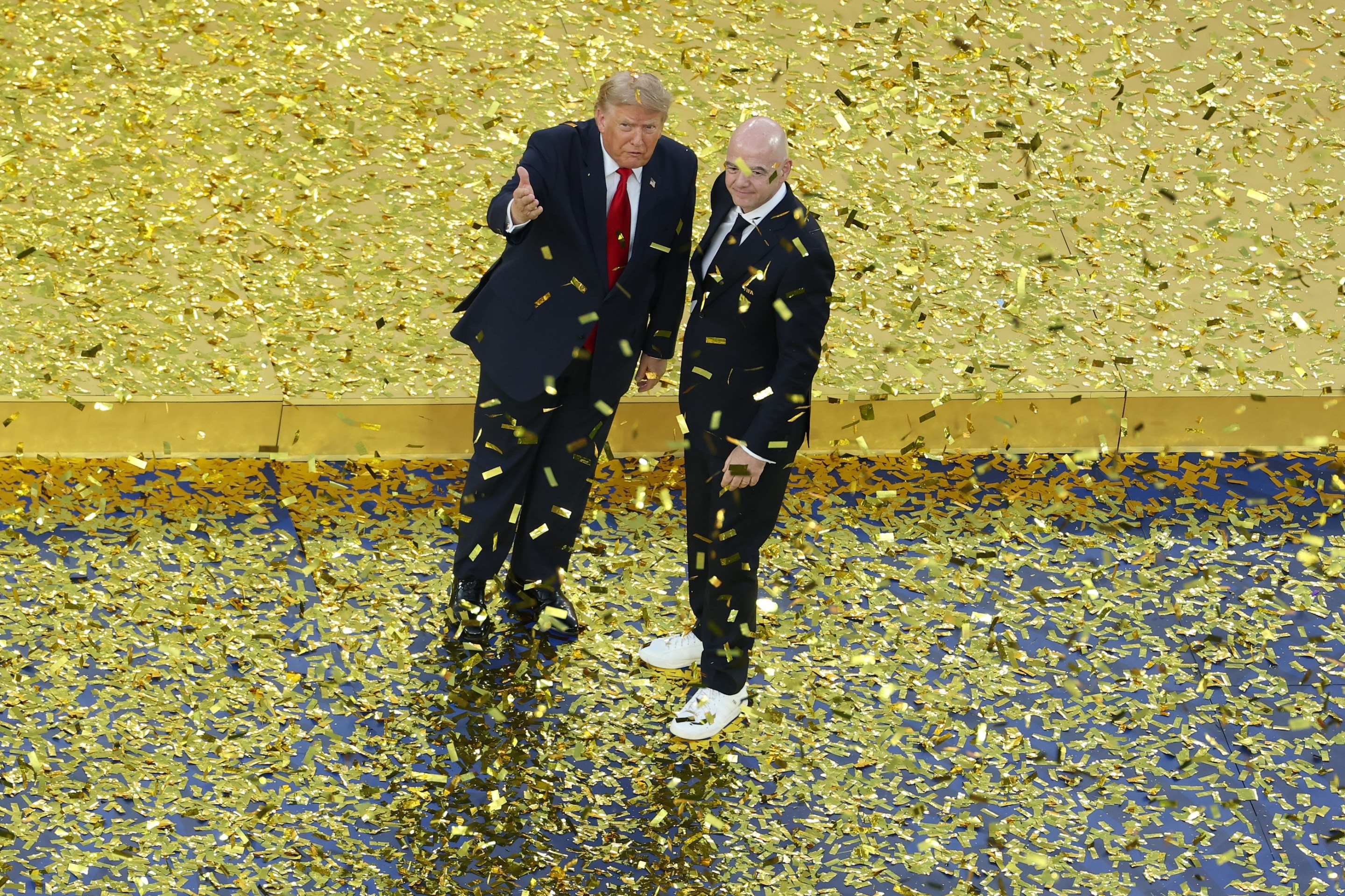
An armada of tinted Escalades clogged the access roads, entangled in a slow-motion game of traffic Tetris. All their drivers seemed convinced that the celebrity or head of state they were transporting was the most important of them all, which meant that none of them could be right. FIFA’s official ledger of celebrities attending the game ran to 11 pages. The enhanced security measures required for U.S. President Donald Trump, who attended the game and later hung around the edge of the stage while Spain celebrated its victory, meant that there was at least an hour-long line to get in anywhere, and sometimes two or three times that.
The stadium, which looks like a giant A/C compressor, regularly hosts NFL games and has put on a Super Bowl. But as the Escalades nudged and the normals shuffled through security, it felt as if it could barely contain the World Cup final. Everything strained under the sheer rigor and expense of it.
Inside, I went looking for the people who had dropped these baffling sums of money to enter a sports game, and was met with an odd reluctance to talk about it. I tried speaking to a dozen well-tanned souls, mostly loitering by a bar behind the most expensive seats. If they were willing to talk at all, they wouldn’t give me their names. Most of them bailed out of the conversation when the price of their seats came up.
“This has been on my bucket list for 52 years, since I was born,” said a beaming, gray-haired man with excellent teeth. “This is it.” His wife pulled him away when I asked about their tickets.
Everybody wanted to be there, but nobody wanted to admit that they had paid the price of entry. Not even the pleasant guy whose tickets had been free—he and his wife had been given them by a sponsor, Hisense—and who said he otherwise wouldn’t have gone was willing to give his name.
“We had to be there, had to be part of the excitement,” said a middle-aged woman in a flowered sun dress. She and her husband had gotten complimentary tickets, too, “because of our company.” They had arrived, she said, on a “corporate bus.”
What’s your company? I asked.
“I can’t tell you that.”
A father from Los Angeles wearing an Argentina jersey was there with a teenaged son in a Spain jersey. He’d gotten their tickets in one of the first rounds of the ticket lottery, and they were sitting toward the top of the lower bowl. “I feel lucky having only paid $11,000,” he said of their seats, which soon sold for a multiple. “If it were $20,000, I wouldn’t have been able to go.”
“Five digits” is all that Dario would cop to. He was a middle-aged lawyer from San Francisco who had come with his elderly Argentinian father after buying tickets four days ago. “Why else do you work if not to enjoy life?”
Danny, who owns a fintech company based in Austin and lives in Panama, was the most forthcoming. He’d surprised his son, who goes to college in Texas, with a pair of tickets in the seventh row that he’d bought three days ago—for $60,000. “I don’t get to see him much,” he said of his son. “It’s a once-in-a-lifetime deal. I’m 60. I might never see a World Cup final in the United States again.”
As we talked about 90 minutes before kickoff, some kind of pregame concert was happening out on the field. The wildfire smoke from Canada that had made New Jersey's air unhealthy to breathe over the previous few days had finally cleared, but FIFA seemed determined to repollute the skies with pyrotechnic smoke instead. I peered down to the ground level, where Fox Sports pundits Alexi Lalas and Zlatan Ibrahimović, the latter in his signature white suit, rode into the building on the back of a golf cart. They got a cheer from a pack of FIFA volunteers in their chartreuse uniforms—in a pinch, any celebrity would apparently do. A woman jogged after them and called their names. Zlatan gave her the finger-guns.
Back on the field, someone sang “God Bless America,” and then someone else sang the national anthem. One of them may have been Jennifer Hudson. The totality of a mega-event of this scale is hard to process, let alone convey. You find things out later on. I learned that Tom Cruise had filibustered the proceedings with a speech about greatness, or something. I didn’t see it, but it feels like something that would have happened.
By then, I’d climbed up to the top of the upper deck. “Vamos carajo,” hollered an Argentine fan with his face painted, who was growing impatient. It was hard to disagree. The Argentine fans, who are reliably the life of every World Cup party wherever the tournament travels, sang and hopped and made the vast edifice vibrate, but then there was another performance. The game started six minutes late, by which point it was clear that this party was not for Lionel Messi or Lamine Yamal, or Spain or Argentina, but for FIFA. The giant signage and the white-and-blue flags and banners, all affixed with the organization’s acronym in its blocky font, told you as much wherever you looked.
It went on like this. The halftime show took 27 minutes, although FIFA’s own rules are very clear about halftime being 15 minutes. Witnessed in person, halftime shows, like opening and closing ceremonies, are utterly confounding. The show and all its stars were produced for TV, and pretty hard to follow for those experiencing it in person. Also it sounded like shit.
The audience, and more to the point the market, were so much bigger than the 80,000 of us staring at Madonna and Shakira and BTS and Justin Bieber and waiting—vamos carajo—for the valuable stuff to begin again. The lingering sense that this was a soccer game of great importance seeped away as the production stretched and echoed out. There was a Ted Lasso bit and apparently also a Muppets thing. Couldn’t tell. Couldn’t hear. This was something that came free of charge with even the most expensive seat—a reminder that none of this was really for you.
In the end, FIFA was right. It was dead on in its assessment that it could just kind of do whatever and extract more than 10 figures in revenue from North America in return. It did all the howlingly tacky things it always does and got away with it, again.
FIFA got away with it because it hit on the same bet it's been making for decades, which is that the World Cup is too big to fail. Every modern World Cup going back to Germany 2006 has been controversial in its own way, and every time, the event itself succeeds regardless. No matter the logistical issues, the odious host regimes, or more recently the obvious fuckery surrounding the commercial/hydration breaks, the suspensions and un-suspensions, and the open sabotage of a participating nation because it is at war with one of the hosts.
FIFA set out to suck every last dollar out of an extremely rich market, and succeeded in that task. Its straw reached across the room and drank our milkshake, and now it is finished. It doesn’t matter that FIFA president Gianni Infantino promised “the most inclusive World Cup ever” and then set to work on mounting the single most exclusive sporting event—and possibly the most exclusive event of any kind—ever put on. It doesn’t matter that FIFA abandoned any pretense that it ever gave a shit about its carbon footprint or human rights; Infantino alone logged some 60,000 miles on a private jet through the tournament, while cozying up to Trump in the middle of his government’s murderous deportation blitz and countenancing its various petty cruelties against FIFA’s own community.
It all felt bad, but the games themselves were great and the stars showed up and the stadiums were full and the TV ratings were enormous. The people paid all that money to watch this unlovely final and may or may not have gotten what they wanted from the experience, but there would be no refunds. By the time Trump and Infantino finally handed the trophy to Spain’s captain Rodri after the game, they had both been on the field so long that all the boos had more or less died out.