Everything about this World Cup is designed to make you hate it. If you live here and you’re a soccer fan, tickets to games are a ripoff, fan zones are built to give you heatstroke, and Fox Sports’ soccer coverage is an unbroken insult to human intelligence. If you’re a local who’s not really into soccer but wants to be part of the fun, you’ll need to work hard to discover pockets of the host cities with any visible sign (flags, bunting, festive paraphernalia) that the World Cup is less than a week away. If you have match-day tickets and want to get to a stadium using public transport, you’ll probably need to sell a kidney to afford the bus or train fare. If you try walking, you’ll probably die (though you’ll keep both kidneys until the end, which may be an acceptable tradeoff). If you make it to a stadium alive, you won’t be able to bring your own water. If you have the genius idea of just watching the whole tournament on TV, once again, and I cannot stress this enough: That will be awful, too.
If you care about quality soccer, FIFA’s decision to expand the tournament to 48 teams means you’ll have to endure a punishingly long group stage, then an inaugural World Cup “round of 32,” before you even get to the good stuff. If you care about footballing heritage, there are assorted “improvements” designed for the American market launching this tournament that will be guaranteed to piss you off (on-field player and coach interviews during matches, a halftime show for the final, advertising on everything), and that’s before we even consider the crime of holding the final at an NFL stadium in East Rutherford, New Jersey, rather than at the temple of World Cup history that is Mexico City’s Estadio Azteca.
If you’re a foreign soccer fan with designs on experiencing the American World Cup in person and you’ve made jokes on social media at any point over the past two decades: tough luck pal, entry is denied. If you’re flying into a sanctuary city, there’s every chance your flight will be canceled before you even start packing. Assuming you make it here, fear not: Unlike the crappy games in the group stage, you won’t go unwatched. ICE will be on hand to “secure” the World Cup and keep the brownshirt party going all summer long. As you enjoy the matches, you’ll face constant surveillance and the continuous risk of deportation for being the wrong race or having the wrong face, with the possibility of indefinite detention in a life-threatening ICE facility as a bonus. Should you survive all that, you can look forward to getting caught in the dragnet of the Trump administration’s “summer surge” of law enforcement around the U.S.’s 250th birthday celebrations.
If you’re a player from a country the U.S. is currently at war with, has recently threatened to invade, or otherwise opposes on the basis of some weird Elon Musk-promoted race panic about white genocide, you’ll be lucky even to make it here (sorry, South Africans), and assuming you do, you’ll probably need to commute from Mexico and cross an international border before every match you contest on American soil (sorry, Iranians). Once you are safely inside the U.S., there is only the threat of abduction, your conversion into a bargaining chip for negotiations over the future of the Middle East, or assassination to worry about.
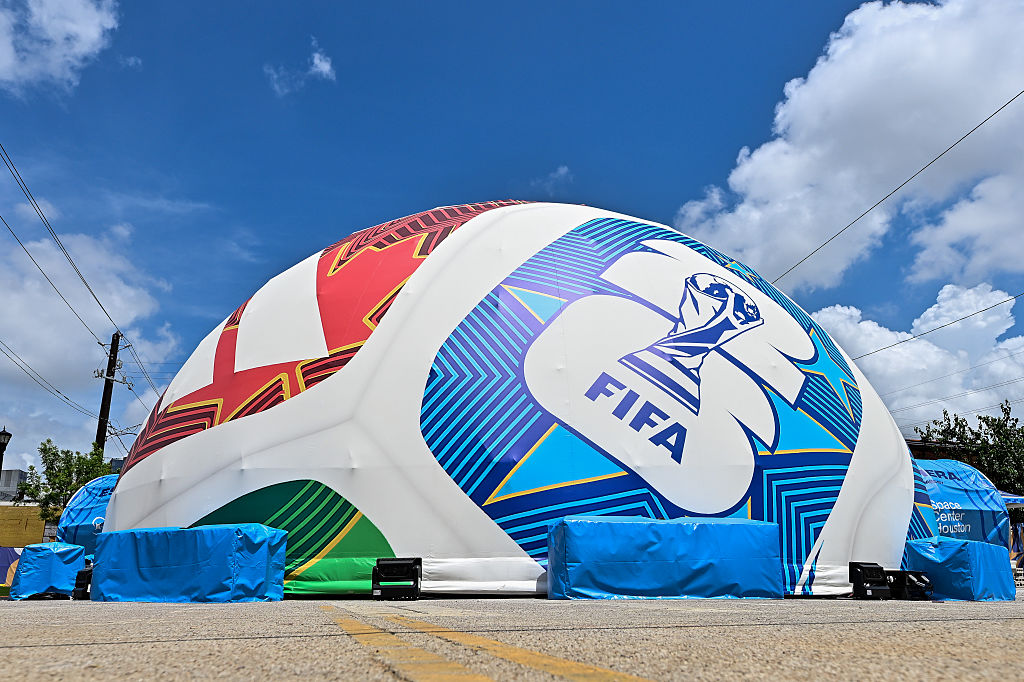
With only a few days to go until kickoff in the historic grudge match that is Mexico vs. South Africa, the on-the-ground vibes around the world’s quadrennial festival of football are either absent or straightforwardly ass. In the neighborhood of Queens, New York, where I live, there’s more visible agitation on the streets about the Knicks and the new Sex and the City-themed café selling $8 “Upper East Chai” than there is about the World Cup. New York’s size and well-earned reputation for indifference to things the rest of the world insists it should care about certainly play a role, but still. On a recent trip to Houston, I passed the section east of downtown that’s being converted into the main fan zone, an amazingly bleak concrete tundra that looks inhospitable to even fleeting human presence. This grim little exercise in urban rejuvenation struck me as emblematic of the whole tournament’s antagonism toward its own public. The bloated format, the unaffordable ticket prices, and all the bombast and ugliness of the Trumpfantino alliance are bad enough—now FIFA expects fans to incinerate themselves in a converted parking lot under the ferocious mid-summer Texan sun just to enjoy a shred of the collective festiveness that should arise organically from any World Cup? One wonders what Maple, Zayu, and Clutch make of the whole thing.
Even online, the vibes are … well, where are they? The traditional signal of an approaching summer of soccer is when a trillion English people take to the internet and delusionally share an updated version of Baddiel and Skinner’s “Three Lions.” But this summer? So far I haven’t heard a single “Football’s coming home,” which is maybe no surprise: Whatever England’s nipple-sized hopes of winning the World Cup, football has as much chance of winding up in an ICE facility as it does of exiting the U.S. and making it “home” unmolested. As a jingle, “Football’s getting detained without due process in a concentration camp in Louisiana” just doesn’t have quite the same ring. Already this is shaping up as the worst World Cup in history, a tournament both hostile to outsiders and patronizing to the American public. The whole thing has the putrid aura of Alexi Lalas in a MAGA suit head-bopping to hip hop—which is, as it happens, exactly how Fox’s star boy has been limbering up as he prepares for the summer of broadcast horrors ahead. It’s no wonder that most Americans, according to a recent survey, have no interest in the approaching extravaganza. The people's tournament is now a World Cup for no one.
Well, perhaps that’s not entirely fair. On the margins (or in New York at least), leaders like Zohran Mamdani are doing their best to bring the tournament to the people, though his fixes (discount match tickets, restaurant deals, hype reels, etc.) are all pretty paltry in the grander scheme. And for the committed fan, it’s not all bad news. If you resent the creeping Americanization of soccer, if you detest the idea that the beautiful game needs to be retooled and dumbed down to appeal to what the FIFA suits are always frothing to remind us is “the world’s biggest media market,” if you oppose the greed and graft strangling the sport, if you boil with rage at the hijacking of America’s first World Cup in 32 years by the most xenophobic U.S. administration of our lifetimes, and even if you simply can’t stand the sight of Gianni Infantino and his hairless Swiss-Italian head: Well, this tournament is for you. The haters will be nothing if not well served over the next six weeks. And things could always be worse. U.S. Soccer could develop its own homegrown answer to “Football’s Coming Home,” for example—a rap-rock track called “Soccer’s Coming Back to the Crib,” or something. Come to think of it, I’m surprised they haven’t run with this already.
What is it that has made this World Cup, in its preceding weeks at least, so profoundly vibeless? Much of the blame, of course, lies with FIFA and the Trump administration, who have together done their best to make sure this tournament feels uniquely exploitative and evil. Could the World Cup ever succeed with a president like this stinking up the scene? In the history of international sporting tournaments, Donald Trump’s unsuitability as a host country head of state is perhaps exceeded only by Jorge Videla, the Argentine military dictator who presided over the 1978 World Cup, and Hitler, who forever stained the legacy of the Olympics with the extended exercise in Nazi propaganda that was the 1936 Games in Berlin. The spectacle of a president who has trashed the U.S.’s tournament co-hosts, terrorized foreigners and immigrants, pushed white nationalism to the center of American politics, and launched illegal wars with impunity overseeing the World Cup makes a very obvious mockery of a sporting tournament rhetorically committed to global togetherness and peace. But it also helps expose a fundamental sickness at the heart of modern soccer.
Between the open contempt shown to fans and Infantino’s fawning accommodations of Trump, this World Cup is just another step in the decades-long project to rip the world’s most beloved sport away from the little people and secure it as a plaything of the rich. The American right, meanwhile, is not a constituency that has historically shown much love for the effete, lib-coded, “foreign” sport of soccer; hoping for a boost to the pre-tournament vibes from the various Trumpworld toadies tasked with running the show seems like a lost cause. U.S. team coach Mauricio Pochettino, with his mind seemingly already on his next assignment in club football, has done his own bit to dim the lights by declaring, weeks out from the USMNT’s first match, that this country lacks an “emotional relationship” with soccer. That may be true, but why say it before a World Cup that your own team is both contesting and hosting? We’re trying to enjoy ourselves here, Poch.
In a country as big and non-soccer-obsessive as America, it’s perhaps inevitable that any event, even one as significant as the World Cup, will fade into the background a little. The nature of USMNT fandom, which manages to be both parodically self-important and irredeemably dorky at the same time, has done nothing to lift the room. Most Americans may be apathetic about the coming event, but 13 percent of the population is apparently “very interested” in it. That’s 45 million people, almost the entire population of soccer-obsessed Spain, which should be a sizable enough community to power a palpable sense of coast-to-coast enthusiasm. But still it all feels so flat and swagless. Is urban planning the real culprit here? With the exception of Seattle, Atlanta, and a few others, many stadiums for this World Cup are situated far from the downtown cores of their cities. This remoteness, plus FIFA’s squalid set of rules on stadium access and tailgating, reinforce the impression of a tournament happening in a vacuum, at a distance (both literally and figuratively) from the lives of ordinary people; in some ways, this Mundial feels more like an exercise in decontamination than popular outreach. The examples of Russia in 2018, Brazil in 2014, and the U.S. itself in 1994 show that a geographically sprawling World Cup can work, but the trend toward co-hosted tournaments necessarily entails a kind of dilution. The last installment in Qatar, though riddled with hypocrisy and inhumanity off the field, was nothing if not compact. In the U.S., Mexico, and Canada, by contrast, the action will be spread across thousands of miles and multiple countries and time zones, portending what appears to be (Saudi Arabia’s 2034 tournament aside) a permanently baggy future for the World Cup.
The U.S. could easily overcome all these structural and cultural hindrances by making the World Cup a truly international event—by welcoming visitors from soccer-obsessed countries and doing everything to encourage local fans and immigrant communities to feel like this tournament belongs to them. These are the people, ultimately, who might be willing to show up and provide the enthusiasm and vibes we're never going to get, say, from a hooting assortment of USMNT fans in Kansas City. And these are the people that the Trump administration has done everything in its power to turn away, while FIFA does everything in its power to price them out of the action. In the summer of 2018, autocratic Russia bent over backwards to welcome tourists and soccer fans; in 2026, America is giving the World Cup all of Russia’s despotism with none of its hospitality. Among his many pre-tournament anti-contributions to soccer, Trump has somehow succeeded in making Vladimir Putin seem like a model of neighborliness and generosity.
And yet, and yet: Against all the evidence, despite the revulsion that stews in the heart of every soccer fan with a conscience at what FIFA is doing to this tournament and this sport, the excitement is starting to build. The warmup matches are under way; there are Argentina fans dancing in Times Square; every pre-tournament infographic is a half-hour of productive work down the drain; and I’m already figuring out a plan to crash the closed-door friendly between the Netherlands and Uzbekistan at Icahn Stadium next week. There’s a powerful conflict of emotions at work here. The Trump World Cup sucks, but it’s still the World Cup. It’s offensive, it’s grotesque, it feels dead on arrival—and I can’t wait for it to begin.