
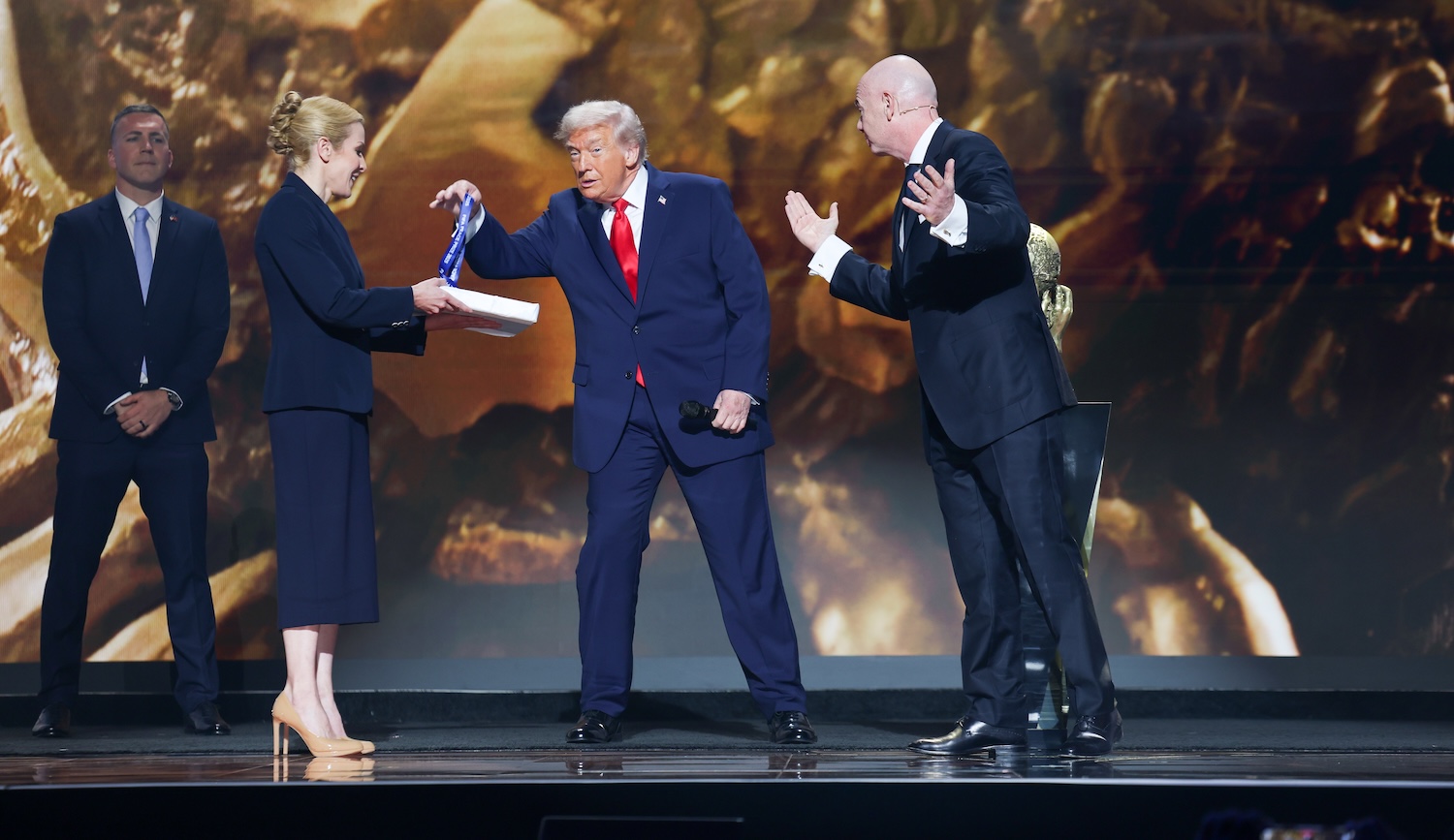
On Dec. 5, 2025, FIFA President Gianni Infantino presented Donald Trump with the inaugural FIFA Peace Prize, nominally for Trump's "tireless efforts to bring people together in a spirit of peace." I found myself less interested in the cynicism of placating Trump with the sort of bribe one would bestow upon a recalcitrant 10-year-old—nobody considers FIFA the imprimatur of global peace—and more interested in the physical award itself.
The FIFA statue is a miniature of a hulking bronze sculpture, on display at the UN, entitled Thoughts and Desires. It offers a hackneyed and vacuous statement of connectivity, depicting five bronze hands reaching up to touch a globe. The viewer is supposed to see the statue and think, Wow, people are important on the planet, and be moved. OK. It was made by Azerbaijani artists Salhab Mammadov and Ali Ibadullayev, who occupy presumably cushy propagandizer roles in the repressive, brutal Azerbaijani state under dictator Ilham Aliyev. The bulk of Mammadov and Ibadullayev's work is tied to the glorification of their national project, a mission the FIFA statue is coherent with, if less overtly. This particular duo helping this particular international corruption syndicate–slash–soccer concern with honoring this particular villain tells one part of the story of what is commonly understood as sportswashing; the other part of the story is told by the fact that their sculpture is hideous.
What is sportswashing? In general usage, it refers to actions undertaken by malign organizations (usually though not exclusively repressive governments) in an attempt to cleanse their international reputations—blighted by things like genocide, the kidnapping and imprisonment of journalists, or gangster-state rapacity—through the sponsorship of sports. It's like giving a dog their heartworm pill wrapped in peanut butter: The pill is, for example, a willingness to hear both sides of the debate about executing teenagers who criticize the Saudi government, and the peanut butter is Formula 1 racing. Though prominent examples of the practice can be found throughout international sporting history—we're 90 years out from the 1936 Hitler Olympics—the term only came into prominence in the last decade, first in reference to the Azerbaijan state using the 2015 European Games (among other international events) to launder its increasingly concerning reputation.
The rise of sportswashing as a term isn't a mere quirk of language, a freshly clarified way of expressing a well-established and consistent practice. It reflects an increase in the practice as a deliberate strategy, amid a recognition that the unique psychosocial position of sports makes them particularly suited to such a use. Sports aren't the only sphere of global cultural production being used as a laundromat, but the global sports-watching populace offers deep wells of irrationality and emotional investment for the would-be washer to tap into. Here, a corollary to the Chalamet thesis is proven correct: People attending a literary festival have a rational enough attachment to their event that they can coherently organize and oust an oil company, while sports fans in general have neither the leverage nor the perspective to do something like that.
This gets at a mild annoyance I've always had with the word "sportswashing." I think it makes a slight category error, assuming without evidence a sincere concern for public esteem on the part of the washer. While a body like the Emirati state or the Trump administration surely hopes to engender feelings of goodwill for itself by sponsoring, respectively, Tadej Pogacar's cycling career or the World Cup, the real benefit they get out of their patronage is the power to hold something hostage. This is, broadly speaking, how capital works, seeking monopoly control to enable unfettered extraction. In the case of private sports ownership, the implied threat of withdrawal looms, but the operative function of holding fans captive is to impose a moral tax on fandom.
The read of sportswashing as a form of public relations also assumes naivety on the part of the sports fan. It's not like a Paris Saint-Germain fan affirmatively views Qatar's modern spin on slavery as a good thing because the Qatari government pays for the team's Champions League–winning stars. When in 2010 Qatar won the right to host the 2022 World Cup, its rulers were transparent about their goal of using the tournament to legitimize themselves on the global stage. On those terms, they failed: If anything, their sports investments have made the world at large more aware of the most committed washers' various human rights abuses.
Human rights abuses are not really the sort of thing that anyone gets held accountable for, and sportswashing can be thought of as holding a rigged trial in the court of public opinion. See, look at all those cheering PSG fans. They have made their choice; they're cool with whatever we do to migrant workers. If you want the theater, camaraderie, and escapism of sports, you have to pay, whether that is cheering for Pogacar as he serves as an ambassador for a country facilitating the butchery of Sudan or rooting for the Knicks as their awful, paranoid owner turns the world's most famous arena into a site of punitive surveillance and invites the President over to ruin the good vibes.
It's through this more expansive definition that we can make sense of the historical and contemporary landscape of sportswashing. As long as powerful people have owned sports teams, they have done so as a way to make their business interests inseparable from the public's interest in sports. Sporting spectacles have been overseen by variously dirty parties for self-serving or otherwise bad reasons for over a century, though defining "dirty" is a subjective exercise that favors entrenched power structures. The U.S. did not boycott the aforementioned Hitler Olympics, because then–U.S. Olympic Committee president Avery Brundage thought doing so would be too overtly "political," a stance that only has internally coherent logic if one views the Nazi movement as something outside of politics, something natural. Brundage and his movement of skull-measurers did not see the '36 Olympics as a form of sportswashing because they didn't think anything really needed to be washed in the first place.
That's an extreme example, though not an isolated one. You can find analogs in the 1934 World Cup hosted by Benito Mussolini's Italy, Francisco Franco's 1964 European Nations' Cup, and the 1978 World Cup hosted by Argentina's military junta. Trying to answer the question of when sportswashing began, or which particular events qualify, assumes a purity tainted from the outside, which is not quite right. There's uncomfortable blurriness around which forms of soft power are legitimate and which are the products of nefarious influence campaigns. The broader geopolitical and economic situation, in which the U.S. and its allies hold a position of global primacy thanks to military-enforced dollar supremacy (for now, anyway), is neither natural nor immutable. Sporting projects in service of upholding that dynamic should be thought of as their own sort of sportswashing. Is the English Premier League's dominance not a form of global soft power? Isn't the DeVos family owning the Orlando Magic a form of all-American sportswashing?
Yes, to both questions. My point isn't that everything is sportswashing and therefore nothing is, so anything Saudi Arabia wants to do to its citizens is fine. Rather, it's that making sense of sportswashing is a matter of determining degree and directionality. The upstarts are trying to break into a game that everyone else is already playing. Also, the point of Gulf countries spending lavishly on F1 or the WTA, or the Rwandan government sticking a patch on an Arsenal kit or a Clippers jersey, is not to supplant the global hegemonies but to join them. This brings us to the modern form.
The largely Gulf-centric sportswashing that has brought so much recent attention to the practice is distinguished by its speed and magnitude. Qatar, Bahrain, the UAE, and, on the grandest scale of all, Saudi Arabia face a fairly simple challenge: The ruling families who control extraction from vast wells of fossil fuels are extravagantly wealthy, but their money is tied to a limited, nonrenewable resource, giving them a limited timeframe for converting all that cash into some engine(s) of growth before either the world weans itself off fossil fuels or the oil simply runs out. The solution they've settled on is to invest as much of that money as possible in the economies of the future: What began as a series of huge investments into digital infrastructure like widespread 5G networks and fiber-optic cables has now exploded in the artificial-intelligence era into hundreds of billions of dollars being spent on data centers and associated AI infrastructure. Sports fit into this not only because the people who watch them necessarily do so with libidinal, irrational attachment, but because sports ownership is a fantastic asset class for the galactically rich to invest in. No one imagines a future without sports.
The Gulf autocracies' investments have been sweeping, with billions plowed into F1, soccer, cycling, tennis, golf, the NBA, and mixed martial arts. Their goals are to make money and entrench themselves in cultural production in the ways I discussed earlier, forcing fans to accept a certain level of moral degradation in supporting their beloved teams.
Nearly 20 years after Sheikh Mansour bin Zayed Al Nahyan bought Manchester City, it is interesting to take note of what has succeeded and what's failed. The most successful pathways for Gulf oil money have been in sports with previously troubled finances or sports, like soccer, where the washers have seized the most control. Cycling, for example, was not in the healthiest place before the UAE and Bahrain bought in. The Italian Lampre team was on the verge of insolvency before the UAE took over sponsorship, and the team now has the world's best rider and the peloton's most dominant team. It came remarkably cheap; Lampre's annual budget is roughly the same as what the Phoenix Suns pay Devin Booker alone.
But it doesn't always work. Let's briefly detour northwest from the Gulf, up to Israel. "I get fulfillment as well as a Zionist, to see the team, which is called Israel Cycling Academy—our name is part of our identity," Israel–Premier Tech (IPT) cycling team owner Sylvan Adams said in 2018. "Our mission is both to develop cycling in Israel but also to project the country abroad in a sportsmanlike manner." Protests met IPT sporadically throughout its time in the peloton, and various international bodies called for relocating the 2018 Giro d'Italia out of Israel, but Adams's ownership of the team went largely unchallenged—until this past year, when protests against IPT at the Vuelta a España brought the race to its knees. Moreover, they made Adams's unwelcomeness in the sport so clear that he sold his license and left cycling altogether.
Adams's IPT project was a show of force, a demonstration of what he could force the cycling world to accept and tacitly endorse. See, Zionism can't be the force of murder and displacement it's portrayed as; everyone is happy that Michael Woods finally got his Tour de France stage win. But the Spanish public rejected the premise, refusing to let its roads be used as a laundromat.
In response to a movement that cut short several stages and derailed the race, Zionists and neutrals alike wondered whether the Spanish protestors' animus toward IPT and IPT alone amounted to a tacit endorsement of human-rights abuses by rival team owners UAE and Bahrain. In that bad-faith question, you can glimpse the dream of the sportswasher: to be allowed to conduct oneself with hegemonic impunity. Follow this line of logic far enough, and you can see infinite potential applications of whataboutism.
Why is the Astana team not being protested despite the Kazakh government's authoritarian turn? Why isn't anyone mad at all the private equity guys buying NBA teams? The argument was never Israel isn't doing bad stuff, but rather Israel should be allowed to do bad stuff. What the protests against IPT showed is that there are limits to what the sportswashing machine can handle before the internal tensions cause some part to fail.
It can also fail on its own terms, without nationwide protests. One of the premises Western media has adopted toward sovereign wealth investment is that it's essentially bottomless, but the past year has shaken that assumption. Saudi Arabia's Public Investment Fund stood up LIV Golf in 2022, and that tournament's gargantuan prize purses were supposed to reshape the sport, sending the PGA Tour into the dustbin of history by sheer financial might. But after four years, and ludicrous sums of wasted money, the PIF has had enough, leaving its would-be breakaway league to wither and die.
Meanwhile the WTA Finals, held in Riyadh since 2024, are leaving this year. The PIF is also reportedly in talks to sell a quarter of its stake in the Newcastle soccer team, which it purchased around the same time as it funded LIV Golf. This is part of a broader PIF strategy, aimed at cutting out the more fantastical stuff like The Line in favor of investing in projects that might pay off.
For sportswashing to be successful as good PR, whether in the traditional understanding of the term or in the hostage-negotiation definition I propose, it has to endure. It is easier to be numb to revelations about dead Nepalese slaves in Year 20 of something than in Year 1. This brings us back stateside, and to the operative reason why there aren't large-scale protests about any of the horrible American sports owners. The system of horrible rich guys owning sports teams is so entrenched in the U.S. as to be taken for granted. That's how things work. The spectacles obscure their extractive nature, and the media ostensibly responsible for exposing it is housebroken to the point of total obsequiousness.
The 2026 World Cup, then, represents the apotheosis of sportwashing. The United States—whose major sports leagues, the standards of professionalism and prestige against which all others are measured, have thus far turned their noses up at Gulf money—is hosting its own Hitler Olympics. This World Cup takes place against a backdrop of mass deportations and arrests. Tens of thousands of people have been disappeared and crammed into horrifying squalor, where they await disease, physical and sexual abuse, death, and other effects of unpersoning. The rapist in charge of the U.S. is actively conducting a war of aggression against another World Cup participant and simultaneously threatening both of the tournament's other hosts. Anyone who visits the country is subject to surveillance and arbitrary detention, if they can even get in, which not even World Cup athletes can do without a hassle.
The Trump administration's goal is not to make the world think none of this is happening, or to make the world think what's happening is fine. It's to show that nobody can stop it. It is not an olive branch but a show of authority, the purest expression of sportswashing, the hegemon applying the cynical tactics of the upstart. The most powerful country on Earth has taken the sports world's most valuable hostage while it articulates a violent, extractive White Christian nationalism at home and across the globe. Like the FIFA Peace Prize, there's omnidirectional malice here in the insulting guise of something nominally uniting. Like the statue, the tournament itself also figures to be some chintzy bullshit.
In his 1967 work The Society of the Spectacle, the French theorist and walking enthusiast Guy Debord wrote, "The tautological character of the spectacle stems from the fact that its means and ends are identical. It is the sun that never sets over the empire of modern passivity. It covers the entire surface of the globe, endlessly basking in its own glory." Debord has been dead for 30 years, but I think if he saw Christian Pulisic hitting the Donald Trump dance, he would have felt that he really nailed it.