
This weekend, history repeated itself on the unnecessarily pyrotechnic stage of Eurovision as singers from Israel and another country waited to hear which would be crowned the winner of the increasingly contentious song contest. In the end, the Bulgarian banger "Bangaranga" by singer Dara edged out Israel's "Michelle" by singer Noam Bettan. Last year, Austrian singer JJ served as a similar spoiler with his operatic "Wasted Love." Now Eurovision, it would seem, plans to proceed as if everything were normal, announcing the competition will take place next year in Bulgaria. But, of course, something is rotten in the state of Eurovision, a competition where many fans find themselves in the harrowing position of rooting not for their favorite song, but for anyone but Israel.
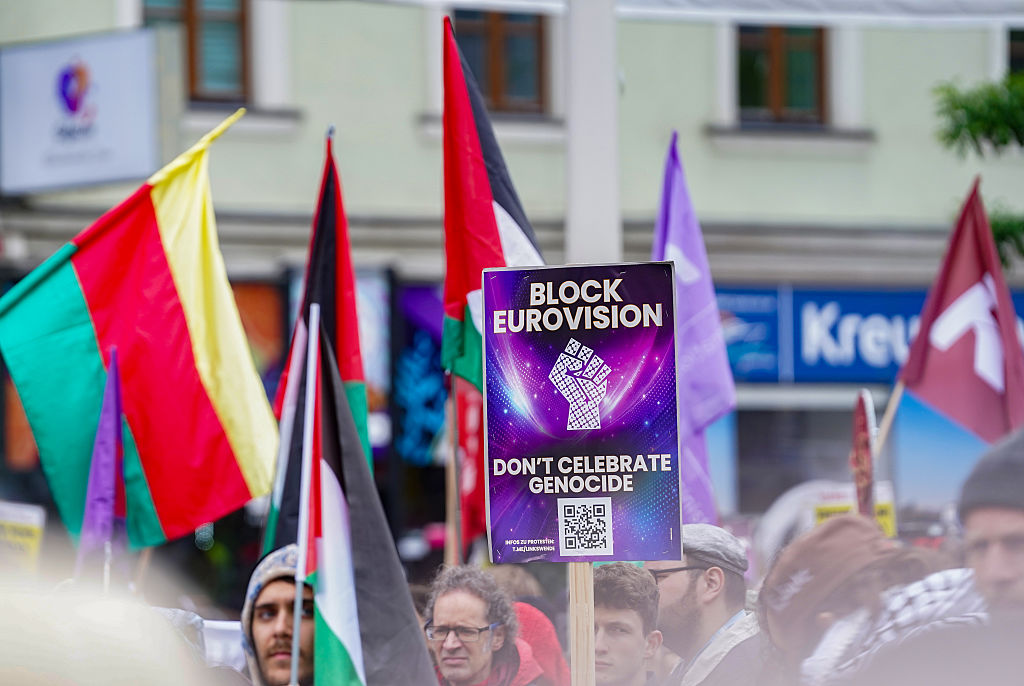
In recent years, artists, fans, and governments have protested the competition's inclusion of Israel over its genocidal war on Gaza. The ongoing boycott against the competition is the largest in its 70-year history. Last September, the European Broadcasting Union, which organizes the song contest, promised to vote on Israel's participation. But the vote was postponed after a ceasefire was announced, per the New York Times. When the broadcasters gathered again in December, after Israel violated the ceasefire nearly 600 times, they skirted the vote once again through a bureaucratic loophole that allowed Israel to remain in the competition.
In response, five countries—the Netherlands, Ireland, Iceland, Slovenia, and Spain, one of the "big five" countries in Eurovision—pulled out. The Swiss singer Nemo, who won the contest in 2024 with "The Code," a song about discovering their nonbinary identity, returned their trophy to Geneva. "Israel's continued participation, during what the UN's Independent International Commission of Inquiry has concluded to be a genocide, shows a clear conflict between those ideals and the decision made by the [European Broadcasting Union]," Nemo said in a statement posted to Instagram. "The contest was repeatedly used to soften the image of a state accused of severe wrongdoing, all while the EBU insists Eurovision is 'non-political,'" they continued.
Although Eurovision has long claimed itself apolitical, there is nothing apolitical about it. The contest banned Russia after the country invaded Ukraine, and has also rebuked contestants for wearing keffiyehs and displaying "political" messages during performances, such as when Ireland's Bambie Thug wrote "ceasefire" on their body in the ancient Celtic language Ogham. In 2025, the broadcaster muted loud booing and shouts of "Free Palestine" when the Israeli singer Eden Golan took the stage, per The Intercept. The competition has always been used as a tool of soft power, and geopolitics have always driven its voting, where countries give their highest points to their neighbors and allies.
The voting format is where modern Eurovision has run into trouble. In the first decades of the competition, which began in 1956, voting power exclusively lay with the country's national juries. But in the late 1990s, the competition introduced televoting, allowing fans from participating countries to vote for their favorite songs from other competitions. In 2023, Eurovision introduced a "Rest of the World" vote for viewers from anywhere in the world. Today, the vote is split 50/50 between the jury and the popular vote. While the national juries generally vote according to the strength of the song, the audience vote often has a strong political or emotional motivation; for example, Ukraine surged to a win in 2022 with 439 televote points, compared to 192 jury points.
The recent changes to the popular vote explain Israel's consistently high placement in recent years. After Israel launched its war on Gaza in 2023, the country placed fifth in 2024, and second in each of the last two years. I am no music critic, but this is not a result of Israeli entrants choosing particularly winning songs. Although Israel's 2024 and 2025 songs were not received well by the national juries, immense turnout in the popular vote lifted them to strong finishes. In 2025, for example, Israel got a measly 60 points from the national juries but 297 from the public. This year, Bettan was eighth in the jury vote but third in the popular vote.
It seems a good thing on its face that Eurovision fans have a say in choosing the winner of the contest. But in light of Israel's years-long domination of the popular vote, fans and broadcasters have accused the country of stuffing the ballot boxes. A recent New York Times investigation found that Benjamin Netanyahu's government organized a campaign to influence the vote, spending at least $1 million on marketing despite Eurovision rules that governments are not supposed to interfere with voting. Last year, in a blatant cash grab, the contest allowed audience members to vote up to 20 times, with each vote costing about one euro. This format made it easy for just a few hundred voters to have outsize influence on the popular vote. The Times found the Israeli government bought online ads in multiple languages asking people to "vote 20 times" for Israel's contestant. This is all very depressing, but also a little funny: Israel has been unable to win the competition despite repeated attempts to rig it.
A few months after last year's contest, Spain, a country where Israel is deeply unpopular and yet still won 33 percent of the popular vote, called for Eurovision to change the voting system. This year, Eurovision allowed just 10 votes per fan. The Israeli broadcaster Kan released ads with the Israeli contestant, Bettan, instructing people to "vote 10 times for Israel," before the competition called for the ads to be removed and issued Israel a formal warning, reported the BBC.
What will the European Broadcasting Union learn from any of this? If the past is any precedent, nothing at all. The five countries boycotting Eurovision have funneled hundreds of thousands of euros in participation fees away from the competition. The broadcasters in the boycotting countries could remove nearly 1 million euros from Eurovision's funding, according to Al Jazeera. Before the finals aired, the Flemish broadcaster VRT stated that Belgium would likely not participate in next year's song contest unless the organizers allow a vote to take place on whether Israel should be allowed to compete. "We expect the EBU ... to make a clear statement against war and violence and for respect for human rights," read the statement.
If the Eurovision organizers continue to punt any decision on Israel, the future of the competition looks bleak. In one scenario, participating countries with a conscience may continue to drop like flies, further denting the contest's credibility, budget, and popularity. In another, very possible, timeline, Israel will win. This would trigger a set of decisions that might ruin Eurovision as we know it. Winners typically host the following year's song contest. Would Israel attempt to host the competition while bombing Gaza and Lebanon, despite declarations of a ceasefire? Would it fall to the runner-up nation to host, as the U.K. did for war-torn Ukraine in 2023? There is no guarantee that whichever nation takes second place would agree to host on behalf of a country that has killed more than 72,740 Palestinians since October 2023. It is and has long been in Eurovision's best interest to take a moral stance. And yet what seems most likely is that the European Broadcasting Union will operate as if nothing has happened, blinders gamely on, until no one is watching at all.