
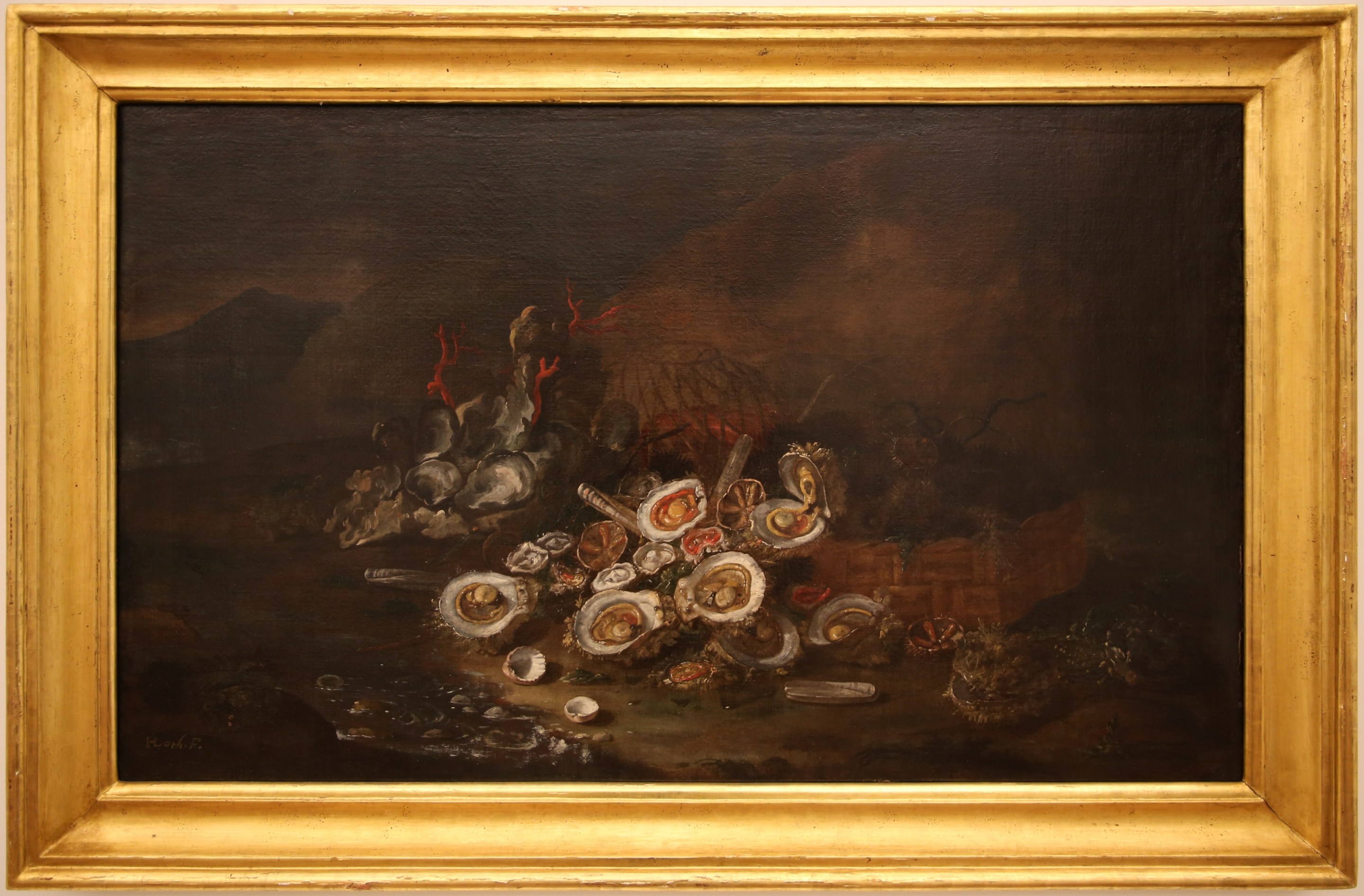

At first, the oysters in the old Italian paintings perplexed Louise Merquiol. The shells looked unusual, reddish in color with a distinctive black spot near the hinge. Merquiol, a marine biologist at the Mediterranean Institute of Oceanology in Marseille, France, was poring over paintings as a part of a larger project identifying marine and freshwater organisms in historical art. "Rather than assuming these were simply artistic inaccuracies or poorly rendered oysters, we decided to investigate further," Merquiol wrote in an email. A taxonomist immediately recognized the shells as Spondylus gaederopus, or the thorny oyster.
The bivalve, which looks like the lovechild of a thistle and a clam, hails from the Mediterranean. Thorny oysters are not true oysters, meaning bivalves in the order Ostreidae, which include most of the oysters we eat. Thorny oysters are more closely related to scallops, and like their kin have coronets of eyes around their soft mantles. But most importantly, thorny oysters are very tasty, which is why they appear in so many historic Italian still-life paintings. Merquiol and colleagues' analysis of what all this historic art reveals about the thorny oysters' historic abundance was recently published in PLOS One.
Compared to most other mollusks, thorny oysters have an outsized presence in art. They have statuesque spines like one of Ernst Haeckel's radiolaria. And their shells, when scrubbed clean of barnacles and other hitchhiking organisms, shine in vivid colors: violet, carmine, and Tyrian purple. For these reasons, Italians nicknamed the species ostrica imperiale, or "imperial oyster." The species had high symbolic and economic value in prehistoric societies in the Mediterranean. Near the Adriatic, people transformed thorny oysters into jewelry as early as 6000 B.C. The thorny oyster also starred in feasts in Spain, Greece, and Italy. But the species nearly vanished in the 1980s, where entire populations nearly died off in Greece, Spain, and Algeria. Although those mass mortality events remain unexplained, more die-offs happened in the 2000s and continue today, caused at least in part by climate-change fueled heat waves and disease outbreaks.
The researchers' broader project, called BiodivAquArt, "aims to test the use of historical figurative art as evidence of humanity’s past relationship with aquatic biodiversity," Thomas Changeux, an author on the paper also at the institute in Marseille, wrote in an email. Through online research, books, and museum visits, the researchers compiled a database of hundreds of Italian paintings from the Early Modern period. Many of these paintings were by from the Reccos, a 17th-century Neapolitan family of Giacomo, Giuseppe, Giovanni Battista, and Elena Recco, all of whom had exceptional skill in rendering the silvery sheen of a freshly killed fish.
These paintings teemed with sea life: oysters true and thorny, scallops, sea figs, limpets, razor shells, and nobel pen shells, often accompanied by larger mullets, goatfishes, salema porgies, squids, sea urchins, spiny lobsters, seabreams, and scorpionfish. The researchers zoomed in on each depicted organism in an attempt to identify them as accurately as possible. This often worked, allowing the researchers to identify distinct species. But around 15 percent of the organisms eluded identification, often too unrealistic or stylized to garner a real-world identity.
This process was enriching, especially when the researchers got to see the art in person. Merquiol recalled one painting by the Baroque artist Giuseppe Recco on exhibit at the Gallerie d'Italia in Naples. "The level of detail and the colors used to depict the marine fauna are truly striking," she said, adding that seeing works in person allowed the researchers to appreciate details that were often lost in digital reproductions. These details. Changeux said, are especially important in identifying thorny oysters, which are easily mistaken for other shellfish. "It camouflages itself," he said. "Its spiny upper shell often becomes covered by other organisms, which conceals its characteristic spines." But once the oyster is opened, its anatomy tells on itself: a black ligament and distinctive hinge structure, a marigold body with a big fat muscle at the center.
The researchers were not just interested in identifying thorny oysters in old art. They estimated the size of their shells, comparing them with other objects or organisms in the painting with known dimensions. Although these measurements were approximate, they suggested thorny oysters have been shrinking over the centuries.
At one point during the research, Merquiol stumbled upon a blog titled "Spuonelo," the Neapolitan name for the thorny oyster. She contacted the octogenarian blogger, who agreed to sit for an interview. "We had several conversations during which he told me about his past as a recreational fisherman in the Naples area," she said. He started collecting thorny oysters when he was 15, setting out in a small wooden rowboat with a mask, knife, and net, and diving for the bright shells. He often found the oysters attached to rocks along with mussels and sea figs. He liked to eat thorny oysters raw with a squeeze of lemon, which he said tasted like mussels but less sweet.
I asked Merquiol if she had ever tasted a thorny oyster. She has not had the opportunity, she said. "But I regularly come across its beautiful shells while beachcombing along the Mediterranean coast of France," she said, and she appreciates the reminder that the species is still around, albeit in smaller numbers.
The researchers were astonished by how little modern research on the thorny oyster they could find. There were only a few scientific papers, meaning the species' current distribution and population status remain poorly documented. When Merquiol reached out to the Stazione Zoologica Anton Dohrn, a marine research institution in Naples, no researchers she interviewed were familiar with it. Despite the thorny oystery's omnipresence in historic paintings and importance to prehistoric societies, "it has almost disappeared from our collective knowledge," she said.
This vanishing, in Changeux's eyes, is a testament to how art can preserve cultural memories of the ecological relationships of the past. Although the thorny oyster may now be overlooked, it was once a centerpiece of Mediterranean culture. Other forgotten species may lurk in these paintings, waiting to be recovered by a someone with a keen eye and refined palate. I imagine I am not alone in my desire to see the thorny oyster restored to its old-world abundance, so that I and other animals may eat them.