

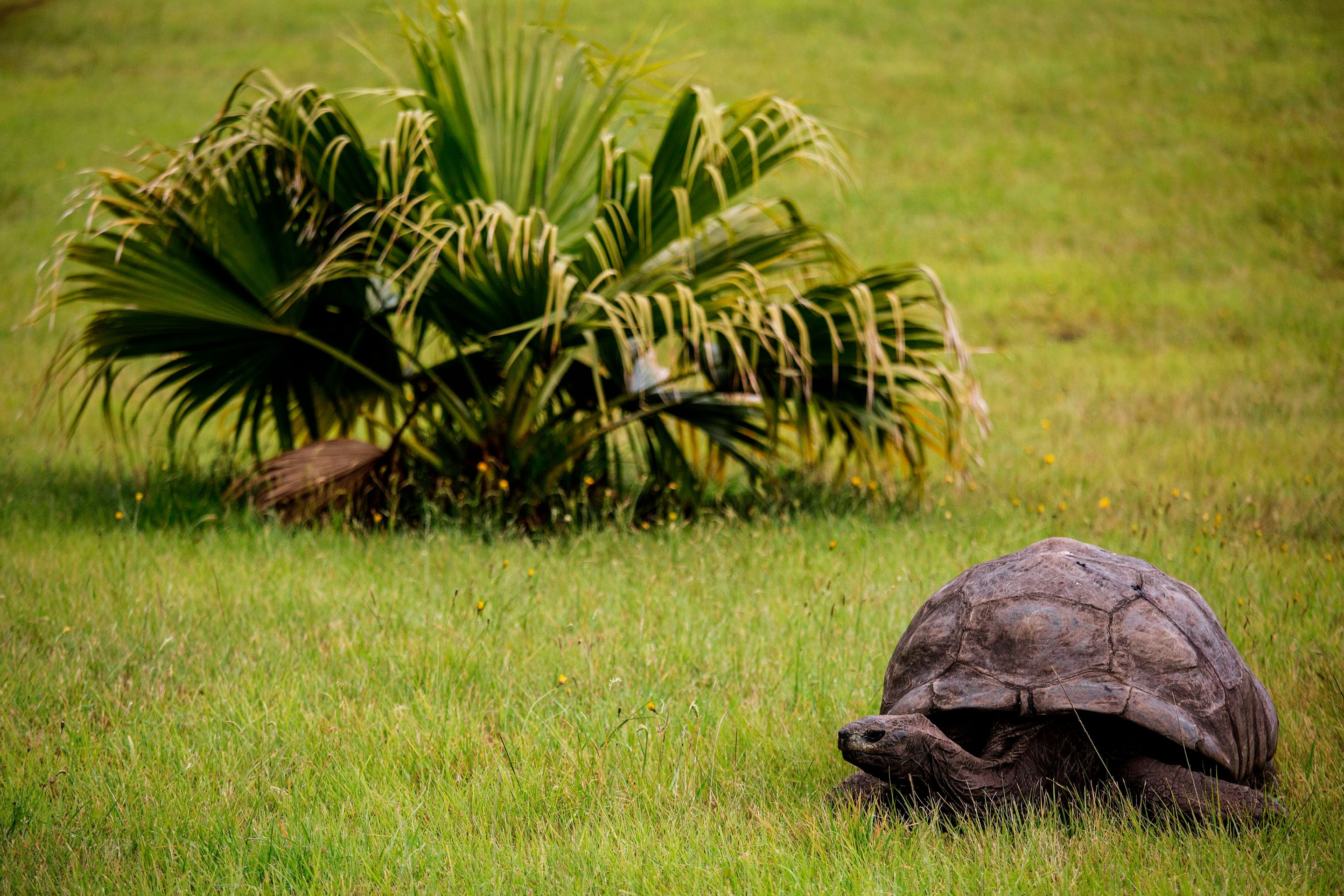
Geriatric Jonathan has made the news again, this time for having his genome sequenced. The Aldabra giant tortoise, who is estimated to be 194 years old, is the oldest known land animal on the planet. (The ocean, which teems with glass sponges thousands of years old and Greenland sharks that have been swimming for centuries, takes longevity to different extremes.) As such, it is understandable why scientists would want to sequence Jonathan's genome. He's lived a long freaking time.
Yet many of the headlines heralding this new inquiry into Jonathan's venerable age, which was published in Science Advances, have made me laugh with their implications that we may follow in Jonathan's closely spaced footsteps. Consider Reuters: "A 194-Year-Old Tortoise, World's Oldest Land Animal, May Hold Clues to Longer Life." Or take The Times: "Has 194-Year-Old Tortoise Jonathan Taught Us the Secret to Longer Life?" What are the clues and secrets to Jonathan's extremely long life? Mainly there is one: Jonathan is a turtle.
I can hardly blame these publications for this headline format; the blueprint was in the press releases issued by the University of Cambridge and Vanderbilt University, both of which framed Jonathan as potentially holding the secret to a long and healthy life, which he very well could! The headline in IFLScience—"We Finally Know How Jonathan The Tortoise, The World's Oldest Land Animal, Is Still Alive And Kicking At 194"—is easily answered the same way. Jonathan the tortoise is alive and kicking because he had the good luck to be born an Aldabra giant tortoise. Were Jonathan a human guy he would not be alive.
Turtles, especially giant tortoises, tend to live a long time. They have achingly slow metabolism, which slows the effects of aging over time and allows the animals to limit cell damage. Jonathan's current record of longevity is trailed by Esmeralda, a 182-year-old Aldrabra who roams free in the Seychelles. The Aldabra named Adwaita, who lived in a zoo in Kolkata, was estimated to be at least 150 years old when he died. Presumably Jonathan was kind enough to let Esmeralda and Adwaita in on his secret.
Giant tortoises as a whole are a long-lived lot; Harriet the Galápagos tortoise was around 175 when she died in a zoo in Australia, and the radiated tortoise Tu'i Malila died at approximately 188, decades after she had been kicked by a horse and run over by a cart. Diva! Icon! Where is her biopic!
The researchers behind the new study suggest Jonathan has lived nearly a century longer than an Aldabra tortoise's usual lifespan. But turtles are hard to age without a hatch date, meaning it is entirely possible there are other turtles older than Jonathan. Jonathan, given as a gift to the governor of St. Helena 144 years ago, has resided on the island ever since, making his age easily verifiable. It is also likely that Jonathan's domestic lifestyle—he's a hand-fed turtle with a dedicated care team—has helped the turtle make it this long. Although Jonathan feels the toll of his many years, nearly blinded by cataracts, he has great hearing. The turtle enjoys bananas, has a healthy libido, and remains blissfully unaware that, earlier this year, his death was reported as a part of a crypto hoax.
The researchers compared Jonathan's genome to four other Aldabra tortoises, a 5-year-old named Hatch, a 12-year-old named Smalls, and two adult males named Toka and Poka. They found that Jonathan had variants of genes linked to aging, such as those involved in telomeres, which are the protective tips at the end of chromosomes that shorten with age. The researchers also looked at the tortoise's epigenome, which are the switches that turn genes on and off, and found the switches that control Jonathan's mitochondria looked very similar to those of the younger turtles. This was surprising because the epigenome tends to change and deteriorate with age. So the tortoise appears to have quite stable mitochondria, which is linked to longevity.
What does this mean? One possible conclusion is obvious and tempting, if a bit of a leap. CNN was happy to make it: "Jonathan the 194-Year-Old Tortoise Could Help Humans Live Longer." Is this true? I mean, potentially. The researchers, like many who have come before them, want to use Jonathan's genes to unlock anti-aging technology for our own species. As Stephen Clark, an author on the study, said in a statement, "Our goal is to take these evolutionary insights and immediately translate them into practical, affordable treatments for everyday people." Clark is the founder of the longevity nonprofit Kallel, whose website features an animation of a giant Aldabra tortoise, presumably Jonathan, being raptured and transformed into a strand of DNA, and some AI art of Jonathan trapped inside an hourglass.
Maybe I'm being a spoilsport about this because of my bias against the human fixation on longevity and the insanity it often spawns. Who doesn't want to live longer? I certainly would like to. Scientists are, of course, conducting this research on humans, too; this paper studying the genome of a 117-year-old woman from Spain also found she had exceptionally efficient mitochondria compared to other women her age. But the new paper is exciting and revelatory for its focus on Jonathan as a turtle in a class of his own. His anti-aging "secrets" do not need to be applicable to us to make headlines. For now, the only way to make it to nearly two centuries is to be a giant tortoise. This is an edge Jonathan will always have over us.