

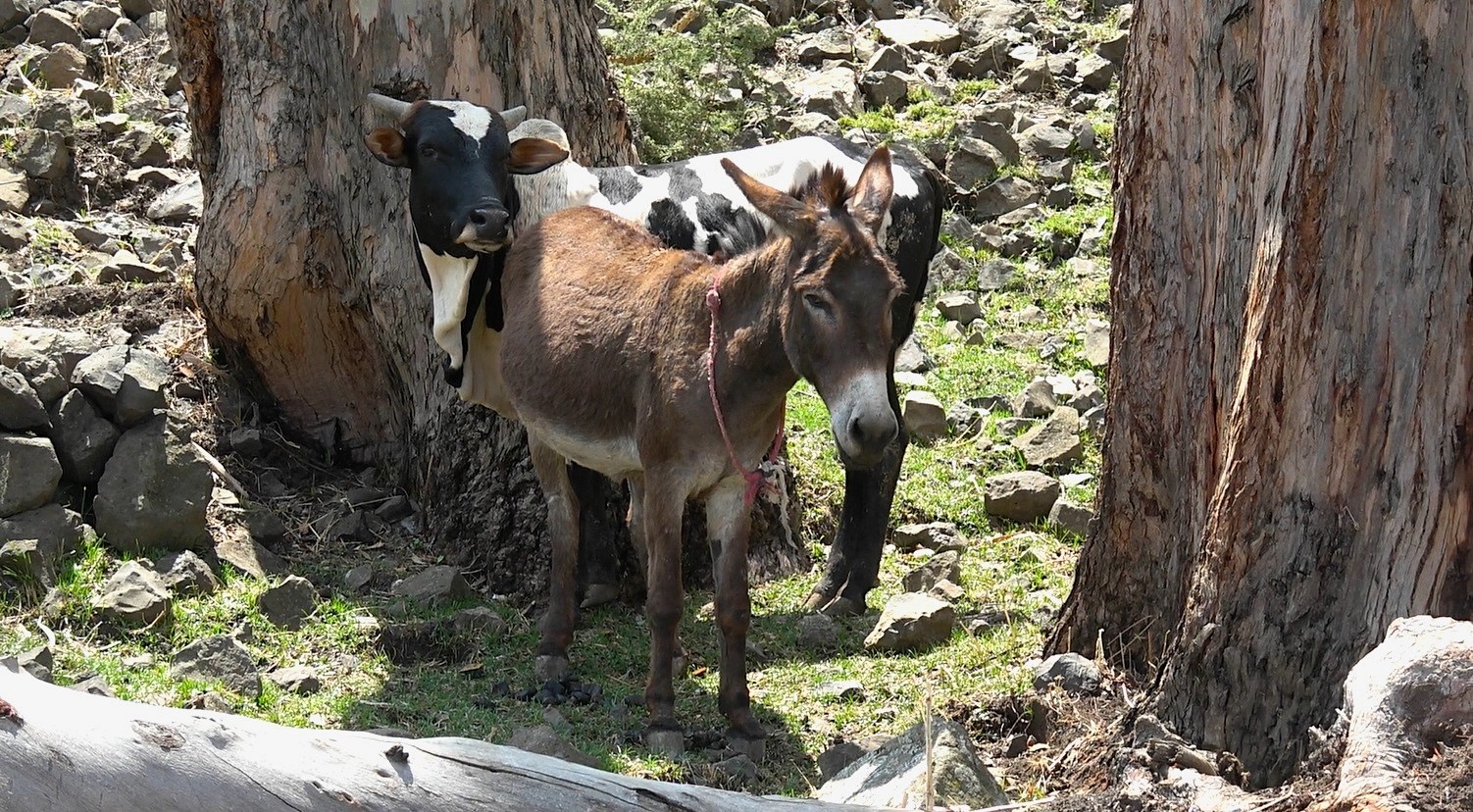
Elisabetta Palagi, an evolutionary biologist at the University of Pisa, had sent her team of research students to Ethiopia to study geladas, monkeys whose hearts appear to gleam out of their chests. But as her students watched the geladas munch on a grassy plateau alongside other grazing animals, they noticed a peculiar interaction between two other animals. A bull approached a male donkey and mounted him. This behavior did not seem to bother the donkey. The donkey did not kick him or otherwise try to escape the interaction. The researchers contacted Palagi and asked if she thought this cross-species intercourse was worth studying. "I said yes," Palagi wrote in an email.
After close observation, the researchers found that the the bull, dubbed Achille, and the donkey, dubbed Patroclo, have a persistent, mutual sexual relationship, which is described in a new paper in Current Biology. Achille and Patroclo's relationship was not news to the local herders, who laughed when they saw the researchers filming the unexpected pair. "What was an unexpected observation for us was evidently a familiar sight to them," Palagi said. (The paper includes explicit footage of the pair's mating that we have omitted out of respect for their privacy.)
Achille and Patroclo, are, of course, far from the only two male animals we have observed having sex. Although scientists have observed same-sex sexual behavior in animals for centuries, they were often loath to report this behavior for reasons you might expect. This underreporting led to the impression that same-sex sexual behavior was rare, and that animals who were reported engaging in it were outliers, per a 2025 paper in PLOS One. Scientists also generally considered this behavior a kind of evolutionary paradox under the presumption that engaging in any kind of sex that doesn't lead to reproduction must be a waste of energy. But a recent wave of research has taken same-sex sexual behavior seriously, investigating its prevalence among certain animal groups and even suggesting that this behavior has existed for as long as animals have been having sex.
Achille and Patroclo are also not the only two animals of different species to be observed having sex. This kind of behavior is often described as an example of "reproductive interference," in which individuals from separate species engage in sexual or courtship behaviors that presumably waste time and energy that could be spent directing those behaviors toward a suitable mate. This behavior is often explained as a simple mistake. Frogs are famous for it, seen attempting to mate with shoes, tennis balls, coconuts, turtles, mangoes, and a literal piece of shit. Reproductive interference is most often observed between closely related species, which might even have the capacity to hybridize, or between introduced species. But it also happens between surprising pairs, often as an apparent act of aggression or harassment, such as the case of an Antarctic fur seal attempting to penetrate a king penguin, or a Japanese macaque mounting a sika deer.
Scientists have far fewer examples of same-sex sexual behavior occurring between different species, especially from those as distantly related as donkeys and cattle. Most male-male mountings have been observed in domestic cattle, often those kept in pens that contain only bulls, no cows. The researchers found no examples of male-male mountings in donkeys. "I would be cautious about claiming an absolute first," Palagi said, noting that similar relationships may have been observed in the past but not reported. But the new study goes beyond a simple one-off observation, quantifying the pair's interactions over a longer stretch of time.
Although the researchers were first drawn in by the mounting itself, they were even more surprised by the nature of Achille and Patroclo's bond. The two never spend nights together, as they belong to different owners. But on the plateau, the two licked and rubbed each other and spent most of their time in close proximity. Over four days, the researchers observed Achille mounting Patroclo 51 times, 34 of which resulted in penetration. In none of these interactions did the donkey react with avoidance or threat. "Patroclo also repeatedly presented his hindquarters to the bull," Palagi said. And their association was not the simple result of a lack of options; there were other cattle and donkeys on the plateau, female and male. Rather, it appears that when given the chance, Achille and Patroclo choose to be with each other.
In one intriguing encounter, when Patroclo approached Achille as the bull mounted another donkey, the bull redirected his attention toward Patroclo, licking the donkey. The encounter exemplified the donkey's active role in maintaining his association with Achille. When I asked Palagi if this could be understood as some kind of jealousy or possessiveness, she said these terms imply motivations or emotional experiences that we cannot discern from the interaction. Palagi added that there is not enough information to know if this interaction is equivalent to any seen within donkey or cattle mating relationships. But she noted that relationships are valuable resources for social animals. "We cannot say exactly what that relationship meant to Achille and Patroclo, but we can document how consistently they sought each other’s company and interacted," Palagi said.
The researchers have more questions than answers about the pair's bond. Palagi wants to learn more about how Achille and Patroclo's association developed, such as if the two had a social bond before a sexual one. But the paper still has important takeaways, such as that the social relationships between animals are often more complex and flexible than researchers expect, she added. Palagi's students named the bull after Achilles, hero of the Iliad, and the donkey after Achilles's dear companion, Patroclus. Homer "does not explicitly describe them as lovers, although later ancient authors interpreted their relationship in that way," Palagi said. In the Iliad, after Patroclus is killed in battle, Achilles falls into a deep despair that eventually transmutes into a deep rage. "Their deep attachment is central to the story," she added.
For now, their ungulate counterparts have also been separated, although under less tragic conditions. The paddock where Achille and Patroclo once grazed together has no more grass, and now each of their herds are taken to separate areas. Palagi's students are back in Ethiopia and plan to ask the herders if the two can be reunited. Palagi wonders how this meeting might go—if the two would resume licking and mounting, or if their interest will have waned after months apart. But for now, their epic affection for each other is recorded as history in the annals of scientific literature, a cock-and-bull story that is actually true.