

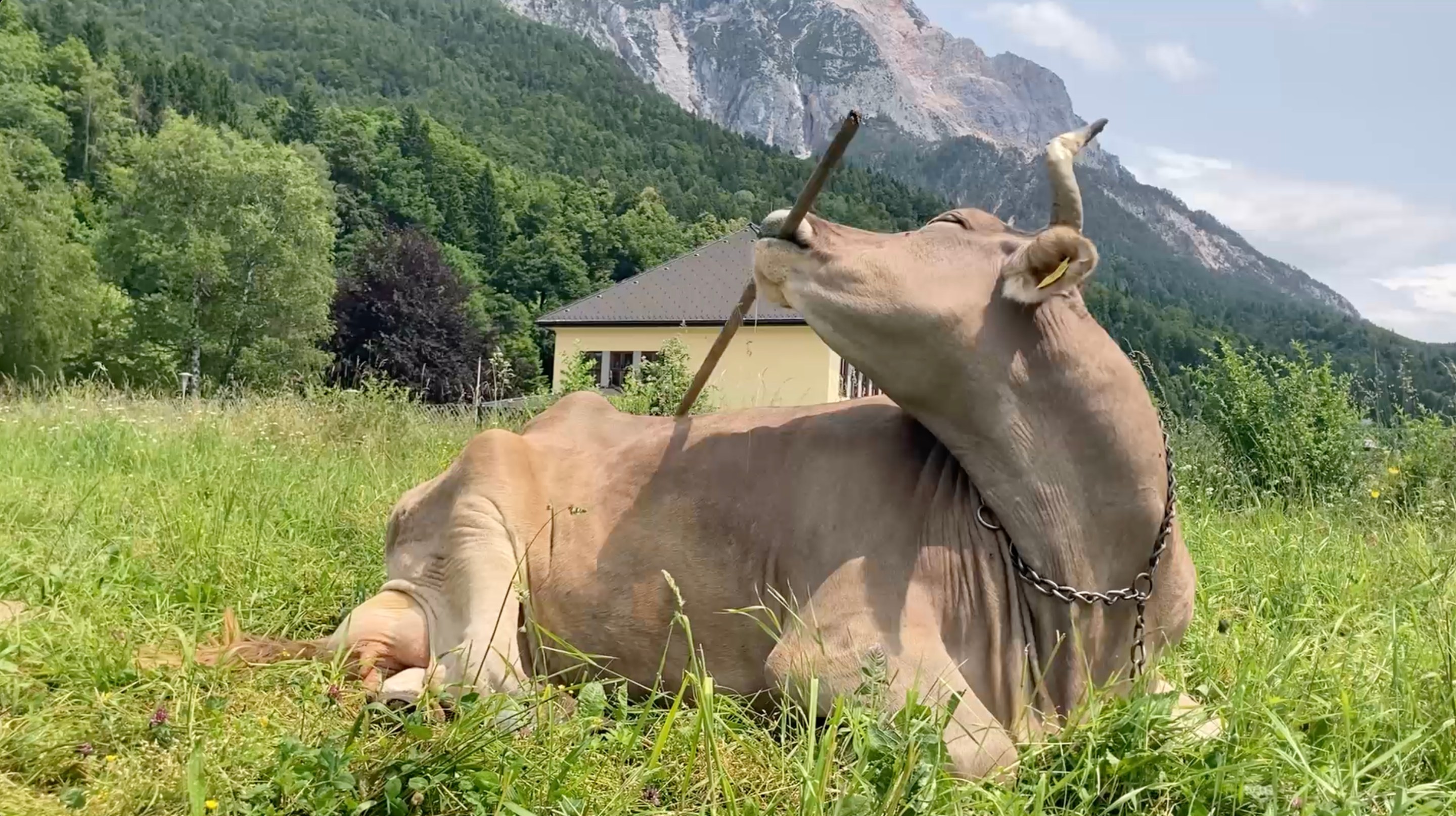
Veronika was 4 years old when she picked up her first tool: a tree branch, found in her pasture in the town of Nötsch im Gailtal in the Austrian alps. Veronika lives with Witgar Wiegele, an organic farmer and baker who keeps the Braunvieh cow as a pet. Veronika's meadow is downright idyllic, nestled among blue lakes and snow-capped mountains and carpeted in grass green enough to make Maria von Trapp hit a whistle note. Here, Veronika nosed through the grass for twigs, which she picked up and used to scratch herself, because she was itchy.
Wiegele never taught Veronika how to scratch herself with a stick. Rather, the cow appears to have taught herself. Veronika is now 13, and Wiegele says she's gotten better over the years. A new paper in Current Biology tested Veronika's stick skills with a wooden broom and found the cow could manipulate the tool for different scratching tasks. The paper is culturally noteworthy for introducing people to Veronika—who is by all accounts a wonderful cow—and scientifically noteworthy because it marks the first documented case of tool use in cows. (Cow tools, if you will.) The authors of the paper, citing Veronika's "anticipatory grip adjustments and technique diversity," conclude that the cow's scratching represents flexible tool use. Before we go further, please enjoy a small sampling of Veronika's anticipatory grip adjustments and technique diversity.
It's no surprise that many animals know how to scratch an itch. Bears are famous for it, and a quick spin on TikTok has introduced me to a rotating contraption called a cow brush that cows seem to love to scratch against. But Veronika was using a tool to scratch herself. That is, she was manipulating an object with a directed aim: to reach parts of her body that she otherwise could not.
The researchers, who specialize in animal intelligence, first learned about Veronika's scratching prowess from a video clip. They immediately recognized the scientific significance of the video and rushed to see the scratching cow in real life. But before they could meet Veronika, the researchers had to meet Wiegele, who runs a grain mill and a bakery by the pasture. “Witgar immediately invited us for cake, and he gave us lots of bread to eat, and he told us about his cow,” Alice Auersperg, a cognitive biologist at the University of Veterinary Medicine Vienna and an author on the paper, told Emily Anthes at The New York Times.
To test Veronika's skills, the researchers offered the cow a deck scrub broom, which has a wooden handle on one end and a flat bristled surface on the other. They hypothesized Veronika would prefer to use the functional, bristled end to scratch herself in hard-to-reach parts of her body. The researchers placed the broom in different orientations on the ground and watched as Veronika used her tongue to pick up the brush and position it just how she liked.
Veronika proved the researchers right. She used the brush end more often than the stick end, and she only used the tool to scratch herself in hard-to-reach spots. But the researchers soon realized that when Veronika scratched herself with the stick end, it was not out of error, but an intentional choice. While she preferred scratching the thicker skin of her upper body with the brush, she used the stick end to scratch the more sensitive skin of her udder and belly. When she scratched her upper body, she moved the broom in a scrubbing motion. This counts as multipurpose tool use, behavior that, besides humans, has only been documented in chimpanzees. And when she scratched her lower body, she gently pushed the stick to reach smaller targeted areas. And throughout her scratching process, she would occasionally readjust her grip on the broom to ensure she was hitting just the right spots.
The researchers suspect that Veronika wanted to relieve herself from the bites of horseflies that swarm the alps in the summer. But this inconvenience is trifling when you consider the bounty of Veronika's life. She lives with Wiegele not as a production animal but a companion. She has a pasture in which to roam and sights and sounds to observe around her, unlike cows held in impoverished conditions on factory farms. The researchers point out her privileges in the paper as evidence that Veronika is not particularly special. ("We don’t believe that Veronika is the Einstein of cows," one of the authors, the researcher Antonio Osuna Mascaró, told The Guardian.) Rather, the authors suggest that any cow might teach themselves to use such a tool.
Other domestic cattle have been filmed scratching themselves with branches. Cows and other livestock have traditionally been excluded from discussions of animal intelligence, a field where animals like chimps, parrots, and whales reign supreme. But it makes sense that we, as an ironically small-minded species, would underestimate the abilities of the animals we raise for slaughter. Perhaps this makes it easier for us to eat them and house them in filthy confinement.
To help redeem the good name of the humble cow, the researchers invite readers to send them any footage of cows or bulls using sticks or other tools for further investigation. Veronika might not be the Einstein of cows, but perhaps there is an Einstein of cows out there somewhere, using tools in a way that would obliterate our minds. (Can you imagine what Veronika could do with a theremin?) By that logic, the best way to find a cow genius might be to give a lot more cows a little more freedom.