

Although frogs and toads as a whole tend to have larger eyes for their body size than other vertebrates, tree frogs take the cake. Some tree frogs have the largest relative eyes of any vertebrate. Their eyes are enormous, taking up a great deal of their head. A tree frog's eyes bulge because they need to see in all directions as they climb and jump and dodge predators in the forest canopy. Their eyes even help them swallow, pushing into the roof of their mouth to squeeze food down their throats.
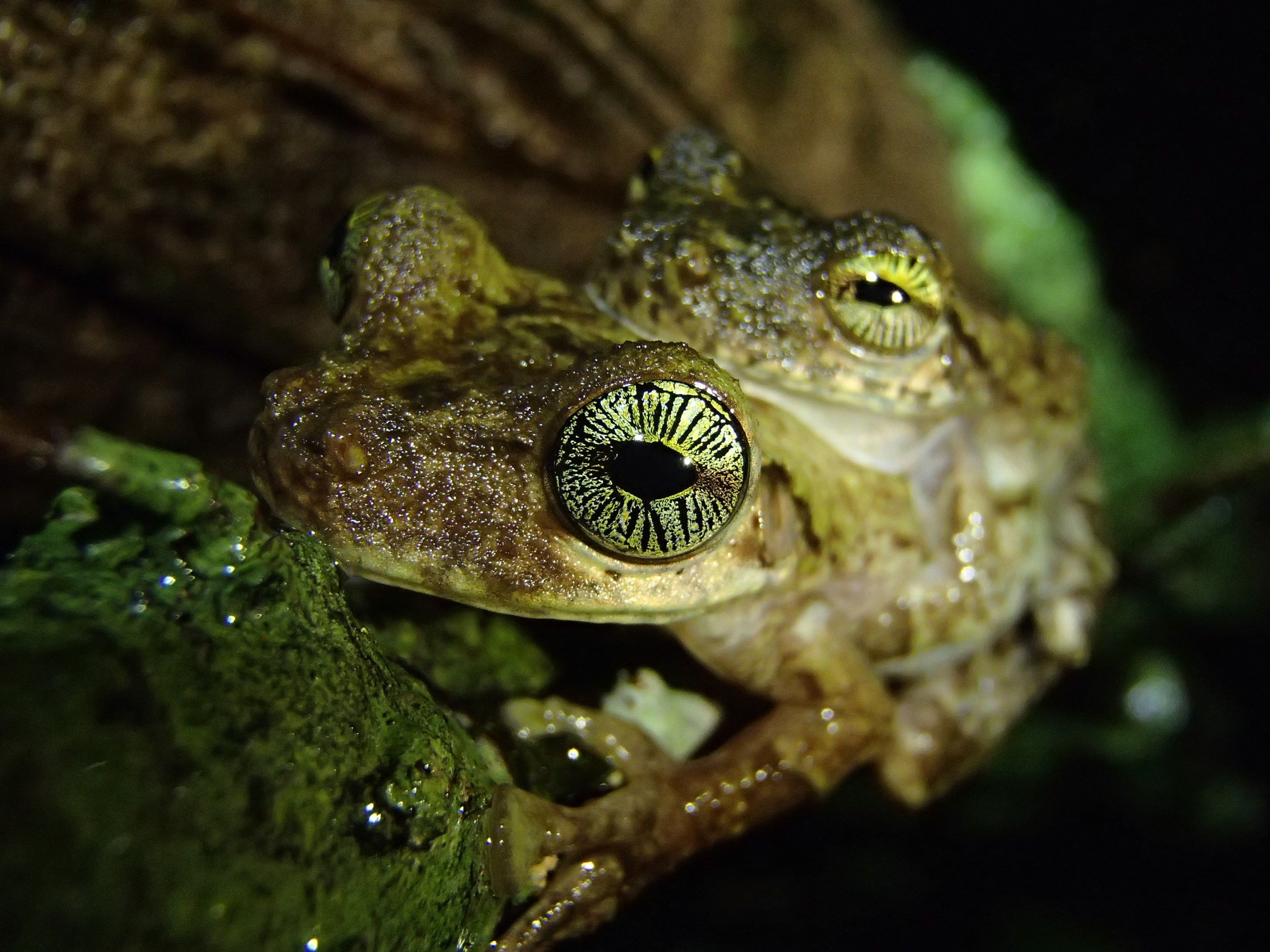
This bulge is often accompanied by beauty. When Mélissa Peignier was a PhD student at the University of Bern in Switzerland, she traveled to a river island in French Guiana to study another frog. Allobates femoralis, also known as the brilliant-thighed poison frog, has a dark body interrupted with pale stripes and spots the color of a sunset on its arms and thighs. Peignier was interested to learn more about the frogs' personalities, how traits like boldness might impact the creatures' reproductive success. But the island was home to many other spectacular frogs, including the pink-bellied Cayenne stubfoot toad and the bulbous-eyed Osteocephalus oophagus. Peignier was taken by the latter frogs' striking irises, golden orbs adorned with black sunbursts.
In the field with her colleagues, Peignier, who is now a behavioral ecologist at the research institute Agroscope in Switzerland, often discussed best practices for identifying wild animals, "especially where to draw the line on what is acceptable in the name of science," she wrote in an email. To identify frogs that are captured and then released, researchers often rely on toe clipping, which involves cutting off part of the amphibians' toes and might impact their ability to survive in the wild. "Some of the people working with us objected to toe clipping, and we respected that," Peignier said.
But some frogs boast distinctly individual patterns that allow researchers to sidestep toe-clipping, as the researchers reveal in a new paper in Herpetezoa. The brilliant-thighed poison frog, for example, has irregular belly markings. "We wondered whether iris recognition could work for frogs the way it does for humans," Peignier said. Most frogs eyes, however big, did not have distinct enough iris patterns. but O. oophagus was an obvious exception.
The frogs spend their days in the forest canopy, only descending at night to find mates. Fortunately, they were not hard to track down. The researchers had already placed an archipelago of flowerpots along the island's trails, mimicking the frogs' natural breeding pools. Good breeding spots are hard to find in the forest, so O. oophagus flocked to the pots. "Once they were there, all we had to do was catch them gently by hand," Peignier said.
Frog in hand, the researchers photographed both eyes and added the images to a reference library. Each time they found a frog, they compared its eye to the photo library. It only took a minute to figure out if the frog was new or a recapture. If the frog was captured in the midst of amplexus—an amphibial mating embrace—they were back at it within an hour.
Peignier was most surprised by O. oophagus's calm demeanor. The brilliant-thighed poison frog is a much more active amphibian. "So working with O. oophagus was very peaceful," she said. The frogs were also easy to photograph without any handling, posing nicely while perched on a pot or branch or even in coitus.
Although this identification method is certainly more compatible with animal welfare guidelines, it is unclear how many other species have eyes complex enough for iris identification. Our irises do not change as we age, but many animals' irises morph over a matter of months, such as those of the Atlantic salmon. But the researchers have their eye on a number of other frogs with suitably intricate irises, such as the giant broad-head treefrog, the tiger's tree frog, the Amazon milk frog, and the ghost glass frog. For these frogs, iris identification may offer researchers a less harmful way to study their populations during a time of alarming biodiversity loss, where amphibians are the most threatened class of vertebrates on the planet. May these frogs stick around and stay beautiful, from head to every single toe.