

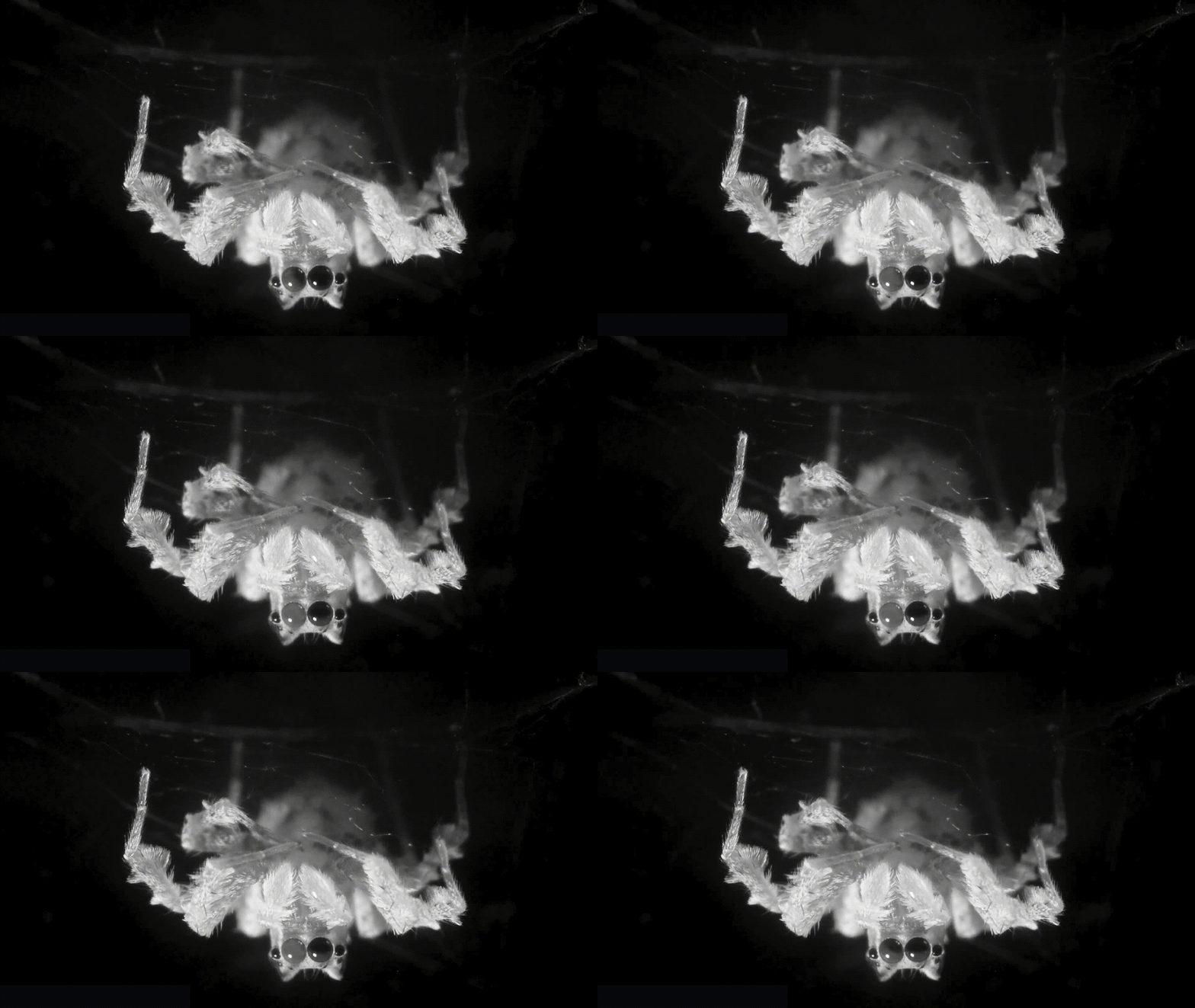
Jumping spiders in the genus Portia are sometimes called "eight-legged cats" for their large, almost feline eyes. Just like a cat, Portia spiders rely on their eyes to find, track, stalk, chase, and jump on their prey. While other spiders trap food in their webs, Portia spiders hunt insects and even other spiders and their eggs. (The spiders' unusual intelligence inspired Adrian Tchaikovsky's novel Children of Time, in which Portia spiders evolve and develop civilization on another planet.) So perhaps it is unsurprising that when fringed jumping spiders, or Portia fimbriata, take time to rest, they resemble cats, too. The spiders, whose bodies are around the size of Cheerios, first search for a safe spot. Then they spin a silken hammock, and groom themselves, cleaning every leg. Then they settle, become motionless, and droop. Their legs curl and occasionally twitch. And they even have little eye movements.
Now a group of scientists has proven that these spiders do not just rest, but actually fall asleep. The spiders even experience a stage of sleep characterized by rapid eye movement, or REM, which is the stage of sleep in which we have our most vivid dreams. Their research was recently published in Proceedings of the National Academy of Sciences.
Over the course of a night, we cycle between two general phases of sleep: an active REM stage and a quiet non-REM stage. In REM sleep, our eyes move rapidly and our heart rates, blood pressure, brain activity, and breathing increase. REM sleep is the time during which we are most likely to dream, and our muscles also quiet down so we do not actually act out our dreams. It's a critical time during which our brain processes our experiences, consolidates our emotions, and repairs itself. REM sleep was first discovered in the 1950s in humans, and soon after observed in cats. Since then, it's been identified in many mammals—horses, giraffes, elephants, ferrets, and platypuses, to name a few—as well as birds, reptiles, and even invertebrates like cuttlefish. But arthropods, the group of animals that include insects and arachnids like spiders, were a different story. For one, most terrestrial arthropods and insects do not have movable eyes, which would seem to make the idea of rapid eye movement impossible.
One of the authors on the new paper, Daniela Rößler, first wondered if spiders sleep in 2020, per a story in Science. During a lonely period in the pandemic, Rößler had collected another species of jumping spiders and placed them in clear boxes. One evening she saw every spider dangling, upside-down and motionless, from silken threads affixed to the ceiling of the box. Curious, Rößler ventured outside and saw the spiders hanging in similar ways in the vegetation. The resulting 2022 paper revealed that young spiders appeared to experience a REM state, such as curling legs and twitching body parts. "However, those behaviors alone could not establish that the spiders were actually asleep," Nadja Geiger, an author on the new paper and a PhD student at the University of Bonn in Germany, wrote in an email.
This time around, Rößler, Geiger, and colleagues wanted to ascertain if spiders did indeed sleep, which would then offer more insight into their REM behavior. Sleep, Geiger said, can be defined using a set of established criteria. To name a few, sleeping animals have a characteristic resting posture. They are inactive. They can be woken up. Although these traits can be observed in any animal, the way researchers test them depends on the species, Geiger said. Spiders, for example, often remain incredibly still while awake. And the technology that makes it possible to measure brain activity in mammals and other vertebrates, which is a common way to study sleep, does not yet exist for animals like spiders. The researchers decided to test fringed jumping spiders because the animals' easily identifiable resting posture and enormous eyes made it easier to detect sleep.
In order to test the Portia spiders, the researchers needed to monitor their behavior extremely closely. They filmed the spiders with infrared cameras and noticed that, as night fell, the spiders searched for their sleeping site and began grooming themselves. Their bodies drooped, and they withdrew their pedipalps—appendages that, for male spiders, are somewhat of a combination leg-penis. The spiders stayed like this for most of the night.
The researchers also experimented with disturbing the spiders' sleep. "Rather than simply asking whether we could wake them, we wanted a stimulus that allowed us to measure how long it took them to respond," Geiger said. They tried various approaches, including puffs of air and visual stimuli, before settling on a 400-Hz sound that increased in intensity over 10 seconds. This frequency resembles the wingbeats of wasps, which predate on the spiders. Because of this, the researchers suspected "it might be a good cue to signal to a spider that it might be time to wake up," Geiger said. Spiders that appeared to be asleep took around three seconds to respond to this alarm, and spiders in REM took more than four seconds to respond. Finally, the researchers released a roving gang of more than 20 fruit flies into each spider's enclosure, to ensure the arachnids would be continuously woken up. After these restless nights, the spiders rested for an extra hour the next day.
The researchers were surprised by how structured the spiders' sleep seemed to be, similar to the way humans catch up on lost sleep. After the animals' rest was disrupted, they "showed a clear rebound and spent almost twice as much time in REM-like sleep," Geiger said.
Do the sleeping spiders dream? Whether a twitching Portia might be hunting down a hapless web-building spider in the unknowable palace of her mind remains a mystery, at least for now. But the takeaway of the paper is clear: Spiders experience true sleep in at least two distinct stages. This suggests that complex sleep may be more widespread across the animal kingdom than scientists previously realized. In Geiger's eyes, this reveals how much science might be missing by focusing sleep research on a few species that we consider more complex, such as mammals and birds. She hopes this research sparks more curiosity and appreciation for its often feared subjects. "Spiders are still incredibly underestimated," she said. But "the more closely we look, the more complexity we find."