

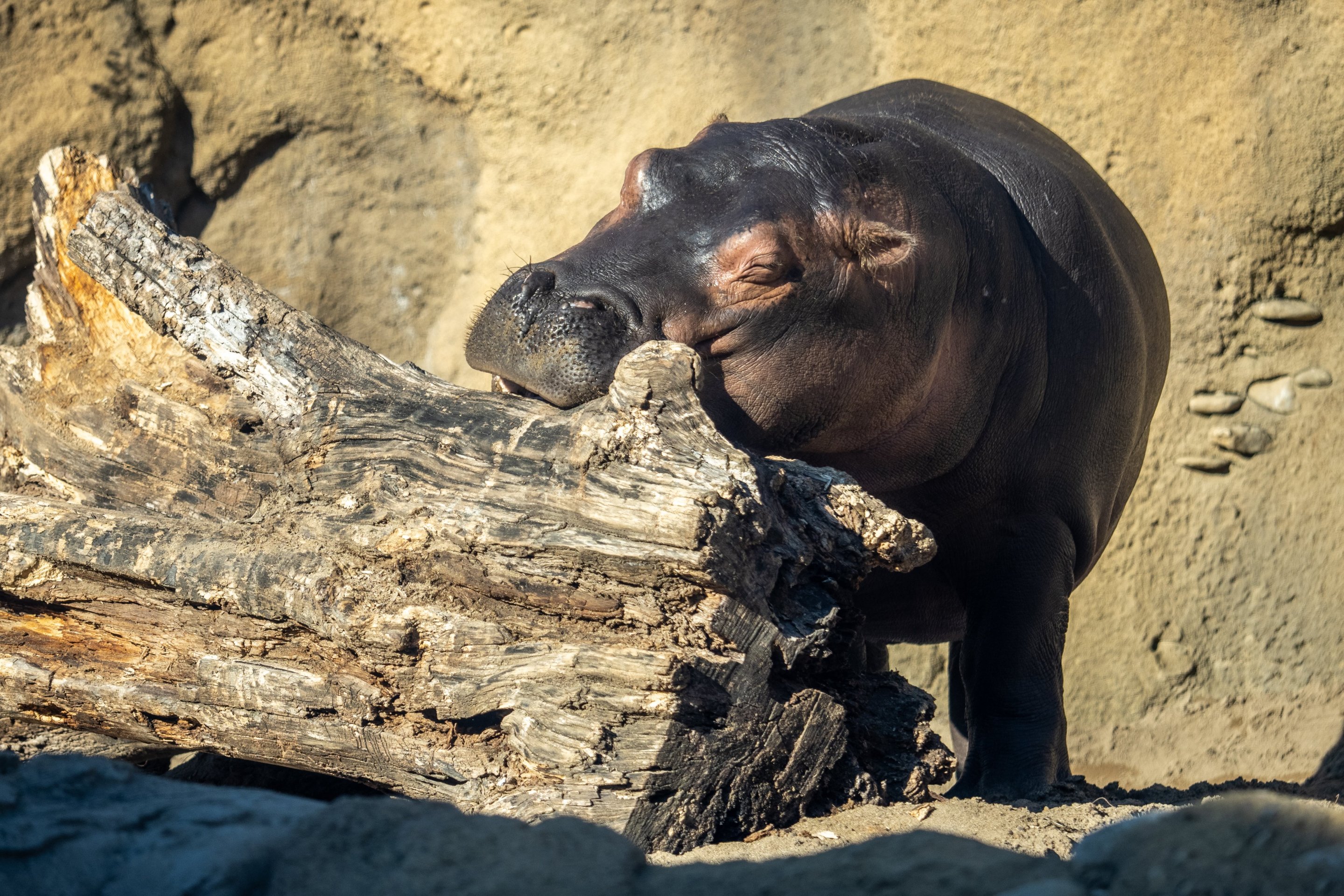
It was, it seems, a freak accident. Around two weeks ago, a child standing by Hippo Cove at the Cincinnati Zoo tossed a knit cap into the air, which was caught by a whirling ceiling fan and launched through the one-foot gap between the 12-foot-tall viewing window and the ceiling, where it landed in the enclosure's pool. Because Nile hippos can grow to be 3,000 pounds, zookeepers and veterinarians are not allowed to share space. There must be a protective barrier between the hippos and the humans, which prevented the swift removal of the hat. This is how Fiona the celebrity hippopotamus ate the hat that would kill her.
After Fiona ate the hat, veterinarians started monitoring the hippo's progress in passing the object. They took her off exhibit. They offered her treats to encourage digestion. They gave her fluids and an enema and a colonoscopy with a nine-foot scope. They placed her atop a vibration plate used to rehabilitate horses, hoping the vibrations might spur some movement in her digestive tract. On Nov. 17, an ultrasound showed her intestines were bunching. Hippos have multi-chambered stomachs that help them digest plants, and these chambers made the hat impossible to see or retrieve with an endoscope. Surgery was out of the question. The keepers didn't even know where the hat was located inside Fiona—her stomach, intestine, or colon—or if it had unraveled. Hippo skin can be over two inches thick, making it difficult for vets to access veins for anesthesia or close incisions. Hippos also need access to water, and Fiona would have needed to be out of the water for several days for her incisions to heal. Despite the veterinarians' best efforts and an outpouring of goodwill from Fiona's countless fans, the hippo died Nov. 19 at the tender age of 9. "Our animal care team was heroic in their efforts to save her," zoo director Dave Jenike said in a statement. "They did everything possible, but her body couldn’t fight anymore."
Fiona was the first celebrity hippo of our age. This superlative sounds silly, and also it is true. Without Fiona, there might be no Moo Deng. The Thai hippo would exist, but she might never have been a star without the Ohioan who paved the way for boisterous hippo calves whose big personalities outshone their still-considerable heft. Fiona made headlines before she was born—her fetal image was captured in the first-ever ultrasound of a Nile hippo's womb—and she became a global star soon after she was born in Jan. 2017, six weeks premature. She was just 29 pounds (the normal range for Nile hippo calves is 55 to 120 pounds) and she could not stand up to nurse from her mother, Bibi. The keepers managed to collect Bibi's milk to bottle-feed Fiona along with other supplements and cared for the baby around the clock. Things were touch and go. At three weeks, Fiona was not drinking, and a Cincinnati nurse managed to find a vein via ultrasound to give the baby a life-saving IV.
Fiona grew stronger each day and soon became a symbol of resilience. She took her first steps in February, and by June she had reached the normal weight for a hippo her age. Her heartwarming story was a PR boon for the Cincinnati Zoo, which had made headlines the year prior for shooting to death a gorilla named Harambe after a child fell into his exhibit. Suddenly the Cincinnati Zoo was not just, or no longer, the zoo that shot the gorilla. It was the zoo that saved the beloved baby hippo, whose plodding first steps and effervescent farts captured hearts around the world. And then Fiona became a franchise, inspiring merch both official and unofficial—t-shirts, magnets, plush toys, Christmas ornaments, picture books, a limited-edition ice cream flavor called "Chunky Chunky Hippo," a mural in downtown Cincinnati, and even a hat.
What does it mean to love an animal you have never met? Although I was not a diehard Fiona fan, I of course watched her videos and found them cute. I found myself most drawn to Fiona after she broke out of the box of being a child star. Like other precocious starlets who aged in the spotlight, Fiona became more complicated to love as an adult. In 2022, Fiona began mating with Tucker, a male hippo in Hippo Cove who was first brought to the Cincinnati Zoo the year prior to mate with Bibi, Fiona's mom. Bibi soon got pregnant and gave birth to a male calf called Fritz, who is Fiona's half-brother. The New York Post treated it as a scandal: "Zoo-family drama as Fiona mates with step-dad Tucker." This framing was, in many ways, stupid. Hippos do not have the concept of a stepdad. It was also not unexpected; the zoo put Fiona on birth control as soon as Tucker arrived. And yet it also seems a kind of parable for the unnatural conditions of the Cincinnati Zoo, which can only house four hippos, a fragment of the size of a wild hippo pod, which teem to more than a hundred individuals. In the wild, Fiona would have had other options.
The deaths of Fiona and Harambe have made some dismiss the Cincinnati Zoo as, per the Daily Mail's parlance, "the doomed zoo where viral animals keep dropping dead." Is the Cincinnati Zoo unusually cursed? Perhaps there are some design improvements to be made at the zoo to prevent hats and children from falling into animal enclosures. (After Harambe was shot, the zoo raised the barrier at Gorilla World.) But this is a trick question, because all zoos are cursed in this particular way.
When you bring together humans and animals that were not meant to safely share space, no amount of exhaustive security measures and consideration for animal welfare can prevent every last thing from going wrong. As I have written about before, there is no way to recreate the wild expanse of an animal's environment while simultaneously ensuring that animal can be easily seen by visitors. So zoos make compromises, striking a balance between animal welfare and human enjoyment, and how much you weight either end of this scale will determine how you feel about zoos. But if we want to view wild animals up close, we must accept the possibility of accidents, some big and some small, some fatal, to either us or them. These unnatural deaths are a rare but inevitable outcome of the ways zoos function today.
Fiona only lived because she was born in a zoo, so perhaps it's darkly fitting that she only die because she lived in a zoo. Although her encounter with an indigestible hat was a freak accident, these accidents are known to happen in zoos. In 2024, a sitatunga named Lief died at a Tennessee Zoo after choking on a squeezable fruit pouch. In 2014, a polar bear named Anton died in a zoo in Stuttgart, Germany, after he apparently ate a purse and a coat. Although the bear's enclosure was encircled by an electrified fence, around 200 children's shoes, 50 pacifiers, hats, cameras, phones, and glasses had been thrown into Anton's enclosure over 20 years. Also in 2014, a hippo named Maikel collapsed and died in his pool at a Frankfurt zoo, where his longtime partner, Petra, swam around him and tried to nudge him up. The autopsy revealed Maikel died an "agonizing death" after he swallowed a tennis ball that blocked his bowel. A tennis ball also killed hippos in a Dublin zoo in 2002 and an Auckland zoo in 1937.
Now that Fiona has died, her legions of fans are hurting. Many are angry. Some of them are taking out their anger on a baffling target: the child who threw the hat. Sure, a child should not be throwing their hat so close to a hippo enclosure. But also the child is a child, one that might grow up with the unimaginable burden of knowing that they killed one of the world's most beloved zoo animals. Some of these angry people, with some half-baked understanding that it is unfair to blame a child for a hippo's death, are instead blaming the parents. They are speaking up on social media, sounding off in the Cincinnati Zoo's Instagram announcement of Fiona's death, calling for someone—who, exactly?—to "hold the parents responsible."
It recalls the viral "Justice for Harambe" campaign that urged authorities to criminally charge the mother of the child who entered the enclosure. What justice does Fiona deserve? They suggest that "at the very least that family should be banned from the zoo." They say "there is zero accountability in our society." The most deranged of them are demanding to "send the brat and the parents to GITMO." The stupidity of this needless cruelty of all this should be obvious. Fiona will not be brought back, nor living animals made any safer by enacting revenge.
If there is blame to be cast for Fiona's untimely death, or even that of Harambe, it should not be directed at individual visitors who fail to wrangle their children. Zoos should have enough protections in place for their animals to ensure that an errant kid cannot accidentally kill a hippo. The Cincinnati Zoo believed it had those protections in place.
The waters of Hippo Cove are now home to just three: Bibi, Tucker, and Fritz. We can only speculate about their understanding of what happened to Fiona, and why she is gone. Hippos are not elephants, animals who appear to have some understanding of death, and even bury their dead. But in 2025, a PBS documentary captured footage of a clan of hippos surrounding the dead body of an old bull, behavior previously observed in elephants. One by one, the hippos nuzzle his corpse, nosing his legs with their enormous snouts and grunting softly in the water. It is impossible to know how a pod of hippos might have treated Fiona's death in the wild, as she would never have survived birth without the team of people who cared for her at the zoo. It is also impossible to know how Bibi, Tucker, and Fritz would have reacted to her body if they had been allowed to encounter it in Hippo Cove, as she died out of her exhibit. Now they are left to make sense of her disappearance, and to wait for another hippo to take her place.