
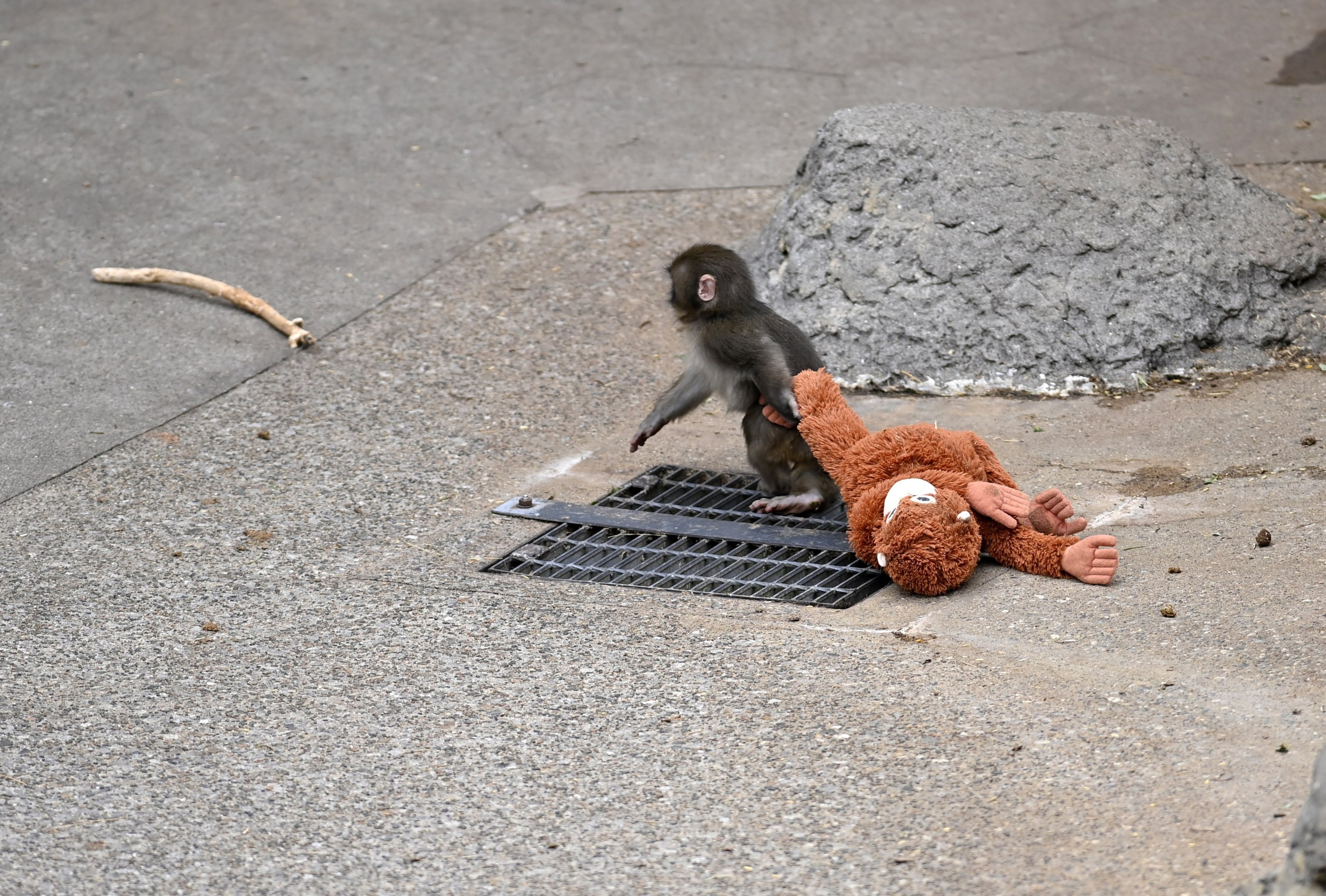
When I first heard rumblings that the world had assembled a conclave to elect a new celebrity zoo animal, I felt preemptively wary, partly due to world events and partly because we still don't know the long-term psychological consequences of fame for child stars like Moo Deng. Then I saw a video of the seven-month-old Japanese macaque Punch dragging his Djungelskog IKEA orangutan toy, and instantly felt my heart swell. It is difficult, I fear, to stave off the pangs of emotion that come when watching a baby monkey—a primate just like us—appear totally alone, clinging to a stuffed toy while he watches the other inhabitants of his enclosure hold and groom each other. When I watched videos of Punch dragging his Djungelskog to yet another empty corner, I felt impossibly sad.
This sorrowful saga has traveled far and wide. When Punch-kun the Japanese macaque was born in July in the Ichikawa City Zoo, his mother abandoned him. This sounds cruel, but it is known to happen under certain circumstances. In this case, she was a first-time mother who gave birth during a heat wave, making for a stressful labor. "In environments where survival is threatened from outside stress, mothers may prioritize their own health and future reproduction rather than continue to care for an infant whose health may be compromised by those environmental conditions," Alison Behie, a primatology expert at Australian National University, told The Guardian.
Without a mother, Punch needed someone, or something, to which he could attach. As Ichikawa City zookeeper Kosuke Shikano told The Guardian, baby Japanese macaques cling to their mothers after birth, both to build muscle strength and to feel a sense of security. But Punch, left alone, had no one to hold. After the keepers attempted to give him several towels, they offered him the Djungelskog, which had the added benefit of looking like a monkey. Punch immediately attached.
In January, Punch rejoined the monkey enclosure, or Monkey Mountain. He was wary of the other monkeys and struggled to connect. Viral videos showed monkeys running away from Punch, even pushing and slapping him. Although Punch took his isolation quietly, retreating to the lonely corners of the enclosure with only the touch of his Djungelskog, the world wailed for the wee macaque, whose exclusion they did not understand. "Punch seems like a perfectly fine little monkey. Was there a specific reason why his mother rejected him?" asked one Reddit user on r/NoStupidQuestions. "It's time to give that baby monkey a gun," tweeted the menswear guy. IKEA, capitalizing on Punch's dejection, posted an ad on Instagram where a macaque-esque monkey toy hugged a Djungelskog underneath the words "Sometimes, family is who we find along the way." When asked what they would want to say to Punch's "bully," assorted Miami Heat players responded with sage counsel such as "Man, stop that! Bullying's not nice," and "I don't know man, I'm scared of monkeys for real."
Primates are easy and obvious targets of anthropomorphism: attributing human-like characteristics to non-human animals. Because of our close relation, macaques look and act uncannily like us, making comparisons to their culture not just inevitable, but logical. I doubt a video of an ant being rejected from a new colony would tug at the world's heartstrings, even though said ant would face certain death upon such a rejection. Ants are not widely considered cute, but also ants do not share the traits we do with other primates, such as strong social relationships. It is practically impossible to watch a video of Punch being shoved, or sitting alone with his toy, and see anything else but a lonely child being bullied. "We have all felt, at some point, like an outsider, lonely, trying to find our place in the group," wrote Mark Colley for the Toronto Star. "Everyone knows what it feels like to be on the outside looking in."
Anthropomorphism has long been frowned upon by scientists, often for good reason. Ants kill ants from other colonies not because they hate them or wish to exclude them. Their prejudice is chemical, the result of sensing another ant's particular mix of hydrocarbon chemicals on their outer shells. But when it comes to species that do share close evolutionary origins with us, anthropomorphism is not always a bad thing, according to the late primatologist Frans de Waal. "After a lifetime of working with chimpanzees, bonobos and other primates, I feel that denial of the similarities is a greater problem than accepting them," he wrote in a piece for The New York Times, also arguing, "In our haste to argue that animals are not people, we have forgotten that people are animals, too."
Accusations of anthropomorphism hinge upon the premise of human exceptionalism: that we are the only ones privileged enough to feel love or grief, the only ones able to catch bad vibes from another primate across the room. In protest of this trend, de Waal coined the term "anthropodenial," which refers to the instinctive rejection of human-like traits in other animals or animal-like traits in humans. Bullying is not a singularly human trait, and recognizing Punch's predicament is a testament to our recognition, primate to primate, of another animal who wants the same thing we do: touch, connection, and a sense of belonging.
We do not live in a macaque society, and so we are not familiar with macaque culture or social norms. Japanese macaques like Punch live in matriarchal societies called troops, which adhere to strict hierarchies. Females stick to the troops into which they are born and inherit the rank just below their mothers, and males leave their troops after puberty and join new ones. A macaque's rank determines the monkey's access to food, mates, and overall quality of life. For example, higher-ranking Japanese macaques with more social connections and therefore more access to grooming had fewer lice. Macaques maintain their rankings with displays of dominance, and Punch would probably still experience similar aggression even if he had not been rejected, Behie told The Guardian. Without his mother, "Punch may not develop the appropriate subordinate responses to show they submit to the dominance, which could have ongoing implications for the way they integrate into the group as an adult," she said.
In other words, Punch is learning how to be a macaque. Behaviors that might seem cruel to us are not unusual for macaques, just as cruel behaviors are not unusual for us humans. Although the Ichikawa Zoo reported as early as Feb. 6 that Punch had succeeded in being groomed by and playing with other monkeys, a widely viewed video later in the month showed Punch being dragged on the ground by an adult monkey. On Feb. 20, the Ichikawa Zoo issued a statement in which zookeepers explained that Punch had approached a baby monkey from the troop, who avoided him. The zookeepers speculated that the monkey who dragged Punch was the mother of the baby monkey, and framed the dragging behavior as "scolding."
"In order to integrate Punch into other Japanese monkey troops, we anticipated that this kind of challenge may arise," the zoo's statement read. And Punch has unflaggingly persisted in his search for acceptance. Last week he was groomed by two monkeys. On Feb. 26, he played with other young monkeys without the aid of his Djungelskog.
Consciously or subconsciously, Punch's bond to his Djungelskog recalls one of the most infamous psychological experiments in U.S. history. When the researcher Harry Harlow separated baby rhesus macaques from their mothers, he placed them in an enclosure with two "mother" figures, one made of wire that provided milk and another made of soft terry that had no milk. The prevailing scientific view at the time believed the monkeys would attach to the figures that provided their basic biological needs, meaning the wire figure. But instead the baby monkeys spent most of their time with the soft "mother," revealing that babies attach based on touch, comfort, and affection, rather than physical nourishment.
Harlow's now-maligned work presents a paradox of care: In order to challenge the status quo and prove that human children needed love and affection, he needed to torment monkeys. Rather, he decided that he needed to torment monkeys. Harlow could have arguably stopped at the wire-mother experiment, but he put more and more baby rhesus monkeys through even more torturous circumstances. He placed monkeys in a "pit of despair," isolating them for 30 days in a stainless steel vertical chamber that could not be climbed, and a "tunnel of terror," in which the monkey was exposed to approaching, frightening stimuli.
Today, macaques are one of the most often-used monkeys in medical research. The U.S. uses about 70,000 monkeys per year to study the brain, infectious disease, and aging, David Grimm reported for Science in 2023. Most of these monkeys are sourced from Asia, although some are bred domestically. "The reason we study macaques is because really, they’re just like us," Margaret Livingstone, a neurobiologist at Harvard, said in an interview for a press release about her research.
Livingstone published a 2022 paper in PNAS which found that soft textures are just as important for monkey mothers as they are to monkey babies. When one of her macaques, Venus, gave birth to a stillborn infant in 2013, Livingstone replaced the baby's body with a stuffed animal, which calmed Venus down. "After that, every time we had to take an infant away from a mother for our research on cognitive development, we offered the mother a stuffed toy," she said.
Venus is an exception. Livingstone's stuffed animal hack assuages mother macaques placed in an unusual and cruel situation, in which their babies are swiftly removed to be hand-reared so they can be the subjects of scientific tests. Livingstone's work has been protested for "knowingly caus[ing] extreme distress," per a letter to PNAS signed by 250 scientists calling for the study's retraction. I bring up monkey testing not for mere shock or alarm, but because it seems relevant to remind people that monkeys suffer extreme emotional distress at the hands of people who have deemed this suffering necessary for possible improvements in our own lives. How you feel about this is up to you. But it seems unfair to lament the plight of Punch without remembering the thousands of other monkeys of all ages whose emotional suffering goes unnoticed because they are, quite intentionally, not on display for all of us to see.
Unlike his lab-bound brethren, Punch has the privilege of living a more autonomous life, albeit in a zoo. Here, captivity has its benefits: If Punch had been born and abandoned by his mother in the wild, he would likely have starved to death without a mother to nurse him or any other monkey to watch over him. He would not have his Djungelskog. I would urge anyone feeling distressingly anguished over Punch to remember this. The little macaque survived because he lives in a zoo, and despite his difficult circumstances, he is being cared for perhaps more than any other monkey at the moment. The Ichikawa City Zoo has been deluged with requests to donate cash or goods, and is thronged with long lines of visitors.
It is possible and important to hold all these tragedies together, big and small, Punch and all other captive macaques, Punch and the suffering of all other primate children around the world, human or not. In most of these cases, people are the common denominator of cruelty, not the macaques. We will always be. Perhaps Punch and his trials on Monkey Mountain can be a reminder of the importance of watching out for those in our communities who people seem intent to exclude, shove aside, or disappear. Don't worry about Punch; he'll be fine. Worry about us.