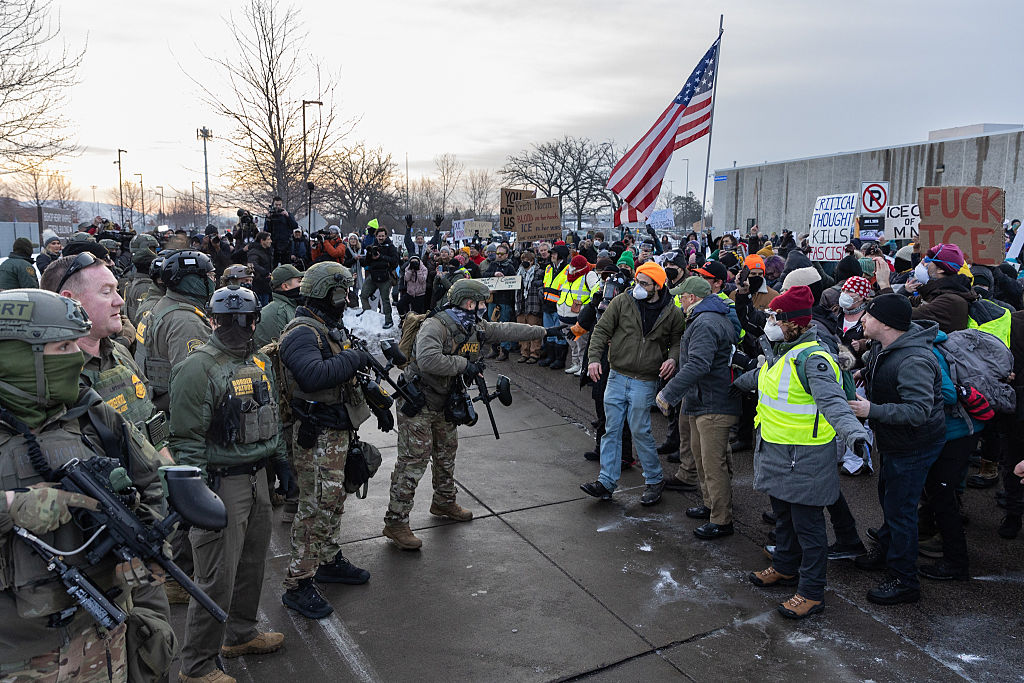
People are back out on the streets of Minneapolis again, they are barricading the roads and tending curbside memorials, and they are asking for someone to make sense of a reckless and unnecessary death at the hands of law enforcement.
On Wednesday, Renee Macklin Good was shot and killed by an Immigration and Customs Enforcement (ICE) officer while driving her SUV on the city's south side. Good was stopped in the middle of the road as ICE agents approached from all sides. The shooter had his phone out, and agents seemed to be bellowing contradictory instructions while another brazenly attempted to pull her out of a moving vehicle. She slowly backed away, then attempted to drive off before several shots were fired. Good's SUV rolled down the street before colliding with a utility pole; the agent who pulled the trigger was driven away from the scene, and agents that remained reportedly prevented a bystander who identified himself as a physician from attempting to save Good's life. She died less than a mile from the spot where George Floyd was murdered by Minneapolis police officer Derek Chauvin in 2020.
Five yeas ago, it was bystander video that told the full story of Floyd's death at the hands of police, footage that punctured a lie about a man who had been resisting arrest and subsequently died from "medical distress." Video of Good's killing began circulating hours after her death, but not before officials at the Department of Homeland Security, including Secretary Kristi Noem, labeled Good's attempt to drive away on a snowy street an act of "domestic terrorism."
Police killings in America have their own set of upside-down logic, an inverted causal loop within which safety can only be earned through violence and law enforcement can only ever clamor for and claim more power, and never surrender it. And in that unreality there is always a threat, real or shamelessly fabricated, that justifies brutality. Under the second Trump administration, state violence is not just a means to an end—a bloody, panicked shortcut to "safety"—but the only end, and an end in itself. If that rationale seems increasingly hollow or plainly absurd, it's the result of the president and his viziers recognizing that when you scale high enough, actions don't have consequences, and that brutal consequences can easily be decoupled from precipitating actions, and that very different rules apply for some people than for others. If that doctrine is now guiding our foreign policy, the roots can be found at home. They run deep.
While the justifications are lies, increasingly the violence is real. ICE and the Border Patrol have become the fist of the Trump regime, and according to The Trace, the shooting in Minneapolis was hardly an outlier:
We’ve identified 28 such incidents, including 14 shootings, as of January 7. They include the shootings of three people observing or documenting ICE raids; the shootings of five people driving away from traffic stops or evading an enforcement action; and the September 30 raid on a Chicago apartment building, during which half-asleep tenants and their children were held at gunpoint. At least four people have been killed and five others have been injured.
Until Minneapolis, the administration's targets were palatable to the president's retribution-minded audience. The campaign, like many others, can be understood at least in part as the administration creating video content for conservatives hungry to see the government chase down immigrants or others easily labeled as criminals. Just one day before ICE agent Jonathan Ross shot Good, the Department of Homeland Security posted a video on Twitter of Noem in her flak jacket and Drybar blowout, easily identifiable unlike the masked warriors at her disposal, as she accompanied agents on an arrest on the streets of Minneapolis. The agency had promised as many as 2,000 federal agents would be set loose in the Twin Cities in the agency's latest enforcement operation, promising to deliver sizzle-reel crackdowns on the immigrants and criminals hiding in Minneapolis and St. Paul.
Increasingly the victims of the administration's campaign of terror are people just trying to survive when their daily life is upended by the presence of masked federal agents. Those agents are ambushing immigrants after court appearances, crashing into drivers while trying to escape protestors, or abducting children if they seemingly impede the arrest of their own parents by dint of simply existing; the people in the cities in which this is happening are just trying to live in those cities. What we are seeing now is the downstream effect of the White House having access to an overfunded and poorly trained federal police force that can be deployed to whichever city the president has decided needs to be punished. ICE is strictly an immigration enforcement unit in name only. The method of its deployment demands that it be brought into direct conflict with the local residents it terrorizes, inevitably turning all of them, immigrant and citizen alike, into targets.
Whether Good was a protestor, legal observer, or simply a mom trying to make it home from school dropoff, watching the bystander video makes very clear that she was not engaged in domestic terrorism. More than simply disputing the administration's lies, the visceral act of bearing witness to the Trump administration's policy of violence does have consequences for many Americans when it pulls them into the fight.
In watching the bystander videos of Good's killing, some of the first sounds you hear are whistles being blown in the background. This is now the standard practice to alerting the neighborhood that ICE agents are in the area; Noem has described it as impeding law enforcement, and a crime. This is just another of the lies easily debunked by most people who care to look: It's not a crime to protect yourself or your neighbor from masked gangs causing chaos in your neighborhood.
Just one day after Good was shot and killed in Minneapolis, Border Patrol agents shot two people in a car in Portland during a traffic stop in a hospital parking lot. Next to nothing is known about that shooting; the officers involved fled the scene. The same Homeland Security spokeswoman who said Good was using her car as a weapon claims that the agents were pursuing a member of Tren de Aragua, who also used their car as a weapon. As has become the norm, the agency has provided no evidence.
Now people are back on the streets of Portland once again, following the same pattern after Floyd died and when ICE began sweeps in Oregon last year. If the Trump administration is going to keep treating people in this country like the enemy, more Americans will come under threat from their own government. And thanks to a limp and feckless political opposition that doesn't seem to think something as trivial as state violence is a reason to take to the streets, friends, neighbors and families will continue to fight back simply by trying to protect themselves.
People are chucking sandwiches at Border Patrol agents, chasing ICE out of neighborhoods on scooters, or openly staring down federal agents while dressed like a lineup from a Nickelodeon cartoon. Renee Good's killing is just the latest proof of how much risk comes with any form of resistance, and of how broadly and brutally the state has defined the idea of resistance down.