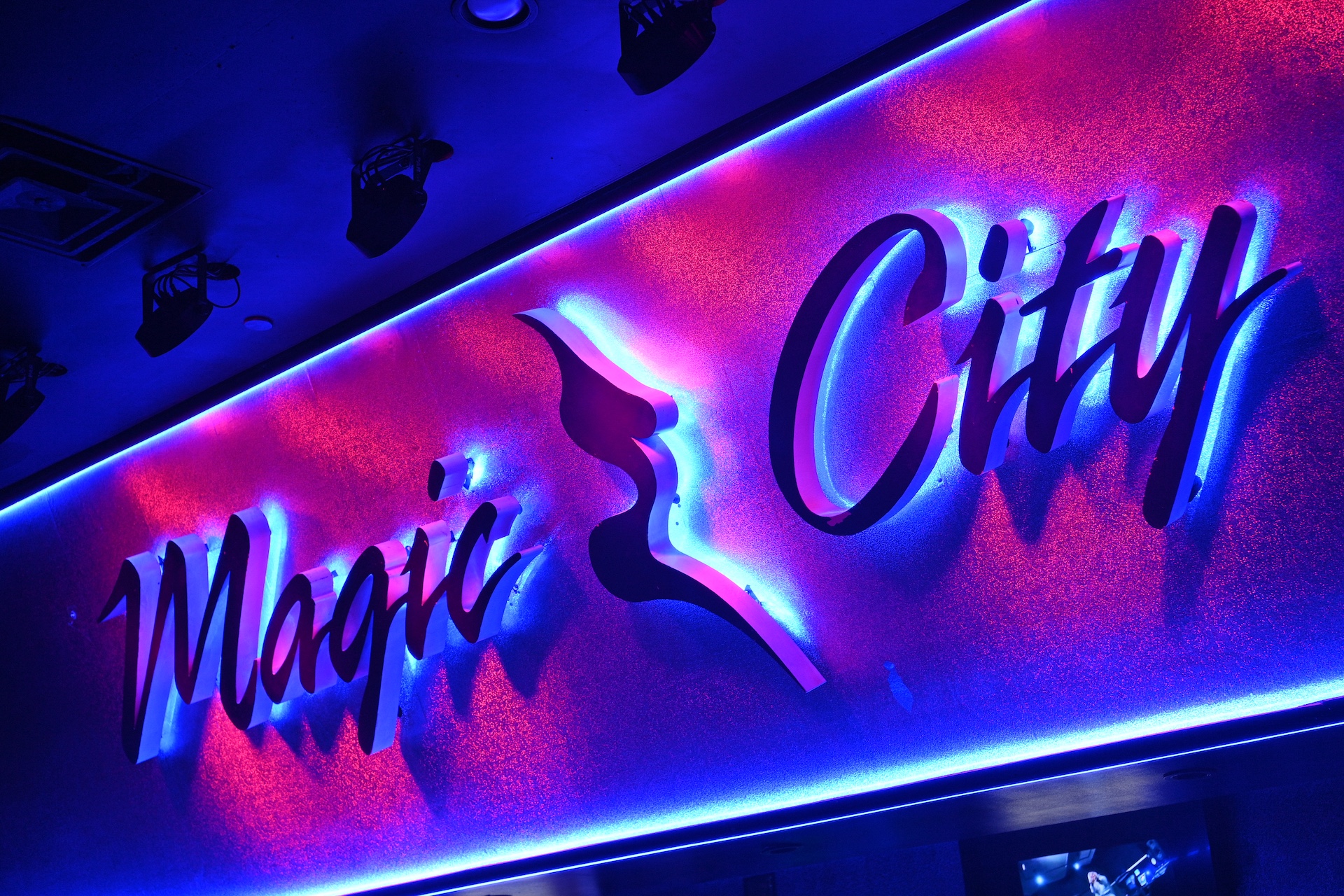
In what could very well go down as the biggest upset of the season, San Antonio Spur and intermittent blogger Luke Kornet somehow has successfully blocked the Atlanta Hawks' attempt to honor an iconic local institution: Magic City strip club. In response to the handwringing engendered by Kornet's completely random Medium post against the event, the NBA announced on Monday that it has canceled the Hawks' planned Magic City night.
In his post, Kornet called out the partnership and the league, stating: "The NBA should desire to protect and esteem women, many of whom work diligently every day to make this the best basketball league in the world. We should promote an atmosphere that is protective and respectful of the daughters, wives, sisters, mothers, and partners that we know and love."
In response to the NBA's cancelation, the Hawks released their own statement, saying, “While we are very disappointed in the NBA’s decision to cancel our Magic City Night promotion, we fully respect its decision. As a franchise, we remain committed to celebrating the best of Atlanta – with authenticity – in ways that continue to unite and bring us all together.”
In a vacuum, it's probably not totally crazy to believe that a corporate sports team should not be in bed (so to speak) with a strip club, promoting such a nakedly (so to speak) adult venue at an ostensibly family-friendly event like an NBA game, in doing so arguably supporting an industry built on the exploitation of young women. (Never mind that the actual event was not going to feature any Magic City dancers, and instead was mostly built around a live-recorded podcast conversation between rapper T.I. and Magic City owner Michael "Mr. Magic" Barney, and a cool hoodie.) But if there's anywhere this kind of vacuum-sealed thinking doesn't apply, it's in Atlanta.
I didn't grow up in Atlanta, but due to its proximity to my native Tallahassee, and to my mom doing business in and eventually moving to the city, I have spent enough time there to know that Atlanta is unlike any other city in America. This is often a great thing: Atlanta was one of the first major cities where black people thrived financially and politically, had long ago beat other big cities in accepting different lifestyles and orientations, and, through its esteemed HBCUs and art scenes, has been the South's premier hub of creativity and intellectual development. This isn't to say Atlanta is the most progressive city to ever exist, but it does show that Atlantans have always had a different mindset from most places in the country.
To discuss the history of Atlanta strip clubs would take a whole book, but you can get some idea of it by reading or watching anything about the city's music scene. A good place to start would be the Starz recent docuseries Magic City: An American Fantasy, which gives a solid rundown of that club's legacy. But to give some brief background, as something like a cultural way station between New York and Miami, Atlanta's early club and rap music tended to mesh the sounds coming from those two poles, hewing a little more closely to its nearer neighbor. The cocaine-fast "shake" music of South Florida was a big inspiration on Atlantan music, in part because it was so danceable, which paired especially well with the city's strip club scene. As Atlanta rap grew and evolved, eventually becoming the entire genre's creative capitol, strip clubs emerged as the preeminent testing ground for what music popped and what didn't. No club was more important in that respect than Magic City. Some of rap's most important DJs honed their craft at Magic City, including the likes of DJ Esco, who would find success working with Future, and DC the Brain Supreme, who co-wrote a Magic City theme song that would eventually be known around the world as "Whoomp! (There It Is)." You cannot tell the story of Atlanta's hip-hop ascendence without Magic City.
On top of being an integral part of Atlanta's music scene, Magic City is not merely a "strip club" in the way outsiders might imagine, and it hasn't been for a long time. The place's significance to the city has far outstripped (so to speak) its original conceit. If you're an artist or athlete coming into town, you go to Magic City. If you're a big-time drug dealer from or stopping by Atlanta, you go to Magic City. If you're a politician running for office in Atlanta or Georgia, you go to Magic City at some point. If you're the CEO of a major company, you go to Magic City. It is genuinely a cultural institution, one that basically anybody who's anybody makes an appearance at eventually. And that's even before talking about the food. I'm sure there are people who never bought what Lou Williams was selling after he got caught breaking the NBA bubble quarantine protocols by going to Magic City, when he said he was only there to get some wings, but at this point Magic City is as famous for its kitchen as it is for the dancers. So it made sense to anyone familiar. It's only in times like these that the rest of the country gets a glimpse of just how different Atlanta is than anywhere else.
But let's get back to those dancers for a moment. The big controversy around the Hawks' event is that Magic City is a place where women get naked for money. This is true. But it also undermines what exactly it is the dancers do, which is almost like a Vegas or Broadway show, full of athleticism, flexibility, and dancing skill. And look, I don't want dismiss out of hand the exploitation and gross working conditions that can be found at strip clubs, but I still find this type of moralizing to be patronizing and dismissive to the sex workers themselves. It seems to me that people would have a problem with any sort of validation of sex work or celebration of sex workers, even in a time when every other vice is being gentrified into wider society. There's a whole feminist debate between how women are exploited by pop culture vs. how women take control within that exploitation that is worth listening to, but that isn't what's happening here.
To that end, the biggest problem with the Hawks' scheduled Magic City night was that it didn't make the dancers a bigger part of it. I'm not saying they should've put on a halftime strip show, but they are the ones who have made Magic City the cultural landmark it is, and should be the ones celebrated for it. As for the NBA, nobody needs any "who will think of the children" platitudes from a league sponsored by every gambling corporation in existence, and that is constantly slapping the wrists of players who inflict much more direct violence on women, whose honor the league is now allegedly protecting with this cancelation. At the end of the day, hypocrisy is still the preferred partnership of every sporting league.