

The winsome fly Istocheta aldrichi does not appear very winsome, unless you are also a fly. The fly looks like any other of its kind, with eyes as red as goji berries and a coat of horrible hairs. It is about the size of a housefly, and you probably would not be able to distinguish it from its more common counterpart if you saw one buzzing around your kitchen.
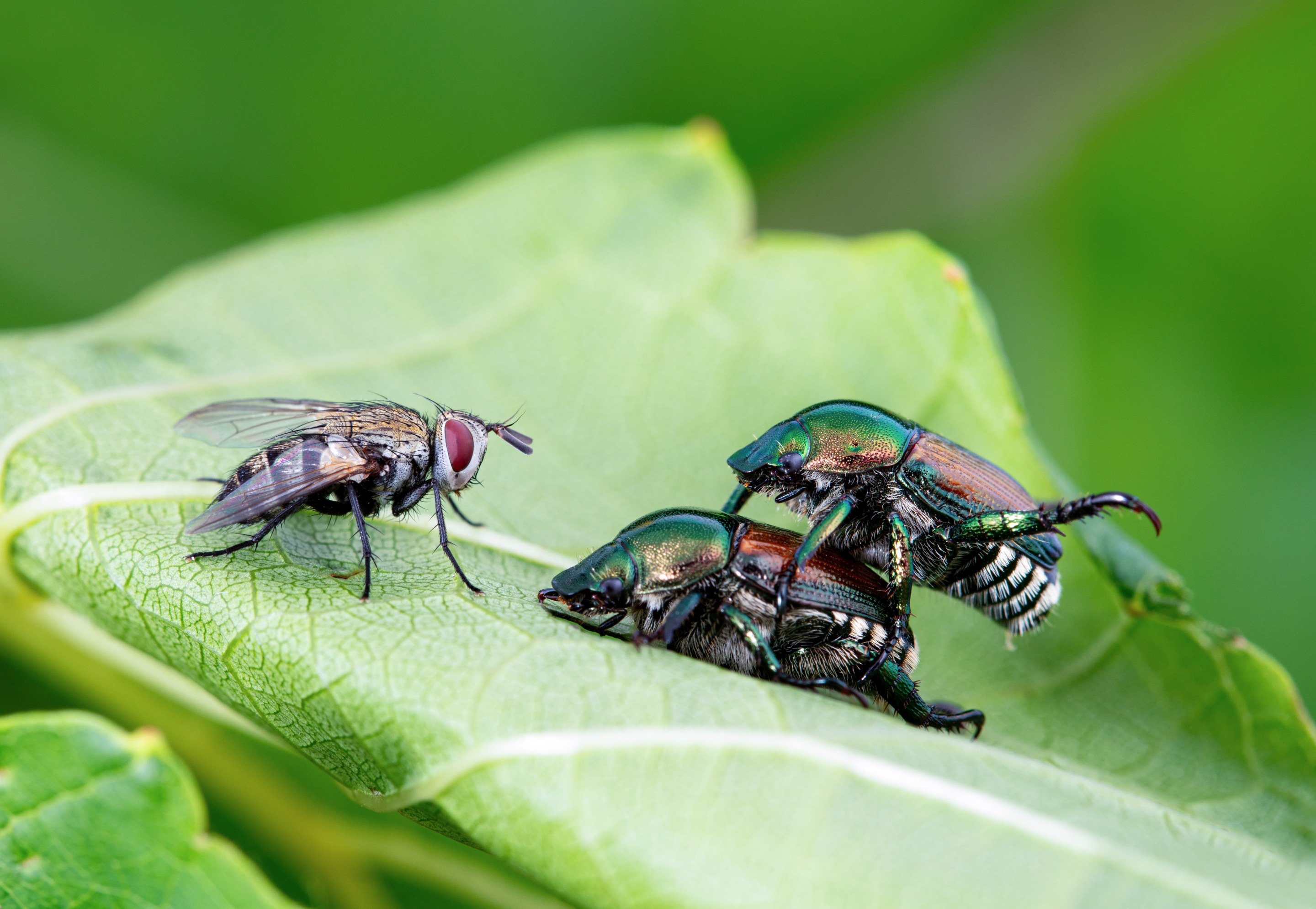
Fortunately for you, however, the winsome fly has no interest in you and your humble human existence. The winsome fly is a parasitoid, and it only has big red eyes for the Japanese beetle, Popillia japonica. The Japanese beetle is the winsome fly's only known host, which explains in part why the fly above is staring so intently at the beetles. But the winsome fly has a trick up its hairy little sleeve. It has learned that the easiest way to parasitize the poor beetle is when the bug is at its most vulnerable, meaning when she is doing it—a beetle caught in the throes of beetle passion, an insect in flagrante delicto—per a new paper recently published in Biology Letters.
Before we get to the Japanese beetle sex, however, let us get to know the beetle. P. japonica is a sprightly sort of scarab that established itself in North America at the turn of the 20th century. It is an excellent eater. It munches on turf, crops, grass, and gardens, chewing leaves into skeletal versions of themselves, branding it a pest. This is why the winsome fly was imported to North America in the 1920s as a potential biological control agent. Once parasitized, a Japanese beetle will die within five to 10 days.
In Quebec, the Japanese beetle has become a major pest in berry crops. Jacques Brodeur, an ecologist at the University of Montreal, was at the botanical garden when he spotted several brilliant beetles with the telltale white specks of winsome fly eggs on their backs. Brodeur immediately fell in love with the system, meaning the relationship between the flies and the beetles, he wrote in an email. Brodeur noticed that the flies most often laid their eggs on mating beetles. Researchers in the 1920s had made this observation before, and even fashioned a lovely illustration of the insects going from couple to throuple.
This is not a "we saw you from across the bar and like your style" situation. Japanese beetles, whether in Quebecois berry fields or your own backyard, have a hectic time mating even without a nearby fly leering at their lovemaking. Female beetles that have not mated will exude a pheromone that summons entranced males. But this pheromone unfortunately also attracts someone else. "The parasitoid has evolved the capacity to detect and respond to the odor," Brodeur said.
After a male beetle approaches a female, he mounts her, intromits (you can guess what this means), withdraws, and then remains resting on top of her for as long as two hours. If you'd like to visualize this even more, here's an illustration of a couple of Japanese beetles that were dropped in liquid nitrogen while in coitus. Though their story is tragic, it is also anatomically illuminating. The beetles do not mate just once, and these pheromones often draw dizzying crowds of up to thousands of Japanese beetles in a scuttling, heaving horde.
A single Japanese beetle can raise its hind legs or drop from a leaf to escape a voyeuristic fly. But copulation, which generally lasts a little over two minutes, renders a female beetle quite vulnerable. "They are immobilized by males during copulation and mate guarding," Brodeur said. "They cannot raise their hind legs or drop to the ground, two efficient defensive mechanisms," he added. So the winsome flies are not manipulating the beetle's behavior, but they are exploiting it.
The researchers collected Japanese beetles in a Montreal park over the course of six years. They counted the beetles, noting their sex and size. They found that more than 80 percent of the parasitized beetles were female, and these females tended to be larger. Although neither the female fly nor the male beetle would admit it, mostly because they are bugs, they are aligned in one common desire: a big female beetle. Their reasons for seeking out a larger lady are obvious. Male Japanese beetles prefer bigger females because they have bigger eggs in greater numbers. So when the flies rely on the sexual preferences of male beetles to find a host, they end up with the best, most bodacious beetles. A big beetle benefits the fly's larvae, which get more room to stretch out their sack-like bodies, and more beetle-flesh on which to feast. (Winsome fly larvae will often pupate inside the beetle's corpse, but sometimes they pop out of the body to pupate on their own, effectively beheading the beetle.)
Although this is certainly bad news for the beetles, it is wonderful news for the flies and their allies, which include the people who want to reduce the Japanese beetles' numbers. Brodeur's focus on biological control agents comes from his concerns about the overuse of pesticides in agriculture and urban environments, which can kill much more indiscriminately than a fly with a laser focus. He said he would never have expected the male beetles and the flies to develop such a shared interest. "I should have learned that parasites will continuously surprise me," he said. You know what they say, at least for the beetles: Two's company, three's a shroud.