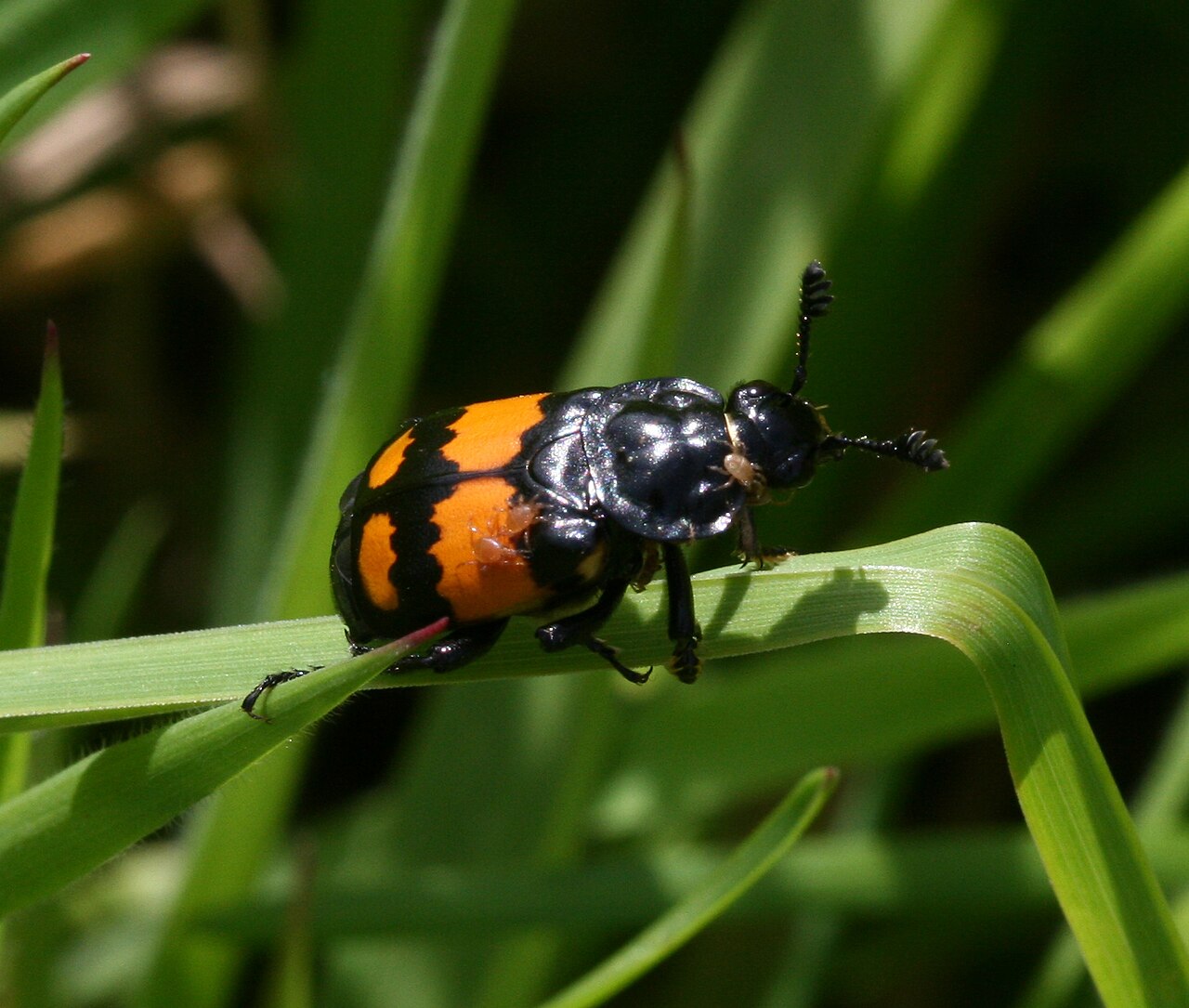
The burying beetle Nicrophorus vespilloides is famously good at parenting. In the leaf litter of forests around the United Kingdom, the beetles scurry around in search of the small carcasses of mice and birds. Once the beetles find a suitable corpse, they get to work. First they strip the carcass of its fur or feathers and disembowel it. Then they smear it with brownish-red antimicrobial fluid. Finally, they roll the flesh into a ball and bury it in the sand. Once under the soil, the corpse is ready to become a nursery for the beetle's offspring—a putrefying rat refurbished into an artisanal crib. (Here is a photo of one such crib, if your curiosity is piqued.)
A nursery needs babies, and so the beetles must also get to a different kind of work. By this I mean the beetles must mount each other. If you are having trouble imagining this, please enjoy the art below.
A male burying beetle uses two tactics to find a suitable mate. He can either search for a carcass, guard it from any intruders, and send out pheromones to attract a female. Or he can take an arguably lazier route and send out pheromones with no carcass at the ready, hoping that whichever female flies over will eventually find a carcass on her own. Which tactic he takes appears to be partly dependent on the time of day, according to a 2008 paper. Daytime is a lovely time to search for carcasses. But as the sun sets, a male might be better off calling empty-handed. Smaller males also seem to be more likely to call without a carcass.
Burying beetle communication depends in part on molecules called cuticular hydrocarbons, which coat their exoskeletons like wax on a surfboard. They hydrocarbons help to waterproof insects and prevent them from drying out in hot habitats. But they also play a crucial role in signaling during chemical communication. Evidence suggests that these two functions may be at odds with each other; investing more in one function appears to decrease the effectiveness of the other. A group of researchers including Solène Morelle, a PhD student at the University of St Andrews, wanted to investigate how climate change affects these trade-offs.
Although a warmer, drier world will push many species to their physiological limits, climate change will have a heightened effect on cold-blooded animals that cannot regulate their temperature on their own. Left in a hot, dry habitat, the beetles would likely depend more on their cuticular hydrocarbons to prevent dehydration, making their chemical communication around carcasses less effective.
Morelle and her colleagues suspected heat might alter the way the beetles approached reproduction, because cuticular hydrocarbons help beetles discern the sex of their partners. Specifically, she suspected the heat might confuse the beetles and make them more likely to mount others of the same sex. So they designed an experiment in which they placed some beetles under controlled conditions, around 68 degrees Fahrenheit, and other beetles under a simulated three-day heatwave, around 79 degrees Fahrenheit. Then Morelle observed how long and whom each beetle mounted before extracting the cuticular hydrocarbons from their exoskeletons and analyzing them in the lab. The team recently presented this research at the Society for Experimental Biology conference in Florence, Italy.
As you might have guessed from the headline, Morelle's hypothesis was correct. Hot male beetles did mount other males far more frequently than under normal conditions. But another result of the experiment caught Morelle off guard. "I was surprised to find out how much same-sex mounting the beetles showed even under normal conditions," she said. In other words, male beetles were already quite into mounting other males. Same-sex sexual behavior appears to be somewhat of a norm for the beetles.
What does this mean? Although it might be tempting to call the burying beetles gay, and you certainly could in a colloquial sense, it's unclear why the male beetles are mounting each other so often. From one view, a heat-stressed male mounting another male might be considered a "sex recognition error," a mistake that wastes a burying beetle's time and energy assuming no beetle offspring will not result from such a union. But it's clear that the beetles do this even when the weather is fair and times are good, suggesting that not much is lost by a male mounting another male. As is the case with any non-human animal, the beetle's precise reasoning and desires are unknowable to us. Maybe they just wanted to have a good time—whatever that means to a beetle.