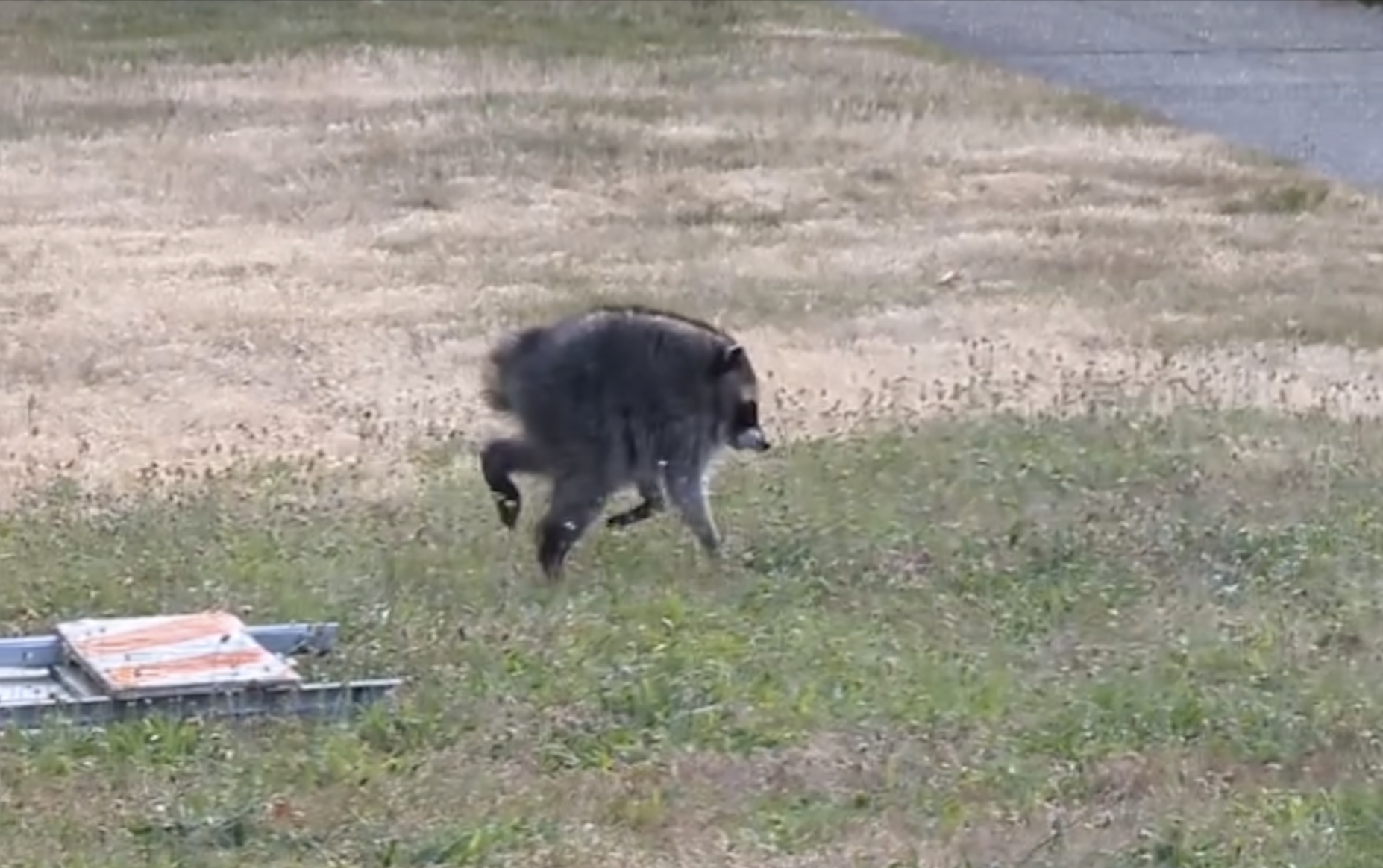
Jimothy crept into our lives like any good cryptid—as a blurry, scuttling thing. Kiana Hall, the Seattle local whose firsthand footage resulted in Jimothy's newfound fame, first thought she had spotted a cat running under a car. But upon closer inspection, the creature was no feline. "I was seeing some kind of gray, fluffy creature that was shaped sort of like an orb with really long legs," Hall said in an interview with Reuters. Hall's vertical video captures the creature, which she christened Jimothy, scampering enigmatically across a desiccated lawn. Although the animal's coat and black mask identifies them clearly as a raccoon, Jimothy is undeniably orb-shaped, as if a planet suddenly sprouted a cluster of legs so that it might prance about to unsettle and delight Seattleites lucky enough to glimpse them. The raccoon has since become unofficially canonized as a local saint, inspiring various effigies in the media of mural, mathematics, medieval marginalia, and even a Mariners in-game cameo.
Although Jimothy's adoring fans use he/him for the raccoon, Jimothy's sex is unknown. "If a video emerges where Jimothy is standing on his (or her!) hind legs and facing forward, then we might be able to determine Jimothy's sex," Lauren Stanton, a cognitive ecologist at the University of California, Berkeley, wrote in an email. So until we are fortunate to be flashed by Jimothy, we're all just guessing.
The reason behind Jimothy's distinct shape, however, is more decipherable. When Kent Morton, a veterinarian at Compassionate Care Animal Hospital in Michigan who co-hosts the podcast Vet Med For Idiots By Idiots, first saw images of Jimothy, he felt he could diagnose the raccoon. Jimothy appears to have a congenital issue called short spine syndrome. "The soft tissues in the spine will fuse the vertebrae, and that's what gives them the short neck appearance," Morton said. "It's a very distinctive condition."
Short spine syndrome is caused by a recessive gene, meaning an animal needs to inherit a copy of the mutated gene from each parent. The rare condition is most commonly seen in dogs. It may even have been documented as early as the 1600s in two paintings by David Klöcker Ehrenstrahl, a Swedish court painter famous for his portraits of various nobility and also two Japanese dogs with recognizably short spines. In 2016, the German shepherd Quasi was reported to be one of just 13 dogs in the world with short spine syndrome. The most famous of them all is Tilly, the 7-year-old Tibetan spaniel, who resembles a sprouted potato.
Although short spine syndrome has made Jimothy a star, it also makes their life harder. Living with no neck means Jimothy can't easily turn their head. "A lot of dogs, when they have this condition, when you call them they turn their whole body," Morton said. When I asked Morton if Jimothy's truncated torso meant their organs were smaller or more squished together, he said he didn't know. He does know that short spine syndrome can also cause pain and pinched nerves. "They tend to get early-onset arthritis due to inconsistent wear on those joints," he added. But Jimothy appears spry and unbothered, bounding through Seattle's Ballard neighborhood with a blithe spirit.
After Jimothy's star ascended, Ballard resident Ben Trammell posted footage he'd recorded more than a year ago of the raccoon as a baby, footage so cute that members of the Defector staff initially dismissed it as AI. As Trammell wrote in an Instagram post, Jimothy was born into a loving raccoon family that lives in his neighbor's cedar trees. "He was so small and clumsy but his mother and siblings were always so patient and caring, keeping him from falling and sometimes just carrying him," Trammell wrote. "I honestly never had high hopes for his longevity," he wrote, adding that he widened holes in the fence to allow Jimothy to pass through more easily. When Trammell's neighbors moved out, the landlord cut down the cedars, effectively evicting Jimothy's family and vanishing the raccoons. When Jimothy resurfaced, older and wiser, Trammell was relieved to hear the raccoon was alive and seemingly thriving.
Although Stanton has never knowingly encountered a raccoon with a congenital disorder in her research, she sees a lot of raccoons suffering from diseases like mange or distemper, as well as raccoons disabled by injury. "For instance, I have seen many raccoons either missing, or blind in, one eye," she said. But wild animals often overcome bodily challenges in remarkable ways. "I have seen urban animals survive for years with a limp, or that have figured out how to walk on their 'wrists' instead of their feet due to a foot injury," Stanton said.
Although cities have fewer large predators than forests, Jimothy still faces the threat of coyotes or domestic dogs. But any raccoon's greatest nemesis is probably vehicular. "Raccoons are frequently hit by cars, and this is something that Jimothy certainly has to contend with in Seattle," Stanton said. The neckless raccoon cannot easily turn their head to look before crossing the road. "But he might rely on different senses to detect traffic, or has developed alternative movements," Stanton said. When she checked with colleagues studying raccoon carcasses in the Bay Area, those researchers said the raccoons they encounter as roadkill appear healthy and free of obvious disability. "So we have no evidence to suggest that disorders such as Jimothy's lead to greater odds of being hit by cars, but we do have evidence of disabilities leading to behavioral innovations, which might aid him living in Seattle," Stanton said.
Some of the more sensationalist coverage of Jimothy suggests the raccoon is "doomed to live a short life," per a New York Post story that calls the creature "deformed," "freaky," and "a cross between an alien-baboon and a cat." But Jimothy appears alert, agile, and healthy. "I suspect he is doing a great job so far," Stanton said. "All things considered, he's moving really well for a guy who shouldn't really be able to make it," Morton said. If you are lucky enough to glimpse Jimothy in the wild, the kindest thing to do is to leave them be. The raccoon is doing fine without our intervention and does not need to learn of their immense celebrity; Jimothy's body is already too small for their head.