

In the spring of 2004, researchers monitoring a population of wild bearded capuchins in a Brazilian woodland saw an infant clinging to Chiquinha, one of the adult female monkeys. The baby was not a capuchin but a marmoset—a much smaller monkey species. The researchers dubbed the infant Fortunata. Chiquinha became Fortunata's primary caretaker until the following summer, when she fell pregnant and another capuchin female, Dendê, began mothering the marmoset. Fortunata behaved like any other capuchin in the group and was raised with the same level of care as a capuchin infant. Fortunata traveled and foraged with the monkeys, responded to their alarm calls, and even helped the group mob a snake. When the young capuchins played with the much smaller marmoset, they adjusted their strength to ensure they wouldn't hurt the smaller monkey. Fortunata eventually vanished the following spring, when the marmoset was almost an adult.
The researchers who observed Fortunata described the marmoset's childhood as a kind of adoption in a 2006 paper in the American Journal of Primatology. The marmoset, after all, was taken in as an infant and raised by two different mothers. Although monkey adoption is common in captivity, it most often occurs between monkeys of the same species, and occasionally within the same genus. Fortunata the marmoset was clearly a very different kind of monkey, unable to leap from tree to tree or crack nuts like the others. And yet not one, but two capuchins cared for Fortunata as if it were their own child.
For a long time, humans have considered ourselves unique in our penchant for forming close social relationships with animals of other species. (I say social relationships to exclude other longterm relationship models, such as the parasitic partnership that can exist between a whale and her tapeworm.) But a new review paper published in the journal Primates suggests that human pet-keeping has deeper evolutionary roots among primates.
Cyril Grueter, an evolutionary anthropologist at the University of Oxford and an author on the new paper, became interested in these interactions after a visit to the Shanghai Zoo, where he saw "a northern white-cheeked gibbon ... gently holding and stroking a mouse that had wandered into its enclosure," he wrote in an email
Later, doing fieldwork in southwest China, Grueter saw juvenile wild black-and-white snub-nosed monkeys repeatedly attempt to climb on the backs of domestic pigs. "Neither interaction fit neatly into the kinds of ecological explanations we usually think about, such as feeding or predator avoidance," Grueter said. When he looked for similar reports in the literature, Grueter expected to find a few dozen interesting examples. Instead, he and his colleagues found 427 cases involving 88 primate species and 127 other animal species. "The biggest surprise was simply the scale of it," he said.
The researchers found these examples both in scientific literature and on platforms like YouTube, where they searched for "unusual animal friends" and "animal odd couples." They then divided these interactions into categories of behavior, such as grooming, carrying, playing, mounting, sharing food, or treating abusively. Some patterns were obvious and consistent. "Juveniles were much more likely to play, adult females were more likely to groom, and primates themselves initiated most interactions," Grueter said. The vast majority of interactions categorized as abuse, such as abduction or physical maltreatment, were directed at non-primate species, such as rodents, swine, pangolins, hyraxes, and non-mammals such as birds, amphibians, and insects.
"Most cross-species interactions are brief, perhaps a few minutes of grooming or play," Grueter said. But some cases, such as that of Fortunata, stood out for their particular closeness. Relationships that persisted over weeks or months and that included social tolerance or even integration into a social group offered much stronger parallels to long-term companion relationships between humans and animals, Grueter said. "I don't think they show that nonhuman primates 'keep pets' in the human sense," he added. "Rather, they suggest that some of the behavioral capacities that make pet-keeping possible (curiosity, tolerance, caregiving and maintaining long-term relationships with another species) did not suddenly appear in humans but have deeper evolutionary roots."
As I read many of the papers cited in the review, I noticed researchers framed each case differently. Although Fortunata's situation was described as an adoption, a 2025 paper describing white-faced capuchin monkeys carrying infant howler monkeys as an abduction. What was the difference between adoption and abduction? The boundaries are fuzzy, Grueter explained. "Intent is probably impossible to determine with certainty, so we rely on behavioral evidence rather than assuming motives," he said. An adoption typically refers to an older individual offering prolonged care to an infant or juvenile. By contrast, the abduction described in the 2025 paper involved young capuchin monkeys removing infant howler monkeys from their mothers and neglecting the infants, which all ultimately died.
Some reports were harder to classify. Grueter pointed to a paper from 1970 that described three female black-handed spider monkeys taking turns carrying a mantled howler monkey infant. It was unclear if the spider monkeys had stolen the infant, but their fascination was clear, and each female tried to pull the howler monkey away from the others by its limbs. One spider monkey sat on the infant for around half an hour while it cried. Eventually, the infant was left on the ground and died soon after. Although the spider monkeys handled the infant roughly, they did not do so with clear aggression. Instead, the interaction could represent play or a clumsy attempt at caregiving. In a similar anecdote, a male Hamadryas baboon in Saudi Arabia kidnapped a domestic puppy and carried it around for extended periods of time. As such, Grueter does not see adoption, abduction, or other framings as completely separate categories, but rather as relationships that exist along a continuum from care to harm. And even encounters that result in harm might stem from an intent to socialize or offer care.
Where, then, does pet-keeping fall on this spectrum? "Proto-pet keeping goes a step further," Grueter said. "It involves maintaining a long-term affiliative relationship with another species that isn't simply explained by parental care or immediate survival benefits." The longer and more socially integrated the interaction, the closer the relationship comes to the kind we keep with our pets. One example in the new paper that suggests proto pet-keeping include a captive crested macaque that adopted a chicken that wandered into its enclosure, grooming, cradling, and playing with the young bird.
The review suggests that behavior analogous to pet-keeping might be more likely to emerge among primates in captivity or living alongside humans. The most famous primate "pet" is All Ball, a tailless gray kitten that belonged to one of the most famous primates, Koko the gorilla. Koko cradled, groomed, and protected All Ball the way a mother might treat an infant. (All Ball died after being hit by a car.) Captive animals often have less access to animals of their own species and therefore might be more inclined to socialize with other species. Evidence suggests that solitary or socially marginalized individuals are more likely to interact with other species; a 1981 paper found that solitary male red-tailed monkeys are groomed quite frequently by ashy red colobus monkeys. And ready access to food frees up time that would otherwise be spent hunting or foraging, allowing animals more chances to explore and play.
The new paper, the authors caution, is not meant to assess the evolutionary significance of such relationships, but rather to offer a framework for future research. Although Grueter has many follow-up questions, he is most interested to learn why some species or individuals seek out these encounters while others do not. He hopes to better understand the influence of individual animal personality, ecological opportunity, and social learning on these relationships. And he is curious to learn whether these cross-species interactions will become more common as the wilderness continues to vanish and wildlife comes closer to our domestic animals.
Of all the reports reviewed for the paper, Grueter's favorites included Japanese macaques grooming and riding on the backs of sika deer—"a remarkable example of two very different species repeatedly interacting peacefully over long periods," he said. (Some of these mountings do appear to be sexual in nature.)
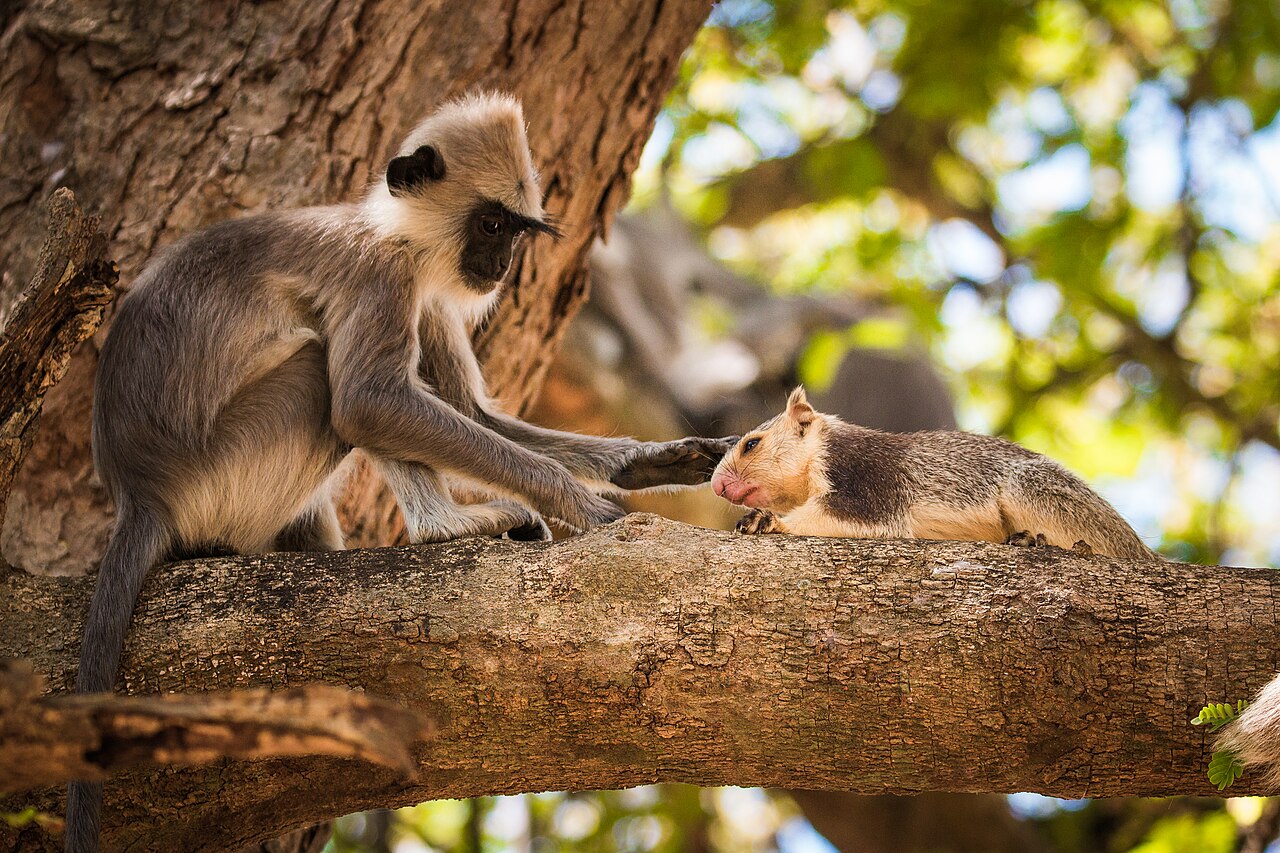
But he was fascinated by many of the rarer observations: "a langur gently stroking a squirrel, a silverback gorilla carefully cradling a tiny wild bushbaby, a bonobo gently holding a mongoose pup, and macaques grooming stray dogs." These reports might simply seem quirky fodder for internet virality. But after seeing dozens of similar reports from around the world, Grueter says, a clear pattern emerges. "They suggest that primates possess a greater capacity for curiosity, tolerance and affiliative behavior toward other species than we previously appreciated," he said.