
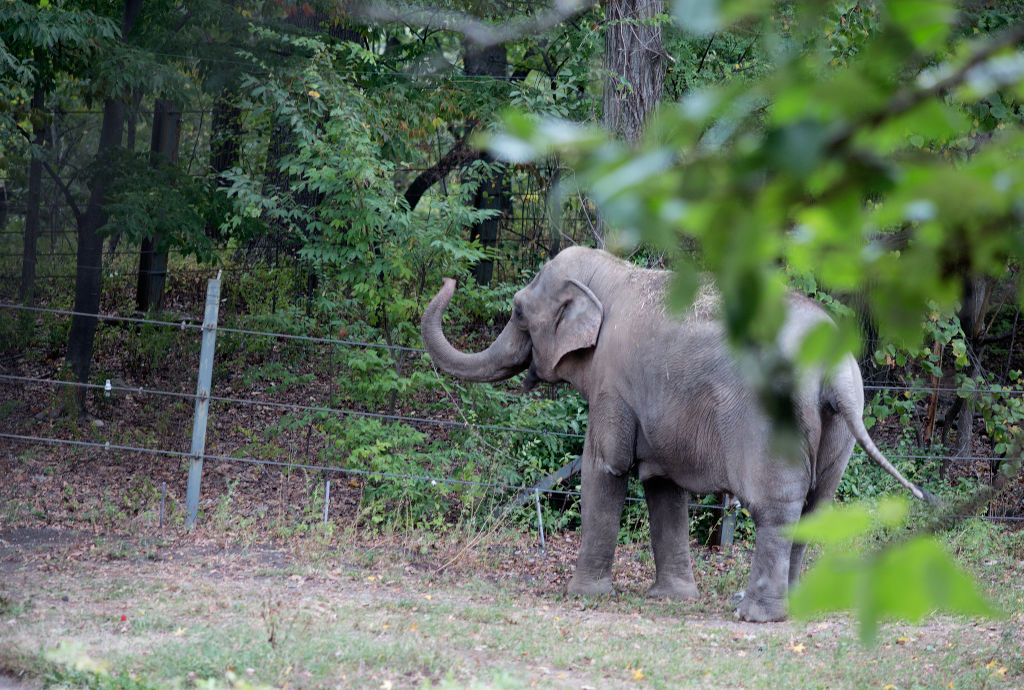
There was always an irony to Happy's name. The elephant's misfortune stamped her a celebrity. In their home in the wild, female Asian elephants roam for hundreds of miles and form lifelong attachments to a group of around seven relatives. In her home in the Bronx Zoo, Happy lived alone in a small exhibit. She had been separated for decades from the zoo's other two Asian elephants, Maxine and Patty, for her own protection. So Happy became famous for her loneliness, deprived of companionship, of family, of physical touch. But Happy was smart, too. She stored treats in her ear. She was the first elephant to pass the mirror self-recognition test, proving her self-awareness when she saw her reflection and poked with her trunk at a white X painted on her forehead. In 2018, the Nonhuman Rights Project, an animal rights nonprofit, sued the Bronx Zoo to move Happy to a sanctuary, arguing that the elephant, in part because of her intelligence, should legally be considered a person. The suit was unsuccessful, and so Happy stayed put in her enclosure until her health deteriorated earlier this year. She was euthanized on May 26 at the age of 55.
Patty, now the last elephant at the Bronx Zoo, lived much of her life in Happy's shadow. While clever Happy passed the mirror test, slow Patty did not. Patty has never been the subject of a lawsuit arguing for her personhood. Patty posed a different kind of problem for the zoo. In the summer of 2002, Patty and Maxine fatally attacked Happy's companion of 25 years, Grumpy, forcing the zoo to separate the elephants and making it harder for the public to root for Patty. When Happy died in May, the Wildlife Conservation Society, or WCS, which runs the Bronx Zoo, issued a press release referring to her as "Happy, a Much-Loved Asian Elephant." On July 7, the WCS issued another press release about "Patty, an Asian Elephant." Patty, it seems, is not so loved.
Now Patty, 57, has once again become a problem for the Bronx Zoo. Captive and wild elephants have been known to live into their 70s, and Patty has no known physical health issues. With Happy's death, Patty has become the loneliest elephant. As such, the WCS is evaluating what should happen to her next—if she will be sent to a sanctuary to join other elephants in a better simulacrum of wilderness, or if she will live out her years at the only home she has known for half a century, alone.
The Association of Zoos and Aquariums, which sets zoo welfare standards, requires at least three female elephants or two males be kept together with enough space to roam. After Grumpy died, the zoo paired Happy with a younger female named Sammy, whose companion had also died. But Sammy fell sick and was euthanized in 2006. Shortly after, the Bronx Zoo announced it would phase out its elephant exhibit, promising it would acquire no more new elephants. With this statement, the Bronx Zoo joined zoos in San Francisco, Santa Barbara, Detroit, and Chicago that had already closed or planned to close their elephants exhibits. This pattern has only continued in recent years, with the Oakland Zoo retiring their last African elephant in 2024 to the Elephant Sanctuary in Tennessee.
It is obvious why so many zoos are getting out of the elephant game. The pachyderms are extraordinarily large, intelligent, and social. It is hard to imagine a zoo that could acquire and support enough elephants to recreate their matrilineal societies in the wild, groups of mothers, aunts, adolescents, and babies. It is hard to imagine a zoo that could also support bachelor herds of males that wander in isolation from females. It is hard to imagine an enclosure that would allow elephants to walk the 50 miles they can traverse in a single day. Elephants in captivity get arthritis and joint problems from standing on hard surfaces. They exhibit neurotic behaviors like swaying and head-bobbing, both of which were observed in Happy, Patty, and Maxine. They try to escape and hurt or kill their keepers. As Emma Marris wrote for The New York Times, they become desperately lonely and tend to die young,
In recent years, zoos have taken measures to improve the lives of their elephants. They have replaced concrete floors with rubber and loam to alleviate the animals' foot problems. Some have expanded their enclosures to keep more elephants, giving the animals more chances to socialize as they would in the wild. Most zoos take their elephants on daily miles-long walks around the park before gates open, practices that help prevent foot infections that can kill them. Keepers hide treats around the yard for the elephants to find. Still, it is impossible to know how much material happiness or enrichment these practices offer to the elephants. It's almost as impossible to imagine that an elephant, in their unknowable but considerable wisdom, would, if given the choice, elect to remain in a zoo.
The Bronx Zoo is currently considering every option for Patty. One is relocation, and a team from the zoo recently visited the AZA-accredited Elephant Sanctuary in Tennessee to evaluate if Patty would thrive there. "We want to make sure that we feel that it would be the right move for her, and the risks would be outweighed by the potential gains," Bronx Zoo Interim Director Craig Piper told Gothamist. The benefits of the sanctuary are obvious. If relocated, Patty would roam across 3,000 acres with 12 other elephants. The sanctuary is closed to the public. The only way to see the elephants is by watching one of their three livestreams. When I clicked between the cameras, I could see only one elephant, a grainy gray speck in a distant and lush field of grass. This felt like an appropriate level of distance between me and an elephant.
But there are risks to such a transfer, the zoo officials say. Preparations would take at least a year. Patty has already surpassed the median life expectancy of a captive elephant in North America by 12 years. Per the WCS statement, "moving a 57-year-old elephant isn't simply transportation; it's a major medical and behavioral decision with real risks and no guaranteed outcome." Even if relocation were successful, there is no guarantee Patty would get along with the other elephants at the sanctuary. "Patty has historically bonded well with some elephants but not with others," the WCS said, quite euphemistically.
Patty, who was captured from her herd in India when she was 3 years old and purchased for $6,000, has lived at the Bronx Zoo basically her whole life. What memory does she have of the wild? What memories does she have of living in a herd? Elephant calves can nurse for longer than five years, often only stopping when a mother has another calf. So we know that Patty was unable to wean fully from her mother, to get to know her sisters, aunts, and cousins that lived in her herd.
This is what else we know of Patty's life: She was a part of the zoo's captive breeding program, and in 1981 she gave birth to a calf, Astor, the first Asian elephant born in New York. He weighed 180 pounds and started walking in just 25 minutes. Astor became a star attraction in his own right, charming children as he romped around his Wild Asia exhibit, his big ears flopping wildly. For his first birthday, Astor ate a cake made of bread, carrots, apples, and flowers. Astor died before he turned two, of endotheliotropic herpesvirus, a leading cause of death of young elephants.
Patty's closest companion at the zoo was Maxine, who came to the zoo with Patty in 1973. In a 2006 interview, Joseph Mahoney, the zoo's supervisor of mammals, told the Times that Patty was a planner, and Maxine was a doer. "Patty will lead Maxine to a log, and Maxine will push it around," he said. In 2002, Patty and Maxine fatally attacked Grumpy. In 2018, Maxine died, leaving Patty and Happy separated by a fence, through which the two elephants could see each other, smell each other, and touch trunks. Now, Patty's closest connections are her keepers, some of whom have cared for her for decades, and her veterinarians, who provide her with 24-hour care. If Patty goes to a sanctuary, she will lose these relationships.
The way I see it, there is no obvious solution to this dilemma, or at least not one that I am qualified to proclaim. There are risks to her staying at the zoo: the profound loneliness of such unnatural isolation, the excruciating boredom of wandering the same two acres. And there are risks to her going to the enclosure: the loss of her longest relationships, health risks, potential social alienation. No matter which route the zoo takes, Patty will spend the rest of her years deprived of something core to what it means to be an elephant. But she is no stranger to deprivation, having lost one of the fundamental privileges of life—her autonomy—long ago.
Patty's plight is not dissimilar to that of Tokitae, or Lolita, the last orca at the Miami Seaquarium. As Marris smartly identified, elephants are "the orcas of the zoo"—a creature too titanic, emotionally complex, and socially rich to keep in captivity, or at least in the ways we are keeping them now. Tokitae was one of six calves separated from their mothers and captured off the coast of Whidbey Island in Washington. She was sold for $20,000 to the Miami Seaquarium, and she would spend more than a half century there, performing for crowds in the smallest orca enclosure in North America, just 80 feet long and 35 feet wide. She was not alone initially; she was kept with another captured orca, Hugo, who eventually died at 15 years old after ramming his head repeatedly against the side of the tank. The conditions of Tokitae's life were abject. She was scarred from the sides of her concrete pool and the teeth of the dolphins kept alongside her. With no shade over her pool, she was always sunburnt. She played with an old wetsuit, which some suggested reminded her of kelp. At night, when everyone went home, Tokitae would call out for her family.
Activists fought for decades to free Tokitae to the Salish Sea, where her family still swims and hunts salmon, the most critically endangered population of orcas in the world. In 2022, the Seaquarium was sold, and Tokitae's release seemed suddenly possible, aided by activism of the Lummi Nation and the pockets of Jim Irsay, the billionaire owner of the Indianapolis Colts, who'd seen Tokitae perform as a child. The plan became to transport the whale across the country to a netted sea sanctuary in the Salish Sea where she could be cared for by veterinarians, a life for which Irsay would pay at least $20 million a month—money that arguably could make a world of difference for her endangered, wild relatives. Tokitae's keepers expressed many of the same concerns that Patty's keepers share now—that the stress of the move could kill her, especially at her advanced age. But Tokitae died before she ever left the Seaquarium. Only her body was returned, her ashes scattered over the Salish Sea.
There is no way to make right the anguish we cause some of the animals we hold captive. What we have taken from them we can never give back, not even with the budget of an NFL owner. As zoos continue to phase out breeding programs of animals like elephants and orcas, there will be more Pattys and Tokitaes, animals who came from somewhere and now belong nowhere. They are unable to live on their own in the wild or even live with assistance in a sliver of it. Their existence rests entirely in our care, and even the extraordinary measures the richest or most powerful of us are moved to take are not guaranteed to improve their lives, let alone offer any of us absolution. The only thing we can be sure of is that whether Patty the Asian elephant stays in a New York zoo or relocates to a Tennessee sanctuary, she will die having known an immeasurable and unspeakable loneliness, and in this way, her death might offer us all some relief.