

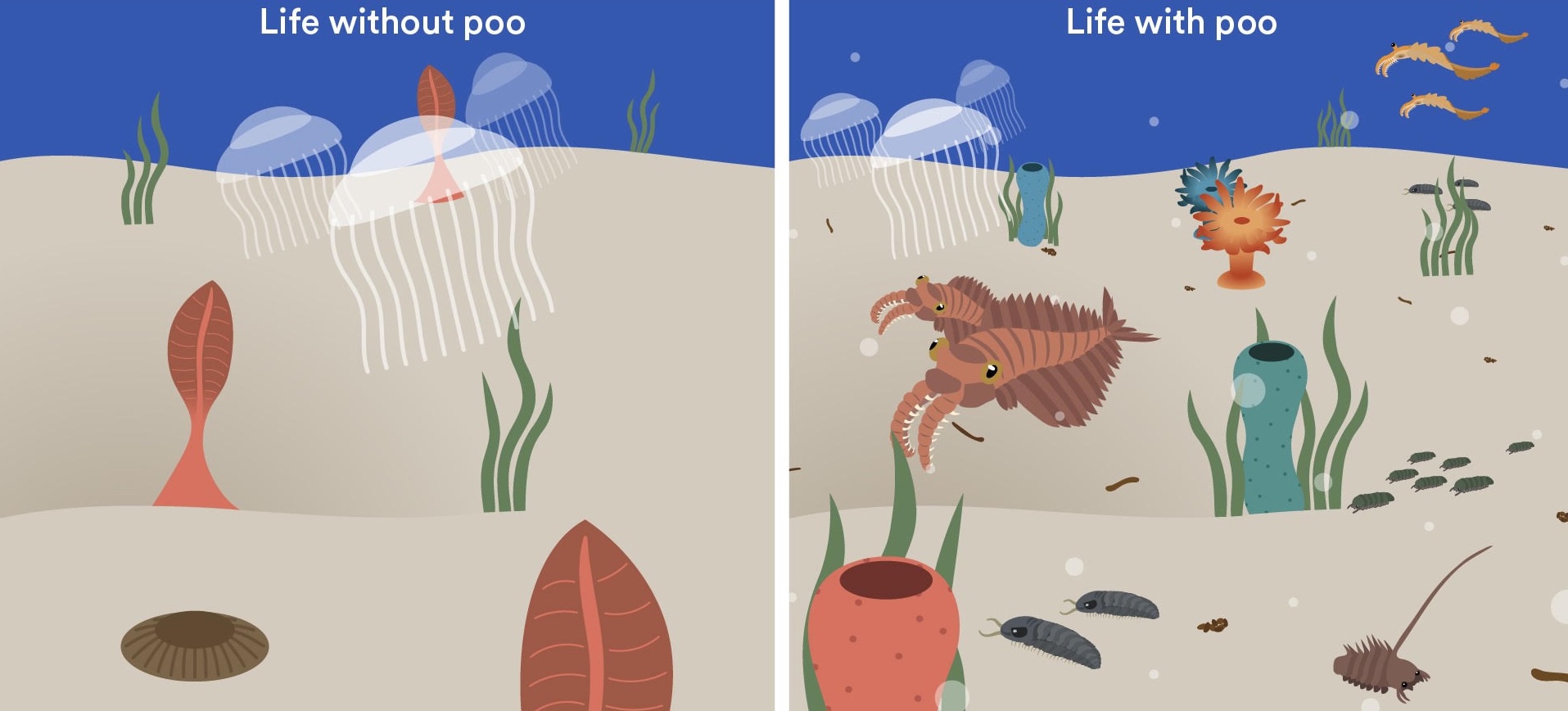
Julien Kimmig's career began with a surprising abundance of feces. As a PhD student working at a Cambrian site in northern Canada, Kimmig realized that roughly half the fossils in that outcrop were coprolites, or fossilized poops. Kimmig, now the head of the paleontology and evolution division at the Natural History Museum in Karlsruhe, Germany, wondered what explained the deluge of dung.
In 2020, Russell Bicknell, an evolutionary biologist and paleobiologist at Flinders University in Adelaide, approached Kimmig with some Cambrian coprolites from southern Australia that no other scientists had particularly cared to study. Prehistoric poops in hand, Kimmig and Bicknell began compiling a database of the earliest evidence of turds on Earth. The project occasionally stalled, but the researchers eventually picked up on a pattern. In the early Cambrian period, around 538 million years ago, all droppings were microscopic. By the middle Cambrian, scat was finally visible to the naked eye, and it came in a cornucopia of forms: spheres, ellipses, pellets, cylinders, and the intriguingly named "exploded fecal carpets." The researchers realized this coincided with the development of animal guts. The fancier the gut, the fancier (and bigger) the poop. After tossing ideas around, they hit on a thesis: What if the presence of poop enabled early animals to expand into deeper waters, accelerating the evolution of life on Earth?
Kimmig and Bicknell's paper on what they dub the "Cambrian fecal revolution" was recently published in Trends in Ecology & Evolution. They make the case that as animals got bigger, their poops exploded in possibility, getting larger and more complicated. This positive feedback loop paved the way for species to expand into new territory, diversify, and define modern ecosystems. So stop whatever you're doing, especially if you're eating, and enjoy this conversation with Kimmig where we try to get to the bottom of the shit underlying the world as we know it. This interview, conducted this past Wednesday, has been lightly edited for clarity.
Before organisms had guts, do we know how they were expelling their waste? And were we not considering that waste feces?
Not really. A bowel movement is by definition a gut product. If we're looking at very primitive animals like jellyfish or sponges, they don't have digestive systems. But they still incorporate nutrients and have garbage products that are expelled. If we want to call it feces in this case, it's likely not, because fecal matter, by definition, comes out of a gut. But it is definitely a garbage product from nutrition. That is what makes the big difference. Once something gets through a digestive tract, we extract certain nutrients. But it's still nutrient-rich to a certain degree, and might actually be enriched with other nutrients through slime microbiota that we have in the gut system. That is then easier to consume for other organisms. Whereas if we are a sponge, we extract nutrients, don't add anything to it really, and just have whatever is left go back into the water column at that point.
Could the compaction or aggregation involved in feces also be more advantageous than whatever diffuse garbage is coming out of a sponge?
It is very likely, even though we don't have physical evidence, that early animals—even the earlier animals with the earliest guts—likely produced this diffusion kind of feces, similar to what parrotfish actually do nowadays. They have a big cloud coming out at the back. When you have that, the fecal matter will stay likely in the upper water levels, which is good for that. You actually have nutrients in the upper levels, and animals will be happy there. But it's very unlikely that it will actually get recycled into deeper waters. With aggregation, we actually get weight to the whole fecal matter. And also we get them bigger, which makes it more interesting for other organisms that are slightly bigger to eat those.
In the concluding remarks of the paper, you and Russell write: "The origin of fecal matter remains one of the most fundamental yet elusive questions in the evolution of animal life." Can you tell me more about why this is an elusive question?
What was an evolutionary advantage for these animals to actually produce fecal matter? Might it have been that if you actually produce fecal matter and it drops down, you have less of a mark behind you, and predators are less likely to find you? It is unlikely that something evolved because it was better for someone else. That is a byproduct, but it's not the reason that it has evolved. Usually, it's something that keeps you alive that evolves. So it's very interesting to see that somehow guts evolved. That is extra energy that you use in the digestion, but it must have had an advantage in some way.
Do you think any of the lack of scientific attention on this issue is because it's about feces?
It's 100 percent the case. Fecal matter is disgusting, and in scientific view often not "high-impact." If someone finds coprolites, in 90 percent of the cases, I would say they never get reported. They they might not even make it to a museum collection somewhere. They might just be left in the field because they are of so little interest for most people.
Could you take me through the timeline of the feces and the coprolites that you examined, starting with the first early guts?
We have the first animals about 600 million years ago. It takes us to about 550 million years until we have the first guts. Those are actually not identified as visible guts, but were identified through geochemical analysis. We have Kimberella, which is now considered ... one of the earliest animals on the mollusk branch, and then a worm-like animal, which we can't really place on any on the modern stems. It takes us a few more million years, and we have Cloudina, which is a worm, possibly a [penis] worm. This is the first time we actually see a gut in the fossil record, and a fairly "advanced one" because it actually goes through the whole animal. So there we have a first through-gut, but it's still a straight gut—comes through the mouth, goes out through the anus.
Around 5 million years later, we find the first coprolites. Those are very tiny, microscopic coprolites. They were actually made out of little sheets of fecal matter and formed a tiny little ball. Those were discovered in China and described last year. Those are directly after the Cambrian starts, so likely can be attributed to something that had a through-gut similar to Cloudinia.
Fast forward 15 million years approximately, and ... guts become more complicated. Instead of just having a gut that is a straight line, the guts actually start to fold up, which prolongs the digestion and helps form more complicated fecal matter. At the same time we find more complicated fecal matter. They look like tiny little pellets. That is basically the second advancement: more complicated guts, more easily distinguishable fecal matter.
Fast forward another about 10 million years, and we find some of the most important deposits in the Cambrian, and those are Chenjiang in China and Sirius Passet in Greenland, as well as Emu Bay in Australia. There we find a lot of animals with very advanced guts, especially arthropod specimens that have different glands that work around the guts. We find also the first macroscopic coprolites, and those are actually several centimeters in size. From there on, we have reached the diversity in coprolites in the Cambrian. The only difference is that we're still in relatively shallow waters. The further down the Cambrian we get, the deeper in the water we find these kinds of coprolites.
Does that also encompass the diversity of fecal forms that are mentioned in the paper?
By this time 520 million years ago, we start finding all these kinds of shapes. We find elongated ones. We find ellipsoid ones. We find round ones. We find them scattered on the sea floor. When they're not as compact, they land on the sea floor and start getting spread out a little bit.
Is that the exploded fecal carpet?
Exactly, yeah.
Did you come up with that term?
It is actually a term that happens a couple of times in the literature. It just means that the feces dissolved after it landed on the seafloor.
I apologize for this question, but is that analogous in any way to diarrhea? Like a looser stool?
Maybe not diarrhea, but definitely a looser fecal matter. When you have a lot of liquid in your body, you don't compact the fecal matter to as strong an aggregate as you would under normal circumstances. This is what makes finding the producers of these coprolites extremely complicated, because we know for modern feces that it doesn't only depend on the producer—it also depends on how you're feeling on that day.
Is it fair to say that the diversification of life on Earth also came with the diversification of feces?
Definitely. The more feces we have in the fossil record, the more diversity we have in the fossil record. You can't always say it's 100 percent the case. In this case, we can 99 percent say that fecal matter had something to do with it. It's not the only reason. We have other factors like oxygen, like primary production of algae and things like this that played a massively important role into diversifying life. But the fecal matter cannot be left out of this. Especially for our life in the substrate and in deeper water, it must have played a very important role.
Can you talk about why is feces such an important nutrient stream separate from prey?
Nutrients are not easily accessible to animals in the water column. We have phosphorus, we have iron, we have carbon, nitrogen, all in the water column. But it's not easily digestible by most animals. When zooplankton produces fecal matter from the particles that they get out of the water column, they make these nutrients more digestible for the other animals.
Pellets changed the game for getting nutrients into your system and making life bigger because you need nutrients to become bigger. These aggregates of fecal matter have a lot of nutrients in them, and if they fall into the substrate, the sediment, they will be incorporated there, putting more nutrients into the substrate, and actually encouraging animals to dig through the substrate. Through that digging, we get more oxygen into the substrate, into the sediment, and it creates new habitats there. Also, the aggregates are heavier than any of the nutrients would be by themselves. So they fall into deeper waters and then bring nutrients into those waters. If nutrients are there, animals that can tolerate these deeper waters will follow to a certain degree, because there are nutrients there and less competition at that point.
What is, in your eyes, the most exciting takeaway of this paper?
One of the most overlooked and maybe disgusting things in life, fecal matter, might have actually played a vital part in not only producing nutrients, but actually conquering new environments ... and basically advancing evolution. We could suddenly have more nutrients and become more complicated. This started modern life. In the Ediacaran we have life, but it looks nothing like modern life. Once we have fecal matter, things start looking so much more like the oceans of modern days. The takeaway is fecal matter might be not the only, but one of the largest reasons that we have modern ecosystems.
Were there any coprolites that stood out to you?
It's not necessarily a coprolite, but fecal matter that accumulates around an animal. We have a big round circle of fecal matter, and in the middle we have an animal. We know those from three deposits. We know them from Chengjiang, where Jean Vannier and [Junyuan Chen] described them. We know them from the rocksite formation in northern Canada, and we know them from the Spence Shale in Utah.
Those are likely these fecal carpets that you mentioned earlier that were moved by currents at the ocean bottom and accumulated around the carcass of an animal in this round form. They are really kind of fascinating. We are still not 100 percent sure how they form. You find them with fecal matter. You find them also with shelly debris, so pieces of trilobites or things like this. Those must have been relatively good currents that accumulated them there. It's still open how they really formed.
The non-scientists in your life, do they think what you do is disgusting?
The paper came out yesterday. I've talked to friends and family about it. They are like, Why the hell do you study fecal matter? Aren't there more important things to study? Once you explain the importance, they start realizing it. But very rarely do people think about what things like fecal matter are actually there for and how important they can be. Maybe they remember a dung beetle that they saw in a documentary at one point. But the importance goes far beyond the small terrestrial ecosystem. In the marine [ecosystem], fecal matter is such a huge and important matter that once you explain it, they start realizing it.
Do you feel like you treat the fecal matter in your life differently?
No. We have a cat, and I'm still scooping the litter and throwing it away. I'm not studying that.