

Humans have trouble with inhuman distances. Miles are about the largest comprehensible unit of measurement we have, because we can understand miles. Watering hole is in a mile? No problem, we’ll be there soon. Aurochs herd is 30 miles away? OK, our hunting party won't walk that in a day, but it’s doable. Miles are a good measure for us, and on the scale of the universe, absolutely useless.
The Sun is about 93 million miles from Earth. Can that possibly be spatially encompassed by a human mind that evolved to think in terms of footsteps? The nearest star after that is about 25 trillion miles away . We have the words, but they blur into a meaningless litany of zeroes and -illions. How big is the observable universe? 546,710,000,000,000,000,000,000 miles across, best we can tell. What does that mean to us? Nothing. I submit that while it’s less accurate, it’s more truthful to say simply that the universe is “very big.”
Enter light. The fastest thing there is, light travels through a vacuum at 186,000 miles per second, which gives us a helpful benchmark for talking about cosmic distances. (And, in a universe where everything is flying around in different directions, light travels at the same speed from any reference point, which is not intuitive but very helpful. Good job, Einstein.) So 186,000 miles is called a light-second. A light-year, naturally, is the distance it takes light to travel in a year. We can say that Proxima Centauri, alluded to in the previous paragraph, is 25 trillion miles away, or we can say that it’s about four light-years away. Guess which astronomers prefer.
For basically the entirety of human history, light-units of measurement had no relevance to objects created by humans. Then, in just the last 60 years, we have started to throw stuff upward with previously inconceivable force, using newfound chemical and physical knowledge of explosives, propulsion, gravitation. Little hunks of metal, set on rockets and pointed at the stars, beeping back at us—and because we know how long those beeps take to travel (the speed of light!)—we could know how many light-whatevers away the spacecraft was. On Wednesday morning, an improbably tough probe is going to reach a milestone that would have sounded fantastical to every previous generation that ever lived.
On Wednesday morning, Nov. 18, at 5:16:07 a.m. Eastern Time, Voyager 1 will be exactly one light-day from Earth.
This is no abstraction. A message sent from NASA now will take 24 hours to reach Voyager 1. A reply will take another 24. It’s a good thing we and Voyager don’t have many things to say to each other anymore—only two of its 11 scientific instruments are still working—because carrying on a conversation at this distance takes some time.
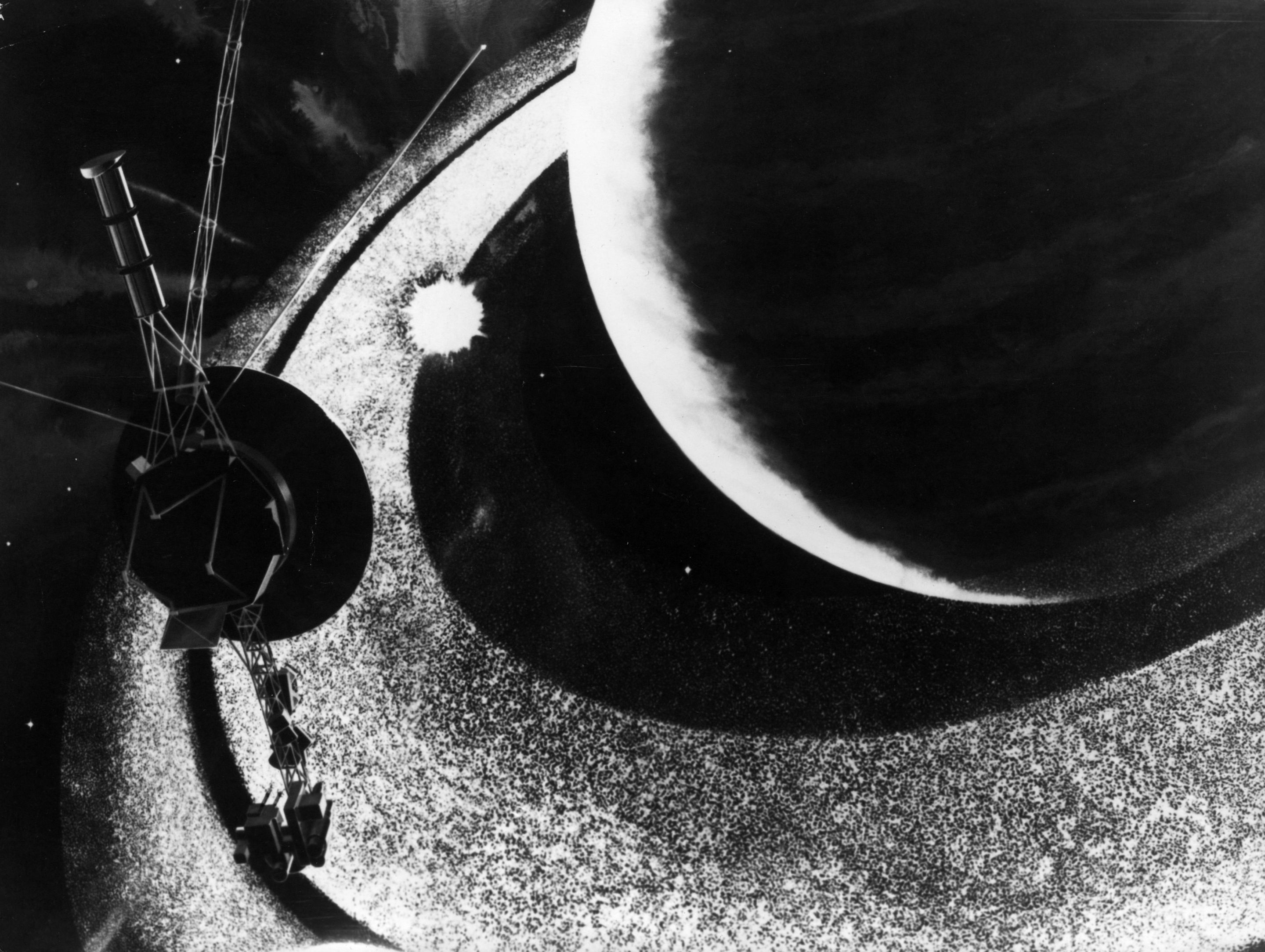
Voyager 1 has gone so far since it launched in 1977 on what was intended as a five-year mission. It has seen Jupiter, and Saturn, and gotten a gravity boost from each to speed up its trip. In 1998 it overtook Pioneer 10 to become the most distant human-made object. In 2012 it became the first spacecraft to cross the heliopause, the boundary where the Sun’s solar wind no longer pushes back the interstellar flow of gasses, and enter the space between the stars. And it is still going, at 38,000 miles per hour.
It is still hard at work, though past its prime. It’s lost its internal heater. It’s lost its imaging systems, its radio receiver, its infrared and ultraviolet spectrometers. Last year its cosmic ray detector was switched off, and in April its Low Energy Charged Particle Instrument was shut down. One by one its systems have been put to sleep by NASA, in an ultimately vain attempt to preserve Voyager’s limited power supply.
It won’t last much longer. This summer, scientists successfully executed a risky plan to lower power consumption even further, extending Voyager 1’s working life a few more years, perhaps to 2030. That’ll probably be it. “Who knows?” said Kareem Badaruddin, Voyager mission manager. “Maybe we’ll come up with something else. This is, I think, the best we can do.”
“The best we can do” has always been the spirit of Voyager. With its sister probe Voyager 2, the program gave us our first real glimpse of the outer solar system. It found that Jupiter had rings, and discovered five new moons of Saturn. It sent back unbelievable pictures of what had previously only been seen through a telescope. “This was full-color, beautiful, glossy photos that suddenly made these points of light into real worlds and real systems," said Casey Dreier, the Planetary Society's chief of space policy,. "It told us how much we didn't know about the solar system in which we inhabit.”
But more than anything else, Voyager 1 showed us how small we are. It took the famous Pale Blue Dot photo that inspired Carl Sagan to wax so philosophically. “That’s us. On it everyone you love, everyone you know, everyone you ever heard of, every human being who ever was, lived out their lives," Sagan wrote, "... on a mote of dust suspended in a sunbeam." Our significance must be in our humanity, in the way we treat each other, he argued, for it certainly isn’t in our place in the cosmos.
To emphasize that, Voyager also took the Family Portrait, a montage showing Earth alongside Venus, Jupiter, Saturn, Neptune, and Uranus. Speaks of light is all we are once you get far enough above it all; light that now takes a full Earth day to reach Voyager. We show it our beautiful blue face, pirouette in the void, and by the time we spin back around again, it is only just seeing our previous day.
Forty-nine years after launch, Voyager 1 still has an unimaginably long journey ahead of it. Within the next five years its nuclear power will run dry and its last instruments will shut off forever. Some 40,000 years from now, it’ll come within a couple light-years of the star Gliese 445. About 263,000 years after that, it’ll zip within one light-year of the star TYC 3135-52-1, its closest predictable flyby. Probability says that it’ll eventually enter another solar system in 1 sextillion years, give or take.
Voyager won’t know any this. We won’t know of it either: It will be beyond our ability to contact, and “we” won’t even be humans anymore by then. But that was the dream behind Voyager, the dream of people ever since they asked themselves, What if we threw up a rock so fast it never came down? It is a statement of optimism, of worlds existing after and beyond us. That optimism drove us to include on both Voyagers the Golden Record, a five-hour-long time capsule of humanity. It is a message in a bottle, sent out into the dark, explaining who we were and what we achieved during our brief time in the light. It is almost impossible that an intelligent species ever actually intercepts and listens to the record. Doesn’t matter. The fact that we did it anyway says everything about our dreams, hurtling outward one light-day at a time.