

It's just like they told you it would happen in D.A.R.E. You have been miraculously, tragically transported 2,800 years back in time, in the land that is now the Uyuk Valley of southern Siberia. The site will be eventually called Tunnug 1 by the archaeologists who excavate it in 2017. But that is the future, and this is the present, meaning 800 B.C. You have come to sit with the Scythians, nomads who roamed the Eurasian steppes on horseback. You have even glimpsed their warrior-king, whose long and stately braids make him seem like a pretty cool guy. Also, he's smoking. Suddenly the warrior-king glimpses you back, his reddish eyes glinting in the firelight. He leans over to you, whispers something inscrutable in an Eastern Iranic language, and extends in his grizzled hands an ancient joint, leaving you with only one question: Would you smoke that shit?
There are, to be certain, pros and cons. But one thing is clear, per a paper published recently in the journal Science: the Scythians were definitely using cannabis to get high. The analysis, led by Fabio-haired University of Bern archaeologist Gino Caspari, represents the earliest definitive evidence of humans consuming marijuana as a psychoactive drug, which was previously only traced back 2,500 years ago where Sogdian mourners once lit up in the ancient Jirzankal Cemetery in what is now western China.
It's only fitting that marijuana hails from one of the highest places in the world: the eastern Tibetan Plateau, also known as the Roof of the World. The plant evolved around 28 million years ago, and as early as 4,000 years ago Chinese farmers cultivated the plant for rope, clothing, and paper, per Science. But it is harder to tell when in the archaeological record ancient people first became gone off that loud. Wild weed, the ancestors of the domesticated kind, has only a little tetrahydrocannabinol, or THC, the plant's intoxicating compound. Some researchers confirmed this when they tried to smoke wild weed and felt nothing, also per Science. (It is unclear if these particular researchers are also the authors of the paper, who described cannabis as an "illicit" substance.)
But scholars have long suspected that Scythians were hotboxing, quite literally, in part due to the testimony of the Greek historian and geographer Herodotus, who was known to sensationalize his accounts (he once wrote of dog-sized ants that harvested gold). Herodotus recorded the following description of the nomads' funerary practices, per this translation of The Histories by George Campbell Macaulay:
The Scythians then take the seed of this hemp and creep under the felt coverings, and then they throw the seed upon the stones which have been heated red-hot: and it burns like incense and produces a vapour so thick that no vapour-bath in Hellas would surpass it: and the Scythians being delighted with the vapour-bath howl like wolves.
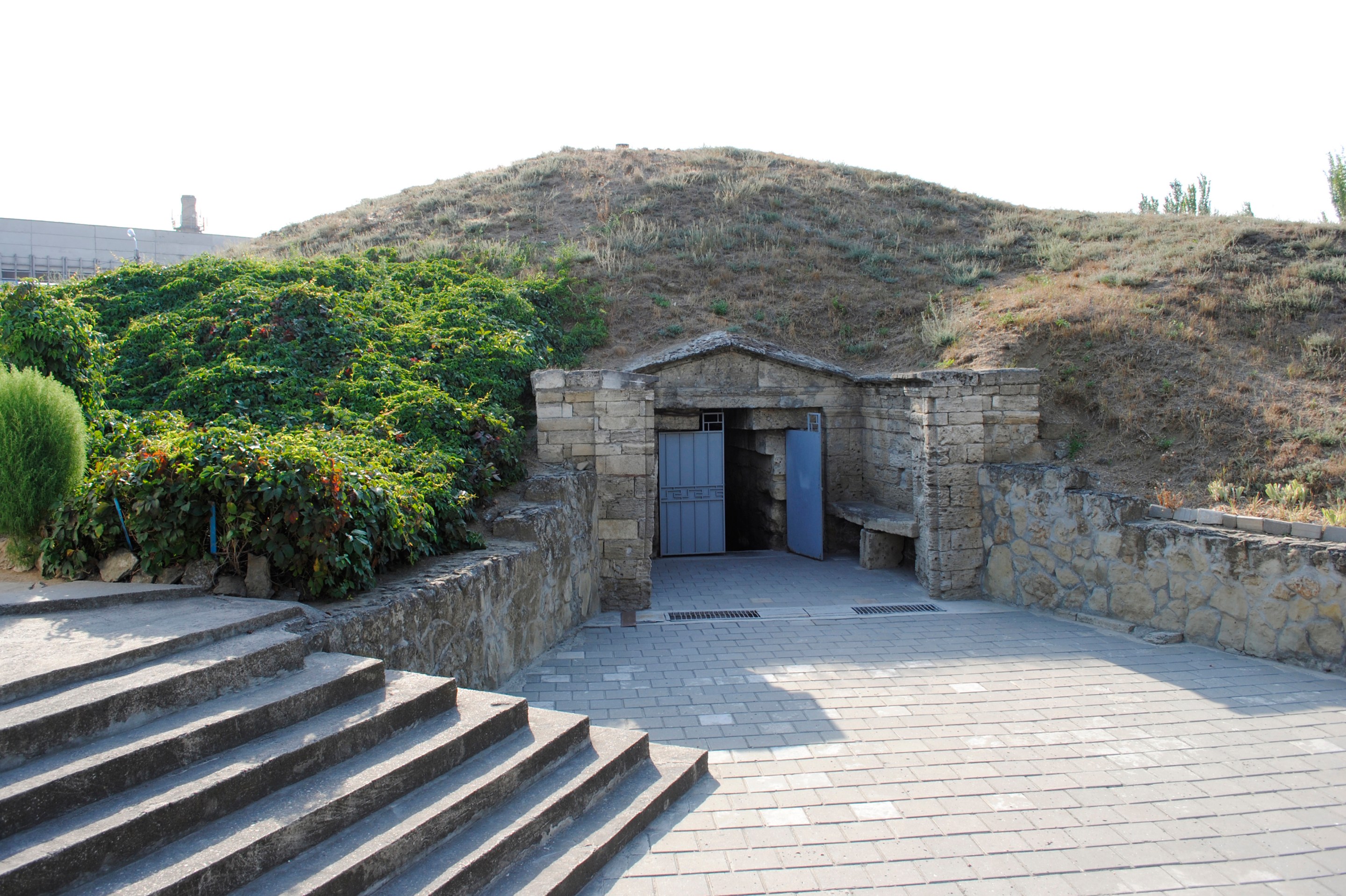
Let's go back to the warrior-king for a second. It's true that we don't know for sure if he's a warrior-king, but he would become one of the people buried at the center of the royal burial mound at Tunnug 1, whose tombs contained gold jewelry, statues of animals, weapons, and, most importantly, nearly a thousand whole cannabis seeds that appear to have been deposited around 2,800 years ago. This is where the archaeologists found strands of human hair, which had been preserved in two pristine braids. When they tested the hair, they found traces of cannabinol, or CBN, which is a byproduct of THC. Archaeology is almost always accompanied by some degree of uncertainty, but this mound of evidence—weed seeds and weed in hair—makes the case for stoner Scythians fairly open-and-shut.
Some outside researchers are skeptical, including forensic toxicologist Volker Auwärter, who told the AP that he found the hair analysis "scientifically weak," as well as a commenter called Fabio who wrote "Drugs of choice back then was opium." But many scientists appear to be convinced, such as William Taylor, an archaeologist at the University of Colorado Boulder. "It’s easy to look at this stuff and say, ‘Oh, the Scythians toked the reefer,'" Taylor told Scientific American. "But in fact, it is a tremendously powerful snapshot into an interconnected world in which the people and cultures of the steppe were starting to shape life on both ends of a massive continent."
Tremendously powerful snapshots, sure, but let's return to the fact that the Scythians toked the reefer. I feel an important question that has been lost amid the buzz of the discovery: What would it be like get smoked out by the Scythians? I've taken the liberty of gathering some pros and cons.
Option 1: 420 B.C. Blaze It
If you were transported all the way back in time to 800 B.C. and offered a joint by a Scythian warrior-king, there are many good reasons to take at least one puff. You could imagine the punishment that might follow refusing a king. It might be nice to take the edge off 2,800 years of time travel. But the most important, I think, is that it would be real loser shit to say no.
But more seriously. The Scythians were famous for their "animal style," which is not the ancestor of an In-N-Out secret menu item—which I'm sure a smoking Scythian would have loved—but rather a stylized artistic tradition that rendered highly stylized animals in gold, bronze, and bone. What kind of altered mental state might produce such a fantastic deer?
Imagine the small talk you could have with a roving band of Scythians. Sure, they spoke a group of ancient Iranic languages that you would probably not understand. Perhaps they would have spoken of their gods, such as the hearth-goddess Tabití. Perhaps they would have told you how to find one of the rivers on the steppe, such as the Borysthénēs, where you could find some kapa, or fish. You would smile and nod to all of this if you were high. Then maybe they would have offered you some cheese called hippákē.
If Herodotus is to be believed, smoking with a Scythian would probably not have involved a joint or a pipe, but rather a communal inhalation of smoke. But Herodotus makes this sound like a real good time. I, too, would like to throw the hemp seed upon the red-hot stones and howl like a wolf at the delights of the vapor-bath! Because the weed was found inside the burial mound, the researchers suspect that it may have played a role in a ritual funerary practice, perhaps for some kind of religious experience. But there is another, more sinister reason the Scythians may have wanted you to, in Taylor's particular parlance, toke the reefer.
Option 2: Say No To Scythians
Although the wooden tombs of Tunnug 1 contained the graves of important individuals buried in coffins made of tree trunks and logs, these wooden structures were topped with what is often called a "spectral cavalcade," a fancy word for a heap of sacrificed horses and humans. Horses, sure, but humans? We must return once more to our friend Herodotus, who described in great detail the spectral cavalcade practice that follows a king's burial in The Histories:
Afterwards, when the year comes round again, they do as follows:—they take the most capable of the remaining servants,—and these are native Scythians, for those serve him whom the king himself commands to do so, and his servants are not bought for money,—of these attendants then they strangle fifty and also fifty of the finest horses; and when they have taken out their bowels and cleansed the belly, they fill it with chaff and sew it together again.
[...]
On the horses they put bridles and bits, and stretch the bridles tight in front of them and then tie them up to pegs: and of the fifty young men who have been strangled they mount each one upon his horse, having first run a straight stake through each body along by the spine up to the neck; and a part of this stake projects below, which they fasten into a socket made in the other stake that runs through the horse. Having set horsemen such as I have described in a circle round the tomb, they then ride away.
Herodotus, again, was known to embellish. But the researchers who found the cannabis found evidence of these cavalcades in the heaps of human and animal bones that topped the burial structures.
What, then, could be the purpose of all that weed? As Caspari told New Scientist, "if you’re trying to sacrifice a human, it might be easier if they’re not quite as resisting." This is speculation, of course. But it is certainly something to consider in the precious moments you have before you decide to smoke that shit that made the Iron Age. But, hell. If a Scythian warrior-king has decided to impale your body on a stake, you're probably not going to be able to stop him. When they go low, you might as well go high.