

It's several million years ago in Africa, and you are an early ancestor of Homo sapiens. You have a small body and a small brain. You can walk on two legs, an innovation that has freed up your hands to do other important things like haul around food and tools. But standing up offers another big advantage. Now you can better see predators in the distance, such as leopards, hyenas, and crocodiles. Your eyes scan the horizon for telltale signs of danger, like an unexpected set of ears, a flicking tail, a dark shadow in the water. There was quite a lot of danger back then, prowling and slinking and clambering on the ground. But new research suggests that there was danger in the sky, too: on top of all that shit, you had to dodge hungry eagles. Can't an Australopithecus catch a break?
For a long time, some researchers believed that raptors could not prey on primates weighing more than around 44 pounds. The largest primate confirmed to have been preyed upon by the African crowned eagle was an adult sooty mangabey, a monkey that was estimated to weigh around 24 pounds. But a paper recently published in the American Journal of Biological Anthropology finds evidence of eagles preying on adult male olive baboons, one of which likely weighed around 48 pounds.
This discovery raises the possibility that early human ancestors may have been hunted by large birds of prey. This possibility has been raised before, most conspicuously in the case of the Taung child, the skull of an Australopithecus toddler found in South Africa. Researchers suspect that the Taung child was killed by an eagle because of the puncture marks found at the bottom of the eye sockets, which resemble marks left by modern eagles. This is an eagle's favored way to hunt a monkey, Cat Hobaiter, a primatologist at the University of St Andrews in Scotland, told Science News: stabbing their talons "straight through the eye, straight through the brain."
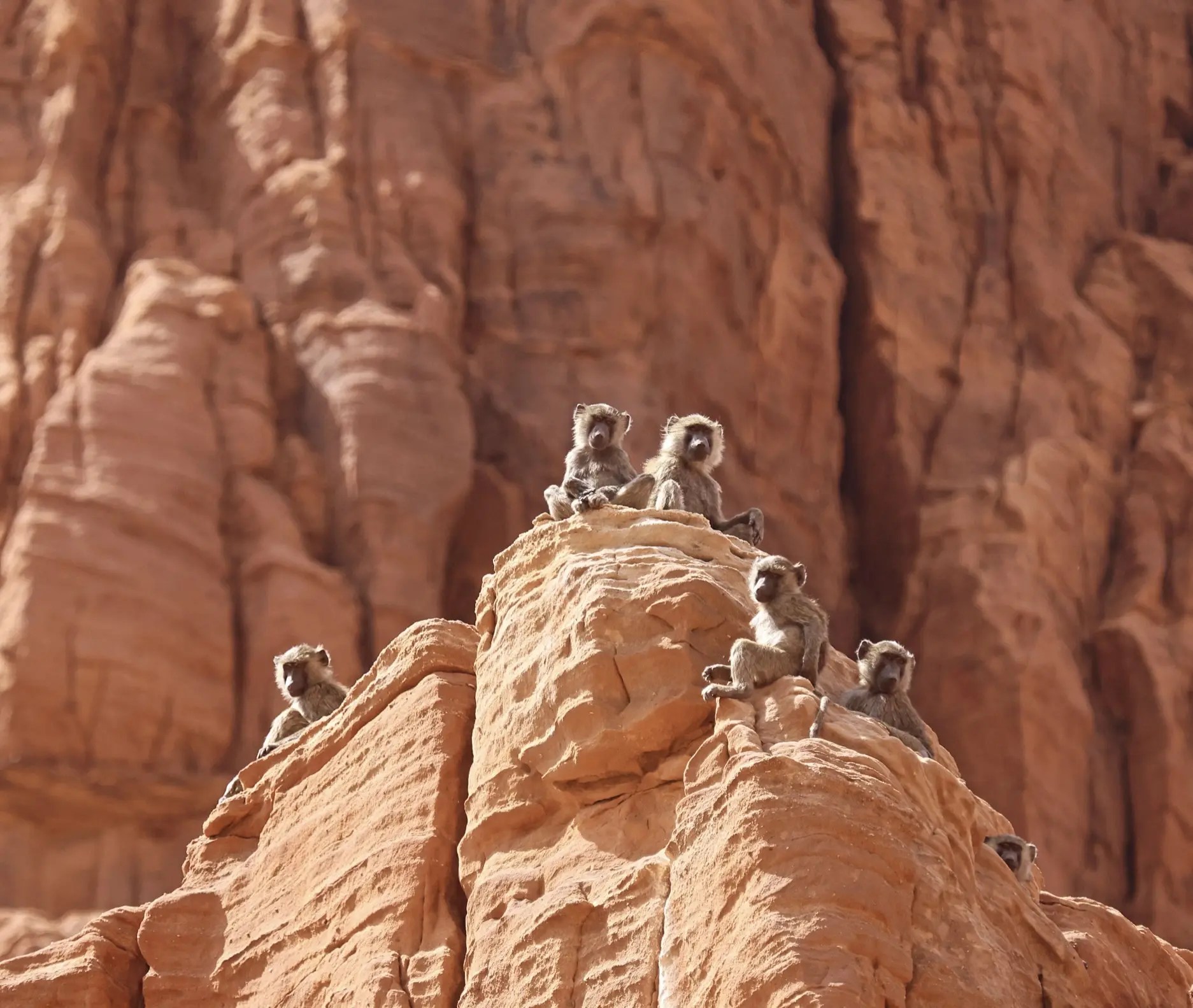
The researchers found the baboon remains on the Ennedi Plateau in northeastern Chad, a spectacular stretch of desert whose arches, pillars, and mushroom rocks certainly make for a stunning environment to run through while fleeing for your life from an enormous eagle. The Ennedi is home to two species of eagles, the golden eagle and the Verreaux's eagle. "We saw the eagles while we were searching for the baboons, but we never imagined that they might be a threat to them," Catherina Hobaiter, a primatologist at the University of St Andrews in Scotland and an author on the new paper, said in a press release. "Then we found the first skull with a puncture mark, and then another, and another.” The first skulls belonged to two male olive baboons that bore similar puncture wounds to those in the Taung child's skull—deep and clean, with severe raking that might have come from talons. They estimated the baboons' size from the length of their femurs.
It is possible that the puncture wound might not have come from an eagle. Perhaps the baboon died of a gunshot, or perhaps it was wounded by the canine of another male baboon. But the researchers argue that a gunshot would have caused more damage to the skull, and a toothy fight would have left more signs of gouging and crushing. It's also possible that the punctures came from an eagle who swept in to scavenge an already dead baboon, not kill a living one. But the researchers argue these puncture wounds would be far more shallow.
The researchers' prime suspect is the Verreaux's eagle, a spectacularly large bird with a wingspan of up to seven feet whose call is an "upslurred scream." Verreaux's eagles prefer to hunt down hyraxes, but have been known to take down an antelope. When the researchers returned to the plateau, they observed olive baboons calling out and seeking shelter as a pair of Verreaux's eagles approached, behavior that did not occur under the presence of other eagle species. They also found more baboon skeletons with raked and punctured skulls, raising their total number of specimens to nine. Eight of the skulls came from male baboons, which the researchers cannot explain. But this clear bias suggests the baboons were hunted intentionally, as scavenging would not likely result in such a clear sex bias.
Modern eagles rarely hunt adult humans, although they have occasionally attempted to mount something like an attack. But early hominins were much smaller. Lucy, the most famous Australopithecus, weighed around 60 pounds and stood at a height of three feet and seven inches. If you were someone like Lucy, you probably needed to watch your back (from hyenas), your head (from eagles), and your feet (from alligators and snakes and their ilk.) And these were just some of your worries as an early human. You also had to be careful not to fall out of a tree—the fate that most likely befell poor Lucy—and avoid any kind of infection, tooth decay, gum disease, or the vitamin A poisoning that came from eating too many livers. At least if a Verreaux's eagle swooped down and stabbed you in each of your eyeballs, you might, in those final excruciating moments, get a chance to fly.