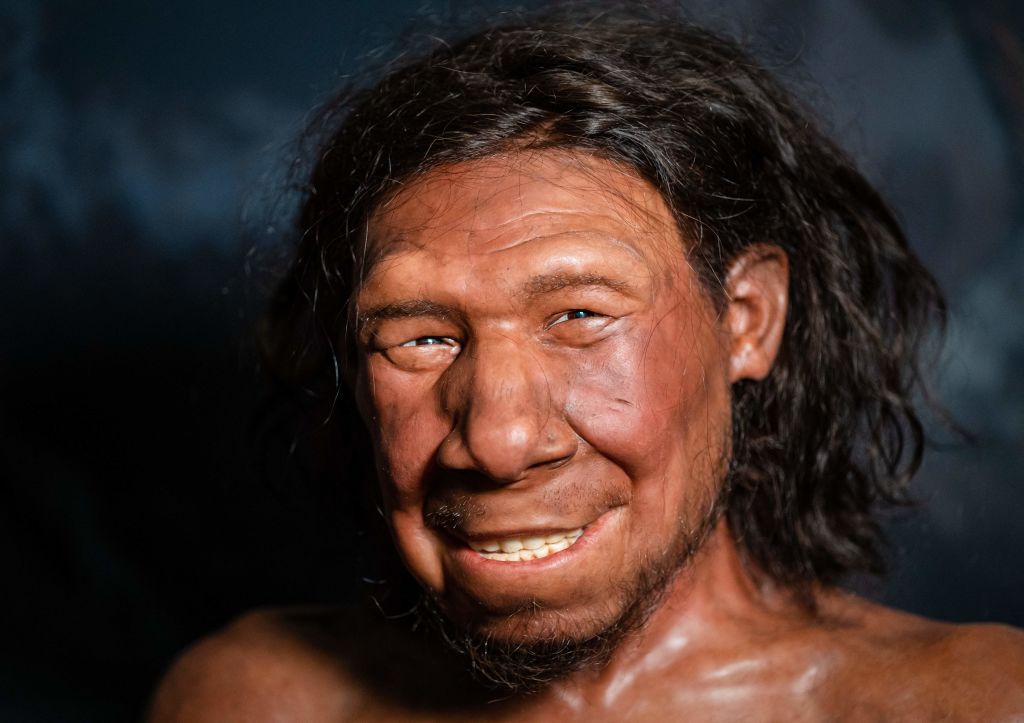
Around 59,000 years ago, somewhere in the Altai Mountains of southwestern Siberia, in lands prowling with woolly rhinos and cave hyenas, a Neanderthal had a toothache. The tooth was a molar, rooted in the lower left corner of the Neanderthal's mouth, and it had begun to rot. Such a dilemma is diabolically familiar to us modern humans, but at least we are fortunate to have dentists, who inflict upon us mild pain and terror in exchange for lasting relief.
But a new paper in the journal PLOS One suggests that this Neanderthal had a dentist all of their own. After analyzing this ancient molar, which sported a strangely deep hole at its center, a team of researchers suggest this tooth is evidence of the world's earliest dental procedure, which, if true, might hold the superlative of being the worst possible way to get a root canal. The claim is big. The earliest confirmed evidence of a prehistoric dental treatment is from Homo sapiens from around 14,000 years ago. This new paper would push that date back more than 45,000 years and record it in a different species of early human entirely, one that has historically and wrongly been dismissed as brutish. But some outside experts are not convinced of the paper's claims.
José María Bermúdez de Castro, a paleoanthropologist at University College London who was not involved with the new paper, does not find the paper's evidence robust enough for its argument, although he said would not be surprised if Neanderthals did attempt therapeutic remedies. Bermúdez de Castro has studied other fossil teeth in several species of early humans that have been similarly modified in a palliative process called toothpicking, which is exactly what it sounds like. "This could be another case of using a toothpick as a therapeutic remedy, without deliberate intervention from other individuals (surgical intervention), an operation that would be extremely painful without anesthesia," he wrote in an email. To Bermúdez de Castro, the Neanderthal molar seems to be just another tooth altered by toothpicking. "In my opinion, the authors of this research have '[made] a storm in a teacup," he said.
The molar was one of many Neanderthal bones excavated from Chagyrskaya Cave. But this tooth stood out to the researchers for its unique pattern of damage. Alisa Zubova, a researcher at the Russian Academy of Sciences and an author on the paper, noticed that the tooth's crown funneled into a oddly deep pit with three overlapping dents. This shape did not match the normal shape of a tooth's soft pulp, nor did it resemble the irregular shape of a tooth that had broken on its own. When the researchers studied the molar with a micro-CT scanner, they saw an array of scratches that pointed in the same direction. This led them to conclude that the Neanderthal was not scraping or picking in the dark, but drilling in a directed motion.
To test their hypothesis that the hole was made intentionally, the researchers replicated the Neanderthal's potential cavity extraction in the lab. Lydia Zotkina, a researcher at the Russian Academy of Sciences and an author on the paper, designed the experimental part of the paper. She collected three modern human teeth, two from archaeological collections and one from her own mouth. "Like many people today, I have encountered an unpleasant feature—there isn't enough space in my jaw for the basic set of teeth that evolution originally provided," Zotkina wrote in an email. "I decided that this was an excellent opportunity to obtain material for the experiment."
First, the researchers tried to drill and scrape the tooth enamel using the tools that would have been available to a Neanderthal: pickers made of jasper, a stone available in the Altai Mountains at the time. Then they tried to remove the dentin by drilling, and then enter the chamber holding the soft pulp of the tooth. In these drilling experiments, the researchers found they had recreated the small scratches found in the Chagyrskaya molar. And the shape of the holes they had created neatly matched the Chagyrskaya's molar's pit. Their experiments proved that such intentional drilling would have been possible, and provide the core argument that the Chagyrskaya molar's cavity was made by a human.
Of course, it was not a perfect recreation. The drilling experiments did not take place inside a mouth, and could not conjure the inflammation and swelling that the Neanderthal would surely have experienced. These conditions would have obviously complicated the surgery. "We are fully aware of all the limitations: we could not use original Neanderthal teeth, nor would it have been possible to reproduce this kind of 'surgery' on a living person," Zotkina said. Still, "a Neanderthal 59,000 years ago achieved essentially the same result with a stone tool and without anesthesia," Ksenia Kolobova, a researcher at the the Russian Academy of Sciences and an author on the paper, said in a statement.
The researchers argue that this seemingly deliberate nature of these interventions distinguishes this molar from the practice of toothpicking, which has been observed in various early hominins. And the tooth revealed wear on top of the drilling, suggesting that the Neanderthal survived this dire dentistry for at least some time, eating foods that smoothed down the pit's rough edges. In other words, the surgery was a success.
If the surgery occurred as the researchers propose, the real revelation is not the mechanical prowess of the drilling, although a Neanderthal with such fine motor control is certainly deserving of praise. Rather, the execution of such a surgery would only be possible by humans who thought in the long term and were willing to endure intense pain for a brief period in exchange for future relief. And they would need an understanding of cooperation. They would need to trust the human who held the drill not to harm them, despite the pain. "This was not a sterile operating room, but it was a deliberate, goal-oriented act," Kolobova said in a statement.
Bermúdez de Castro's hesitations around the paper have nothing to do with Neanderthals, he said, adding that these early humans had impressive abilities. "It is increasingly clear that these humans carried out tasks that were not previously recognized," he said. "They had symbolic thought, buried their dead, adorned themselves, etc." But in his eyes, the molar's wear and modification does not prove that the tooth is the result of a surgical operation. Christopher Dean, an anatomist emeritus at the University College London who was not involved in the study, told Scientific American that the hole could be the result of an injury, such as biting on a small stone. And then the surface could have been smoothed over time by way of toothpicking.
Neanderthals likely experienced a greater sensitivity to pain than modern humans, according to recent genetic research. However this Neanderthal came to create such a hole in their tooth, whether in a shockingly early prehistoric surgery with the first Neanderthal DDS or by a less intentional scraping of a painful spot in their mouth, we can hope their intervention left them with a little less pain. And we can at least take solace in the fact that they never had to experience that horrible plastic thing you bite before the X-ray chair or the sucking vacuum that whizzes around your mouth or the tiny scythe that peels your teeth. I'd rather face a cave hyena.