

The last real star in the universe will be a red dwarf. This will not be for some time yet. The conditions are ripe for stars to be formed, to live out their lives, to burn out or explode, in cycles for the next 100 trillion years. The universe is, then, unimaginably young, as far as things go, at just 13.8 billion years. If the lifespan of the so-called Stelliferous Era were a single 24-hour day, we'd be nearly 12 seconds in.
But one day, all that stellar fuel will be used up, distributed, converted from delicious and powerful hydrogen to more complex elements useless for star formation. The day will come when no new stars are being born, and the ones that exist will start to go out, one by one, forever. Of the hydrogen-burning stars, red dwarfs will hang on the longest. G-type main-sequence stars like our Sun get a few billion years before they exhaust their fuel. Red dwarfs possess a lifespan of about 10 trillion years.
We think. It's all theoretical, since we have yet to actually observe the death of a red dwarf star, because—again—the universe hasn't existed nearly long enough for any of them to die.
To me, this deserves respect. Everyone goes all crazy fawning over a giant tortoise when it turns 150 or whatever. Where is the love for the giant tortoises of the universe? When I google "red dwarf," the British TV show comes up. When we were ideating Reds Week blogs, Ray Ratto jumped on Red Dwarf the show, and no one even suggested the class of stars. Yes, the amount of time it takes for an English TV show to produce 74 episodes can feel like 100 trillion years, but it was actually only 32. Even in that show's narrative, the lead character is held in suspended animation for 300 million years, and it's supposed to be a long time. That's nothing. Red dwarf stars laugh at that. Ray Ratto has no respect for the universe.
If we are honoring notable red things this week, it falls to me to carry the torch for red dwarfs, because they are too busy undergoing nuclear fusion to blog for themselves.
"Red dwarf" is a descriptor of both the temperature and the size of a type of star. At one end of the spectrum of stars, you have your supergiants, massive and luminous and short-lived (some survive only a few hundred thousand years) and destined to end their lives violently in a big kablammo. On the other end, you have some real weirdos in brown dwarfs, small (not much bigger than Jupiter) and dim and relatively cool, not powerful enough to fuse hydrogen, but managing to cobble together some weak starlight out of deuterium fusion. Weak! Get out of here with that weak shit.
But on the main sequence, where stars emits light and heat as a byproduct of the fusion of hydrogen into helium, nobody's smaller or less powerful than red dwarfs. This size works to their survival. In "normal" stars, the helium rises to the surface, releases its heat into space, then sinks back down into the core, where it gradually forces out all the hydrogen. When there's no hydrogen left, the star is out of juice and it collapses or explodes or, like our Sun will, settles into life as a dense and non-fusing white dwarf. But the entirety of a red dwarf, where fusion reactions happen more slowly, is a convective zone, and fresh hydrogen is transported back into the core—allowing it to re-use its fuel almost indefinitely.
Slow but steady may not win blog headlines, sadly, but it is a recipe for an astonishingly successful star. You probably don't think much about red dwarfs because we can't see any in the night sky with the naked eye. This does not mean they aren't thriving. Three-quarters of the stars in our galaxy are estimated to be red dwarfs, with roughly similar proportions throughout the universe. Our closest star is a red dwarf.
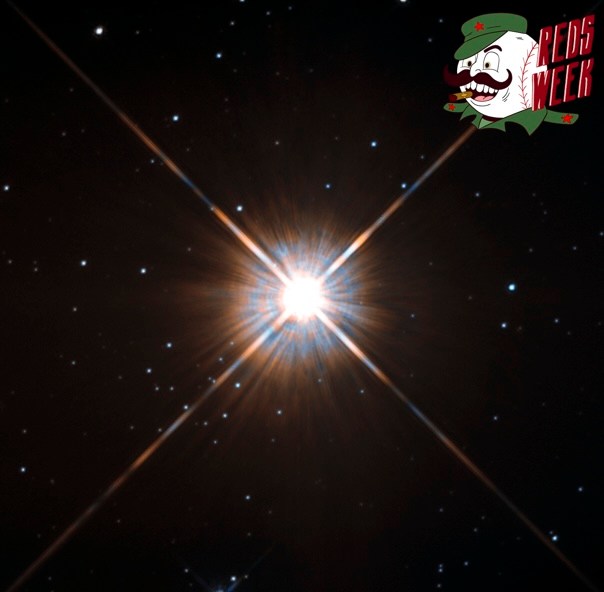
Yes! You have likely heard of Alpha Centauri, just four short light-years from Earth. Alpha Centauri is actually a triple star system, though: Centauri A and Centauri B are gravitationally bound to each other, but Centauri C, also known as Proxima Centauri, is a red dwarf star orbiting that binary system, and for the next 25,000 years or so will be the star closest to us.
Proxima Centauri is only about one-seventh is the size of our Sun, but much, much denser. It also has planets, two confirmed and one possible. One of those planets, Proxima Centauri b, is startlingly Earthlike. At best guess, it's just a little larger than Earth and exists within the so-called habitable zone, the right distance from its star for liquid water to exist. Due to its proximity and the familiar nature of its planets, there's a very good chance that the first exoplanet we ever send a probe to will be orbiting a good old red dwarf. (That is, if humanity achieves interstellar travel before our time bomb of a Sun goes off. Proxima Centauri will cooperate and wait for us as long as needed; it's a red dwarf; it can wait forever.)
We might have trouble if we want to move there, however. Planets around red dwarfs would seem at first glance to be good candidates for life to arise and thrive, but recent study has thrown some cold water on the possibility. First, because of the small size of the star, their planets orbit relatively closely, and end up tidally locked—showing their star the same face at all times, making the daylight side unbearably hot and the night side crushingly cold. Second, there is some evidence that red dwarfs emit regular high-energy flares, which would likely snuff out any scrabbling attempts at life. There is hope, however. Scientists theorize that a planet farther out from the star could be safe from its flares, and potentially habitable as long as it had another method of staying warm, like a greenhouse effect.
Oh, and for reasons we don't yet understand, red dwarfs have been known to eat their own planets.
You do not need to worry about any of this. You will not be affected by a red dwarf in your lifetime, or its. But hopefully you have been edified by spending a few minutes thinking about the unsung glue guys of our universe. They will never go supernova and light up the sky; they will never collapse into a black hole and break spacetime. They are just there, doing their thing until the end of time, sparkling as the background static of existence.