

Post-apocalyptic comedies have not been in vogue since the notably less comic actual apocalypse has started filling our windscreens. Even moderately depraved cultural products like Survivor and Squid Game have stopped short of ritually killing and eating lesser characters as part of the competition. Then again, those shows don't pretend to be comedies, and so could easily make cannibalism part of the show without a sizable loss in audience. We bring that up to open your minds to the idea of the Survivor contestants rising up as one and finishing off Jeff Probst with a nice coconut chianti once and for all. Now that would be comedy.
But because that hasn't happened (yet), we can say that this genre pretty much topped out with Red Dwarf, the hydraheaded British comedy of yesteryear that took the post-apocalypse and pushed it into a corner in which there was only one human left, plus a hologram, a cat, a neurotic robot butler, a ship-piloting head, a brief unrequited love interest, and a few spare characters here and there. Mostly there, because Earth was not part of the universe Rob Grant and Doug Naylor plotted out when they first pitched an idea they had originally assembled as a series of sketches for the radio called Dave Hollins: Space Cadet. They proposed it to a typically obstinate BBC programming department—typical, because all programming departments are preternaturally wired to say no to anything that hasn't been done six other times before. It was eventually greenlit by BBC North in Manchester through the persuasive powers of Grant, Naylor, and producer Paul Jackson, and debuted on BBC Two in 1988. Yes, that's 38 years ago. What of it?
The broader plot, which any good smeghead (more on that in a bit) could recite in their sleep, is simple enough. It is certainly unencumbered by a surfeit of extraneous characters. A human technician on an outer space salvage ship who is known mostly for being an unambitious slob is punished for smuggling a cat on board and then for refusing to surrender said cat; he is imprisoned in stasis for what is supposed to be 30 days. While he was busy being inert, the ship incurs a radiation leak that kills everyone on board except him, and the ship's computer does not release him until the radiation levels are once again acceptable for humans—which is three million years later.
The computer, which in many other ways is a laconic nitwit, provides him with a hologrammatic version of his nominal superior who serves as his ongoing pain in the ass, as he had in the flesh-and-blood days. The cat, which has evolved over those 3,000 millennia into something known in the show as Felis sapiens, is there, too—still a cat, but in an aggressively fluid and sharply dressed human form. Hilarity ensued, and then just kept on ensuing, first as a recurring series that sprang forth from a radio show, and then as a miniseries, and also a movie-length special, and also as four novels and a magazine, plus two full runs (on BBC Two and then Dave) that spanned 32 years. It was, in short, an enduring masterpiece.
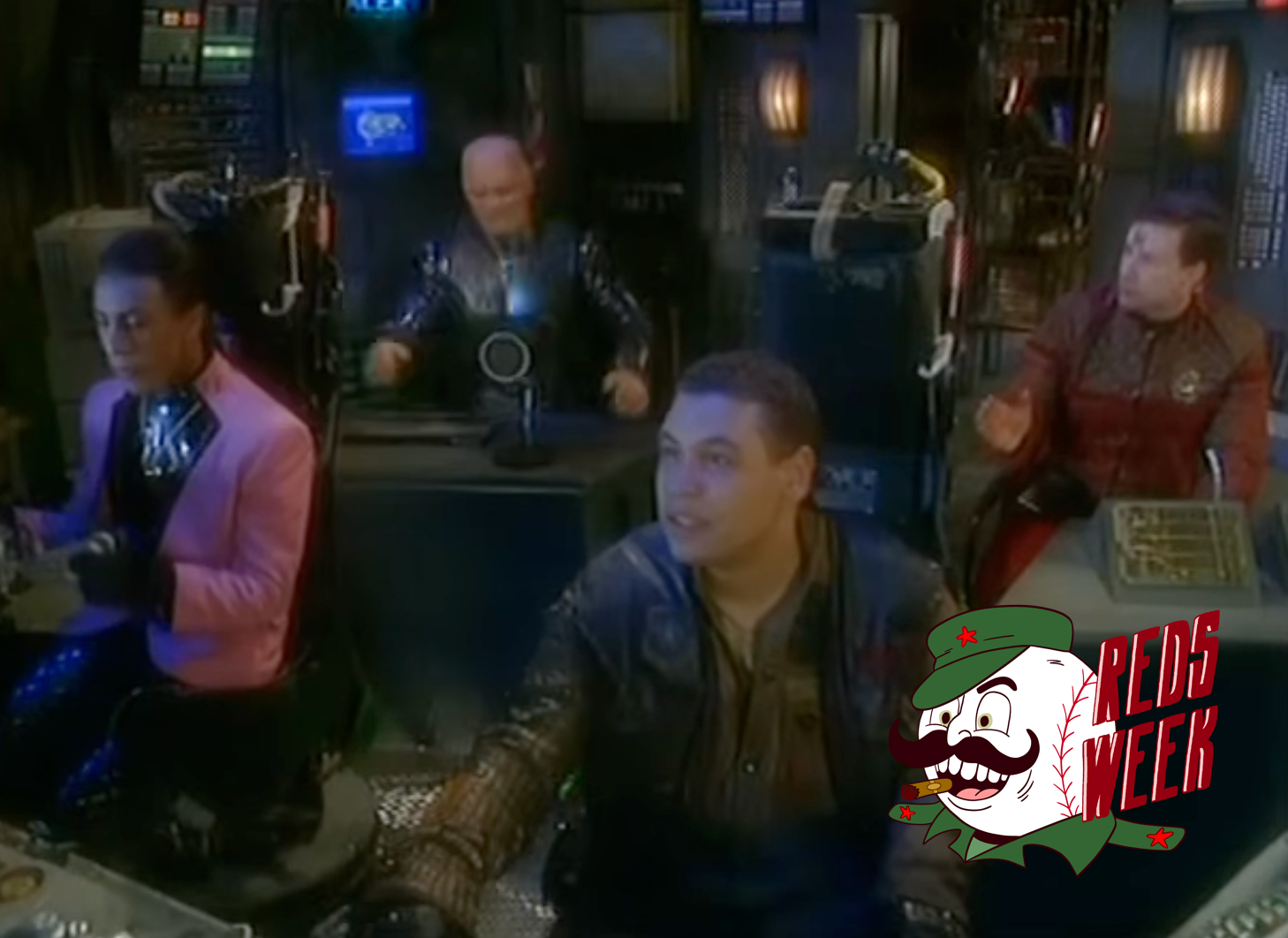
And not just that, but an enduring masterpiece that didn't rely on aliens or modern special effects—which is to say "industry-standard production values"—to tell a science fiction story about the last known human and his failed attempts to return to a home that no longer exists. It was a show about a mining ship worker who only wanted to go home and live in Fiji (Craig Charles as Lister), accompanied his highly evolved feline (Danny John-Jules as Cat), and hounded by his overofficious failure-riddled boss/nag/asshat (the aforementioned Arnold Judas Rimmer, played by Chris Barrie), the ship's senile computer Holly (Norman Lovett, then Hattie Hayridge, and then Lovett again) and a robot butler/side character who became part of the cast (Robert Llewellyn as Kryten).
As is typical of most excellent shows with a weird premise, it was met with derision, revulsion, and even in the best of times disinterest by BBC executives. They let the idea moulder for three years between pilot and schedule until it was picked up by BBC North in Manchester, and even then the show had to survive an electricians strike to avoid being cancelled before it even began. It also had a three-year hiatus between Series 6 and 7, but after full reruns on the British comedy channel Dave, the audience was large enough to convince the channel to create a miniseries and two new full series that ran through 2017.
It hit its stride quickly enough to be picked up by American PBS stations in 1989 and shown often enough to create a sufficient audience to induce NBC to commission not one but two spectacularly failed pilots in 1992. PBS is how most Americans got hooked into the series, and like Monty Python, Fawlty Towers, and other brief but brilliant British shows from even earlier, it remained the network where BBC comedy thrived, at least until its ambitions and funding shrunk.
Space was only minimally involved in the show; as written by Grant and Naylor it was more of a broadly drawn character study. For obvious reasons in the real world, continuity was very much optional, which helps over the course of a three-decade run; cast changes were plentiful—beyond the Holly changes there were two different Kristine Kochanskis, Lister's former girlfriend, for no apparent plot-driven reason—and the original ship itself was eventually written out of the show entirely and replaced by a smaller and goofier Volkswagen of the skies known as Starbug.
And there's the point of why you should invest your next bingebomb on this very strange series from nearly four decades ago—the sheer structural madness of it is thrilling, all the way down to the Series 3 opener that takes place on a planet where everything runs backwards.
All that hoopdeblah, though, is just inside baseball. The real selling point is the simple experience of laughing at and with a series that started and stopped and reinvented itself several times over the course of its run. The actual timeline is almost too baffling to follow, but the important thing is that its run, somehow, is still going—there is another novel in the pipeline even though Grant, the author of said novel, died in February. Red Dwarf never prioritized coherence or even chronology both because of its real life circumstances and because its creators never really cared, either; it didn't have the special effects advantage it might have because 1) that technology didn't exist at the time and 2) the Beeb would not have paid for it even if it had. Indeed, the lighting in the first series had to be improved because the original series was lit in the way that a deep space mining ship would have been, had it existed—the look was monochromatically dingy, like a rug your dog slept on.
And so Red Dwarf focused on what it could control, which was the characters, the writing, and the skills and interplay of the actors. Barrie was the perfect insecure uptight suck-up and prig, Charles an ideal insolent wise guy, John-Jules nailed the elegant glide and unchecked narcissism of the future cat, and Llewellyn had the insecure robot bit down pat. To call this science fiction does very little credit to science, but it was more on point than most fiction. Although it paid homage to a number of movies of its era, it was also brilliant comedy on its own. The props were essentially irrelevant, which is convenient because the props were generally not great.
Red Dwarf also invented memorable bits of language that were specific to the show and nothing else. "Smeghead," which has already been mentioned, was based on, well, you know. But there were also fictional insults like "gimboid" (which sounds like a futuristic version of "git") and "gwenlan" (adapted from the first name of a BBC Head of Comedy who rejected Red Dwarf as a concept). The universe that Grant and Naylor created and the actors perfected was both strange and hospitable for a show that borrowed from everything and was religiously devoted to nothing.
It goes without saying that Red Dwarf could not and would not be made today, for the same reason that Mystery Science Theatre 3000 would not be made unless you could find a friendly executive who was committed to the comedy part and willing to look past the lack-of-science-fiction part. Those people no longer exist, or just no longer get to make programming decisions if they do. Shows need to hit within the first 15 minutes or die, and Red Dwarf, like Blackadder, Absolutely Fabulous, and other gloriously timeless British comedies, needed a series or two to get up to warp speed. Its four-year hiatus between 1993 and 1997—Grant and Naylor broke up as a writing team and the cast members got other gigs—would not have been tolerated now for corporate reasons. You can combine "not have been tolerated" and "corporate reasons" for nearly anything these days, and the stubborn survival of the show despite all that might be the most enduring part of the Red Dwarf mythos. It's just not the best part.
The best part is the work, and the workers. The details are just that, and the context can't be helped, but the show stands on its own as not just bingeworthy comedy but something more memorable, and more elaborate. The novels flesh out the process; the series' amorphous end may not be an end because nothing truly dies. Only a few things truly live, though, and Red Dwarf glows despite its unavoidable technical and budgetary limitations. Sometimes, rarely but still sometimes, genius wins over glitz on its merits.