Two things are true about me: I hate rich people and I love architecture. These days that presents a terrible contradiction, because only the extremely rich are able to finance the perpetuation of architectural production, whether in the form of new and interesting houses or in the financing of skyscrapers and grand, expensive public-facing private projects like museums or concert halls. Meanwhile places like schools or libraries are cash poor, public resources like parks or housing are privatized, and much of what remains of the political infrastructure that ushered in the 20th century’s great social programs is as decrepit as some of the buildings, bridges, and roads they’ve left behind.
For about two or three years now, it’s become increasingly difficult to know what to say about architecture, honestly, even though writing about it is my very privileged job. It’s one thing to write “We need an architecture that serves the people, not one that’s a mere bauble for the ruling class” over and over, but as the years roll on, my belief that such a thing is possible is beginning to wear quite thin. This is for a number of reasons, the least of which is the deteriorating political situation in the United States writ large, but perhaps the main one is that the ideological dynamism of the 2010s within architecture (and without) has largely stalled. What has taken its place is either the continued perpetuation of the digital tech-brained “floating cities will solve climate change” way of thinking, whose origins begin in the ’90s and have never stopped (as evidenced by the immediate embrace of AI), or a kind of resignation to the status quo—a pretty building every once and a while, a small library by Jeanne Gang or whatever, and then mostly faceless skyscrapers, luxury apartments, whatever pays the bills or makes an interesting shape that distinguishes itself from all the other interesting-shape buildings. As you can see, I am very depressed.
Recently, I was in Europe hoping to catch those familiar whiffs of a world that is still mostly bad but slightly better than the one we have here. I hold no delusions about some kind of EUtopia; I was simply hoping to encounter buses that run on time, generally pro-social features like public bathrooms, and good bread. Mostly this turned out badly for me. In Berlin, AfD signs littered flagposts (it is election season), and half of the museums were closed for renovations that will take seven years because the city has no money.
In Bayreuth, where I attended Wagner’s Ring cycle on a press junket (which was staged “with AI” in what was one of the worst crossovers in the history of contemporary art), I was greeted by all kinds of foul characters: German haute bourgeoisie whose money came from places of suspicious provenance, nouveau riche post-socialism types with their sugar babies, Upper West Side cretins and resentful and self-conscious financiers who think that the arts are some way to wash their hands of their day jobs. By the time I got to Vienna, I was ready to jump in the Danube.
When Defector asked me to write about Red Vienna for Reds Week, this was something I also wanted to jump in the Danube about, as there has never been a more annoyingly worked-over topic in the entire world. Every year, The New York Times sends some wonk on a press junket to credulously ask Why are the rents so low in Vienna? or What can we learn from Vienna’s Social Housing? only to broadly conclude that it’s a 20th-century phenomenon that would be nice, but is not possible anymore. Alternatively, there’s always a leftist rag that takes up the same topic from the other flank: Vienna Proves Social Housing is Possible. What Socialists Today Can Learn From Red Vienna. ENOUGH.
It’s true: Vienna in the early 1900s was unlike any other place on Earth in terms of its political makeup, its dichotomy of extreme duress and cultural output, its ability—its continued ability—to become and remain a haven of liberalism, a flickering beacon in the general backwater that is the country of Austria, which, even today is mostly under right-wing rule. People love to say that the reforms of the Social Democratic Workers’ Party of Austria (SDAP) from 1918-34 was one of the few pre-war instances in which socialist politics were instituted without resorting to political violence. This did not stop political violence from coming for Red Vienna, as it did for most of the radicals scattered across Germany and Austria in the 1940s.
Jakob Reumann, the freshly minted SDAP mayor, inherited a shitshow when he became mayor of Vienna in 1919. Hyperinflation, disease outbreaks, over-crowding, mass migration and damage from the First World War made Vienna worse for wear, something that was exacerbated by extreme income inequality. Pestilence, war (albeit not at home), inflation, overcrowding: These are still very much the issues of our own time.
In our current housing debates, however, you’ll hear the same excuse thrown around: There’s no money for public housing. Only private development can alleviate the housing crisis. Well, at the beginning of Red Vienna, there was no money being thrown around at all for any type of housing. The Social Democrats very quickly realized that housing was at the nexus of all other programs, that it above all was necessary for the basic perpetuation of human life and dignity. Building that housing, however, was no small task, because, again: no money. The post-war economy’s coffers were drained—the cost of construction was ungodly because of lack of materials and labor, the charities and the state were both empty-pocketed. Before housing could be created, the potential for housing had to be created.
Lucky for the socialists, there was already a rent freeze in play from wartime and a basic framework for tenants’ rights, a concession made by the previous government. As for the money? There was only one source left untapped: the Bayreuth class. The rich. The luxury taxes levied by the SDAP touched every aspect of bourgeois life: servants, casinos, expensive booze (and those who sold it), cars, drivers, and more. Even a meal out on the town was subject to taxation. Closer to home, there was also a tax on new private housing construction, a proposal that would be anathema in the climate of today’s housing debates.
The Red Vienna dream was bigger than simply building housing: It was to completely remake the fabric of the city into a socialist one, full of modern, hygienic, but especially communal resources like parks, kindergartens, kitchens (including prototypes designed by Margarete Schütte-Lihotzky, the pioneer of the labor-saving Frankfurt kitchen), bathhouses, gardens, theaters, sporting facilities, laundries (such as the one in the Karl Marx Hof which is now a museum) and a crematorium in the central cemetery (which would later become a massive political debacle in heavily Catholic Austria). Construction work, too, was a communal affair. Another world was possible, and by necessity it had to look nothing like the one that came before. This was where architecture came in.
The architecture of Red Vienna is its own “style”—a subset of early modernism aesthetically situated in between Jugendstil (similar to our Art Nouveau), the ornamentalists of the Vienna Secession like Otto Wagner and Hans Ulrich Obrist, and International Style modernism of Bauhaus fame. Often misidentified as Art Deco, it features clean lines, Cubist or angular motifs, socialist-realist murals and sculpture, and long, neatly broken-up facades. But despite this unique architectural language, the housing blends so well into the surrounding fabric (well, with the exception of the very famous Karl Marx Hof) it’s easy to miss at first glance, or would be, without the text.
“Erbaut von der Gemeinde Wien, in den Jahren 1924 und 1925, aus den Mitteln der Wohnbausteuer," reads the text in bold red letters on the Matthias Gall Hof, a stark, cream-colored building with small ornamental interventions built by Heinrich Schopper and Alfred Chalusch, right above a nude of a worker holding a bushel of wheat. “Residential estate of the Municipality of Vienna built from 1924 to 1925 financed from the revenues of the Residential Construction Tax.”
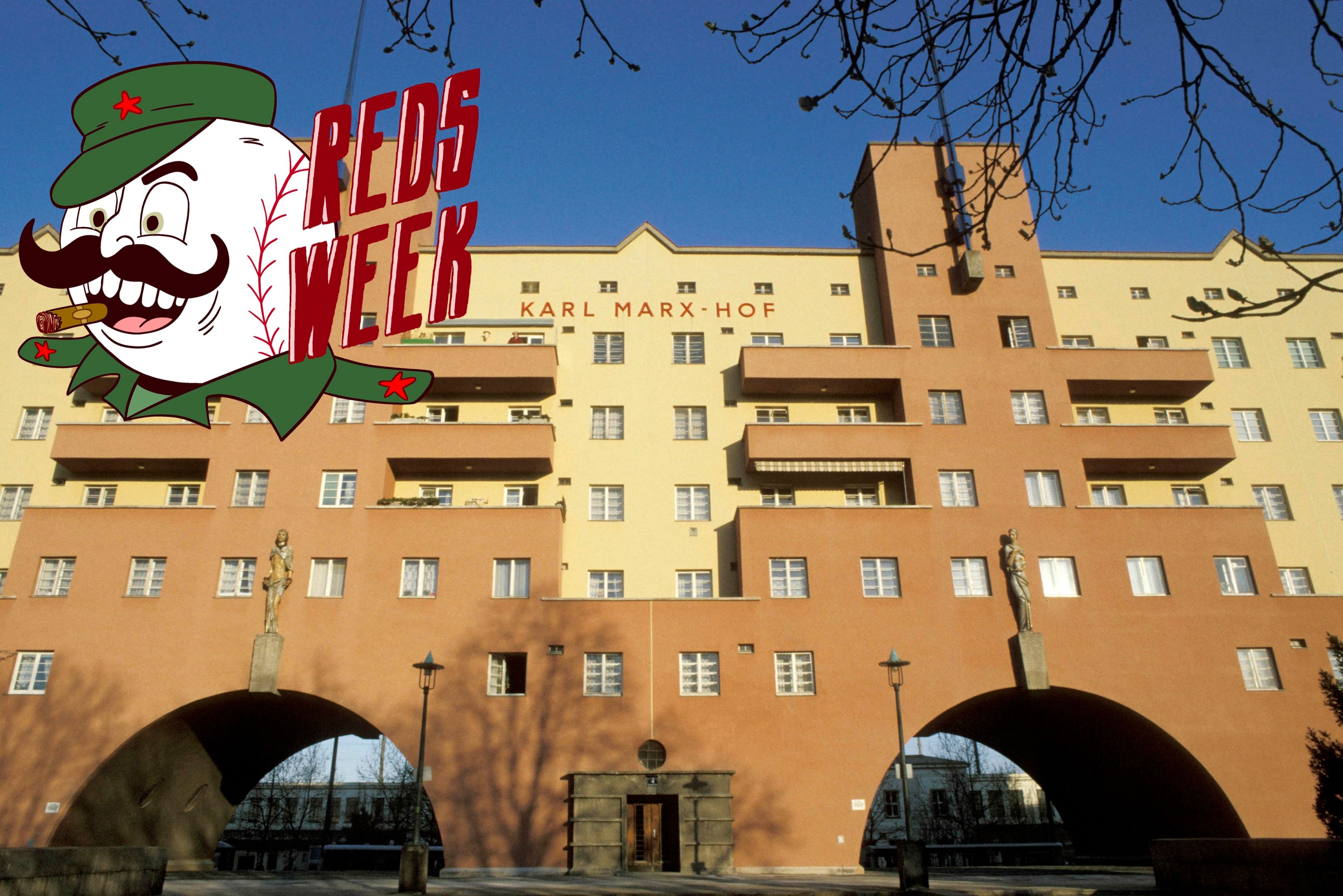
When you are in Vienna, you will see this text everywhere, in all parts of the city, from rich districts to the sticks, from buildings that are truly nondescript to the literal Karl Marx Hof, the sprawling complex designed by Karl Ehn, that is the lasting face of Red Vienna, even today. Despite my two previous trips to Vienna, I’d never been to the Karl Marx Hof, which is parallel to the street leading to the Heiligenstadt train station. Despite the famous image of the complex being the three wide arches, atop which apartments sit like a bridge, punctuated by statues and capped with blue spikes reminiscent of radio transmitters, the entire thing takes up multiple city blocks, morphs and changes with the urban streetscape. To walk around the whole thing takes about half an hour. The scale is staggering—the complex was intended to house no fewer than 5,000 people.
Having got off the train, I stood there and stared at it, cowed, the way people always are when famous images from books suddenly populate real life. I walked under the long, low-set archways into the first courtyard and took in my favorite of the statues that act as keystones over the arches: the woman holding a stack of books. It was quiet in the courtyard. People came and went. I found myself frozen in place, watching every small movement that took place there, the twitch of the curtains in the windows, the movement of shadows, the beeping of the train, both moored to reality and transported to the past, something that is only possible when encountering a living architecture. As for the building, the architecture critic Owen Hatherley put it best when he said, “Simply, this is a building you can imagine people laying down their lives for.”
I have visited many sites of formerly socialist architecture —from Yugoslav monuments to bars in East Berlin to council housing in London to New Deal post offices—and almost universally I find these visits to be agonizingly sad experiences, reminders of what was once possible but which seems foreclosed to us now, pictures of a better but fallen world. But what separates the legacy of Red Vienna from all the rest is that it lives on. It lives on in the buildings themselves and the fact that they continue to be constructed—you see that red (red!) text on buildings from the ’50s, the ’80s, even today.
Sixty percent of Viennese residents live in social housing. Even in the transition toward neoliberalism, this resource was never privatized—though it is noteworthy that a temporary stay on new construction was a requirement for Austria to join the EU. Perhaps the most beautiful part of the Karl Marx Hof, or any of the others, is not so much the building—because a building can easily be co-opted for all kinds of purposes, most nefariously, nationalistic ones—it is that working-class people still live there. It is that the purpose, the execution, and the use of the building are still, despite what the world has come to, one. That is what Red Vienna offers architecture: ambition, purpose, dedication to a political idea that is legitimately sincere and worth pursuing, and a general regard for public well-being, for new ways of living. A better world is possible is something people love to throw out there, pointing at a pile of ruins. Here in Vienna, however, a child is playing in a courtyard and will go home to a safe, clean, beautiful place to live while her parents spend their money on the things that matter: her clothing, her schooling, a night at the theater. There is no secret to social housing in Vienna. There isn’t something that makes it nebulous and mysteriously impossible, as though it were some spirit that somehow still possesses us today. There is only the will to do it and the belief that it matters, the thinking not of maximum year-end yields or how to make building profitable for developers. There is only thinking about the courtyard and the little girl.