

My Grandma Powell was a knitter. She’s still alive, but she’s too old now to knit. Before there were YouTube tutorials, or YouTube, or the internet, she taught herself how to do it. She spent years knitting sweaters, scarves, mittens, and toques (Canadian for "beanie") for herself, her husband, and her four children. By the time my cousins and I came along starting in the ’70s, she was extremely fast. My younger cousin and I got matching sweaters. We also got sweaters with matching leg warmers when that was in vogue. A little later, we got sweaters with matching miniature duplicates to dress our Cabbage Patch Kids in.
No needle held by human hands can produce stitches as fine as you get in a machine-knit sweater, of course. But even when a loose-knit sweater is sold in a store, you can just tell it wasn’t made with love. Those of us who have been the lucky recipients of knitters’ work, or have learned the skill themselves—I personally never progressed far enough even to turn a square Grandma started for me into a scarf—can spot good knitwear at a glance, even on a screen.
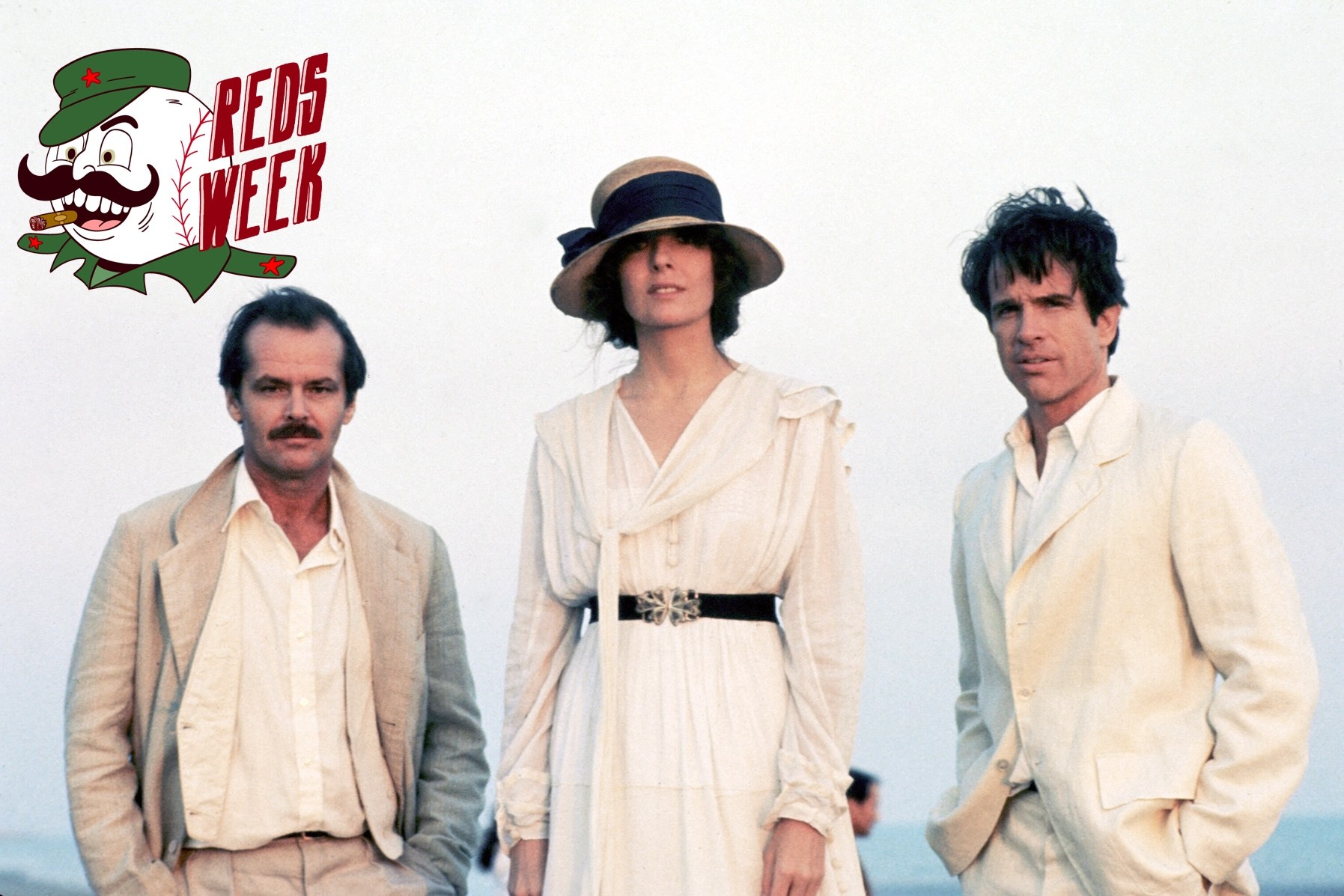
And while the sweaters in rom-coms like When Harry Met Sally are rightly famous, sweeping epics about love and dialectical materialism can be chock-full of them, too. Reds, Warren Beatty’s 1981 debut as a solo director (he had previously co-directed 1978’s Heaven Can Wait with Buck Henry), stars Beatty as John “Jack” Reed, a journalist, poet, and socialist-turned-Communist activist; Beatty also co-wrote the screenplay with Trevor Griffiths. The film chronicles his life from first meeting his eventual wife Louise Bryant (Diane Keaton) in Portland, Ore.; their romance in Greenwich Village, Provincetown, Croton-on-Hudson, and Petrograd; and his death in Moscow, after which he became one of just three Americans buried in the Kremlin Wall Necropolis. Am I qualified to comment on its historical accuracy, politics, or whether Maureen Stapleton deserved the Best Supporting Actress Oscar she won for playing Emma Goldman? No, on all counts. I’m here to rank its handmade sweaters.
First, a couple of honorable mentions for non-sweater knits. Thanks to beatniks, the French, and a young Monica Lewinsky, the beret is probably the second-most-punchlined hat style in the modern era, outdone only by the fedora. But both Louise and Witness Dorothy Frooks prove how chic an oversized beret can be.
On to the official rankings!
10. Jack’s Charcoal Crewneck Pullover
This looks like a warm woolly layer for a New York City winter; it’s just a bit unremarkable. That said, it’s a more appropriate choice for a socialist organizer than …
…this oatmeal number he wears in multiple scenes—including when he’s in Russia during the 1917 Revolution—which looks both mass-produced and cashmere. Decadent!
9. Jack’s Brown Marled Crewneck Pullover
Very well could be the same pattern used to make the previous entry in this list, but at least the variegated wool gives it a little more visual interest. (Does the complexity of its color story reflect Jack’s increasingly ambivalent feelings about the governing policies of the Comintern post-Revolution? Hmmm.)
8. Louise’s Gray-Green V-neck Pullover
I ranked this one higher than the previous two unadorned pullovers out of respect for how much more difficult the pattern looks, but good god is it ugly. It truly breaks your heart to think of Diane Keaton having to put on this hideous piece in even one scene, never mind two. I don’t know what any of these yarn colors were officially called, but I’m going to guess “Hopeless Green” and “Disconsolate Gray.” Louise is wearing it when Jack finds and confronts her about a love poem to her from another suitor, which he’s just found in the book she used to hide it from him, so maybe she threw it out after that to exorcise the bad memories. Let’s hope!
7. Eugene’s Ivory Cardigan
Among the film’s many Oscar nominations is Jack Nicholson, up for Best Supporting Actor for playing Eugene O’Neill: playwright, alcoholic, and—surprise!—author of the poem over which Jack and Louise fight while she’s wearing the awful sweater above. This cardigan comes out during the segment of the film when Jack, Louise, and a bunch of their friends depart Greenwich Village for Provincetown and are very committed to wearing only summer whites. There’s nothing especially objectionable about this; it just looks like the kind of pilly shmatte a mom throws on over her pajamas to get her kids ready for school. The mustache is doing what it can, but this fit is not sexy.
6. Heaton’s Henley
As far as I can tell, the actor playing young ukulelist Heaton White Vorse (who appears as himself among the present-day Witnesses) is uncredited. But who needs a name when you get to show up and show out in a textured henley, one of the hottest neck styles a man can wear? Whoever this guy is, he should have taken the sweater home with him and dared anyone on the production to challenge him. Property is theft!
5. Eugene’s Boatneck Pullover
I really wasn’t kidding about the white dress code. At first glance, this might look as dull as the crewneck pullovers way back at the bottom of the list; you can hardly even tell what the neckline is, and if Eugene’s pilly cardigan was unsexy, seeing his button-down shirt placket through this one is a real turnoff.
But CHECK HIM OUT with NOTHING under it. Even from this tiny slice, you can tell how slutty it is.
4. Jack’s Ribbed Cardigan
Ribbed … for her pleasure. (“Her” is me: All I want to do is get close enough to it that he can wrap it around both of us.)
3. & 2. Floyd and Max’s Textured Pullovers
Here, you see future TV comedy stars Max Wright (ALF) and Edward Herrmann (Gilmore Girls) as writers Floyd Dell and Max Eastman, respectively, out talking politics with Louise at a bar. While the real Dell was prosecuted for publishing subversive literature in the magazine The Masses, the real Eastman took a hard-right turn after the Great Purge and frequently wrote for National Review, so ... choose your fighter. At this point in the story, however, they’re comrades in arms and in the kind of textured knitwear my grandma would have found complex enough to challenge her.
While we’re here: Jeremy Strong for a Max Wright biopic? Wright lived quite a life.
1. Louise’s Turtleneck (And Watch Cap)
A turning point for Louise and Jack’s lives as writers, activists, and spouses comes when he tracks her down in France, where she’s been reporting on the First World War, and convinces her to accompany him to Russia. Some might not be prepared to take a long train journey in winter, but Louise is well supplied with pieces that are both cozy and practical: soft knits that won’t wrinkle but will camouflage spills. (We don’t see Louise mess herself up with borscht or whatever; I’m projecting what would happen to me in her situation.) The watch cap is a timeless classic, and the textured pullover—with a buttoned turtleneck—will serve her well everywhere from raucous political meetings to the siege of the Winter Palace. I dare anything in the J. Peterman catalog to make such a claim.