Many new species have been announced this week. There are new mites from Saudi Arabia and a new weevil from Japan. There are new midges from China and new spiders from Brazil and China. There is a new dragonfly from Vietnam, a new jewel beetle from Borneo, and a grasshopper from Ecuador. Each of these creatures is no doubt beautiful in their own right. And yet, none of them are monkeys. Seemingly every week science announces new midges, new spiders, new spineless hopping things that hadn't been described because they are so small and elusive. It is not every week that science announces an animal so big and charismatic and closely related to us. It is not every week that science announces a new monkey.
New monkey! When you got under the covers last night, could you have imagined that just the next day, that there would be a new monkey? When you placed your head upon your pillow and closed your eyes, did you have any inkling that, just around the corner, there would be a new monkey to know and love at a respectful distance? When you opened your bleary eyes this morning, could you have in your wildest dreams that you would, shortly after 2 p.m. Eastern Daylight Time, gain a greater understanding of the biological resplendence that abounds on our lush and precious planet?
I have known about the monkey for around a week, which means I have had to actively restrain myself from telling everyone I know about the monkey, whose visage now graces the hallowed pages of this august website. I could not tell anyone about this monkey because of the rules of academic embargo, in which scientific papers are released to journalists a week or so before they actually publish so that we have the time to write up new stories that can be published as soon as the paper comes out. This means, by the time you are reading this, publications around the world will have published their own stories about the new monkey. Each will have its own merit, and many will be more serious than this one. But will they also have verve and gusto? Will they give the new monkey the flowers it deserves?
This is a rare occasion. The last time we were so blessed as to welcome a truly new African monkey into our midst was in 2012, when scientists described the monkey Cercopithecus lomamiensis, which lives in the heart of the Democratic Republic of the Congo and has a blue butt and the haunted face of an aging child actor. Like many other species that are technically new to science, the monkey was already known to locals, who called it the lesula. The lesula is a shy and cryptic monkey, but each new photo unearthed of the lesula feels uncannier than the last.
Enough with the throat-clearing! you are probably saying to yourself. I did not come here to learn about a monkey that was new 14 long years ago. Regale me with facts and anecdotes of the newest monkey!
Settle down! Here is the new monkey, Colobus congoensis, which is described today in the journal PLOS One. Watch the new monkey roar!
Like the lesula, Colobus congoensis lives in the rainforests of the DRC. Also like the lesula, this new monkey is not so new to some local communities. But C. congoensis appears still quite elusive. When the researchers polled the 52 communities around the new monkey's range, residents in just eight of the communities were familiar with it. The people in the Balanga ethnic group living west of the Lomami River call the monkey likweli, and the Mituku communities around the monkey's eastern range call the species kasaba knkoni, which translates to "the branch shaker."
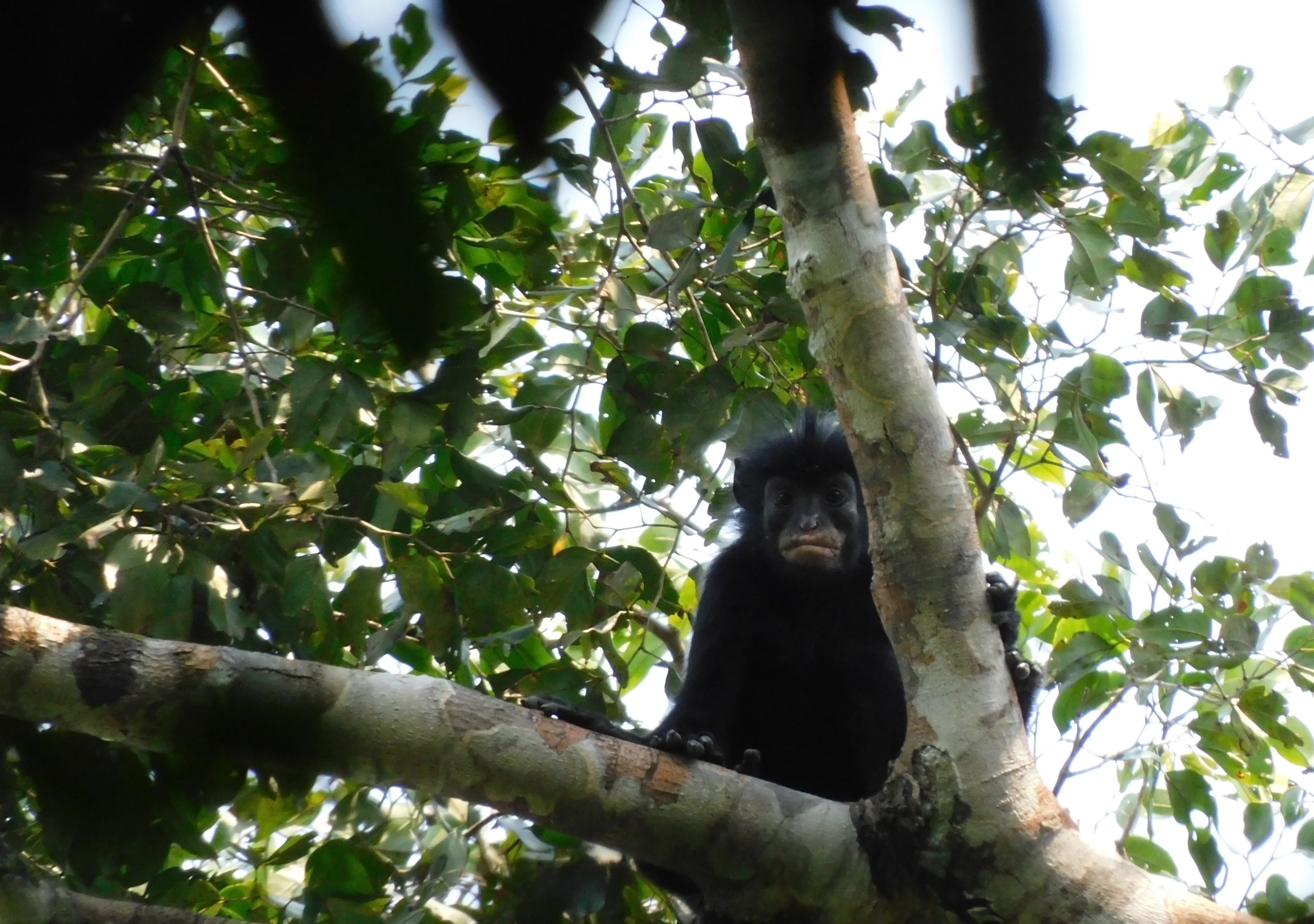
The likweli's coat is black and glossy and shines under certain light. The monkey's face is dark, too, except for a halo of bare skin around the mouth that can be the color of a peach or an orange creamsicle. The monkeys have long black facial hairs that give them a charmingly electrocuted appearance, and their ears are folded and sleek. Male and female likweli monkeys look quite similar. Like other Colobus monkeys, the males have slightly more pronounced canine teeth. The likweli is smaller than other Colobus monkeys, weighing in at around 15 pounds. Also, likweli monkeys have whitish butts, but I will not include any photos of these markings as a sign of my respect.
In 2008, Ashley Vosper and Bernard Ikembelo, scientists from the Lukuru Foundation, photographed an unidentified monkey in the forest canopy of what is now Lomami National Park in the DRC. The photo, as it is described in the new paper, does not appear to have been very good. But it was good enough that the scientists suspected it might represent a new monkey. But the monkey was not sighted again until 2018, when Jean-Pierre Kapale, an author on the paper and a scientist at the Lukuru Foundation, a nonprofit based in the DRC, spotted the monkey in the park. For the next 10 months, Kapale and a team of researchers surveyed the park in search of this elusive monkey, which they knew had a pale mouth and an even paler butt. "This discovery is both exciting and deeply personal, highlighting the extraordinary biodiversity of my homeland and how much remains undocumented," Junior Amboko, a PhD student at Florida Atlantic University and an author on the paper, said in a statement.
Like other monkeys, the likweli likes to roar. They most often can be heard calling at dawn, and their pale mouths result in a distinct visual display. When scientists happened upon a group of 10 likweli monkeys fending off an attack by a crowned eagle, they heard the monkeys call out in a bout of rapidly repeated roars. The likweli's roar differs from other closely related monkeys by its rapid pulses, each broken up with a distinctive snort. (Although, the researchers wrote, the monkey often snorts even without roaring.)
The likweli appears to occupy a vanishingly small geographic range: a patch of approximately 650 square miles of rainforest in the DRC, ranging from the Lomami River to the Lilo River. The researchers detected the monkey 114 times over a four-year survey; many of the eight other primates in the area, which include seven other monkeys and a bonobo, are spotted more frequently. The researchers propose the likweli be considered endangered, given its small range and relative rarity, as well as the considerable threats to its survival, which include habitat loss, human expansion, and hunting. At least the likweli seems to be a congenial monkey. It lives in groups, often groups encompassing multiple species of primates, such as the Angolan black-and-white colobus and the Lomami red colobus.
I'm proud to award the likweli a coveted 10 out of 10 monkeys, the highest possible rating a new monkey could hope to achieve from the Defector Monkey Council. I will not name the members of the council, nor will I share what rating the lesula would have earned if it were announced this week, because the council does not retroactively rank monkeys. But rest assured that the likweli is not just a new monkey; it is a new monkey with the highest possible distinction.