There comes a time in every skeleton's death when, upon their being discovered in a grave hugging another skeleton, modern people start foaming at the mouth, guessing at what that relationship might have been. This is understandable and quite defensible from my perspective as a modern person. An embrace is a gesture that transcends however many centuries might separate us. Of course we might wonder who these two people were to each other. We might want to know the nature of their love.
This is of course an assumption. An embrace is not proof of love, but it is a powerful suggestion of it. In archaeology, people buried in double and multiple burials are often interpreted as having some kind of connection, whether through social or family ties. An adult buried with a child might be interpreted to be the grave of a mother and a son, for example, and a double burial of two adults, male and female, is often interpreted to be a couple.
But sometimes assumptions are overturned by evidence. In 2024, a paper that extracted ancient DNA from the skeletal material in Pompeii's plaster casts challenged several traditional interpretations. For example, the casts of an adult with a golden bracelet and a child sitting on their lap, traditionally assumed to be a mother and child, were revealed to belong to an adult male who was not related to the child. And the smaller of two people who died in an embrace, traditionally interpreted as sisters or lovers, was revealed to be a man who was unrelated to the other skeleton. This suggests this man might have died embracing another man or a tall woman, both of which are certainly more exciting options than sisters.
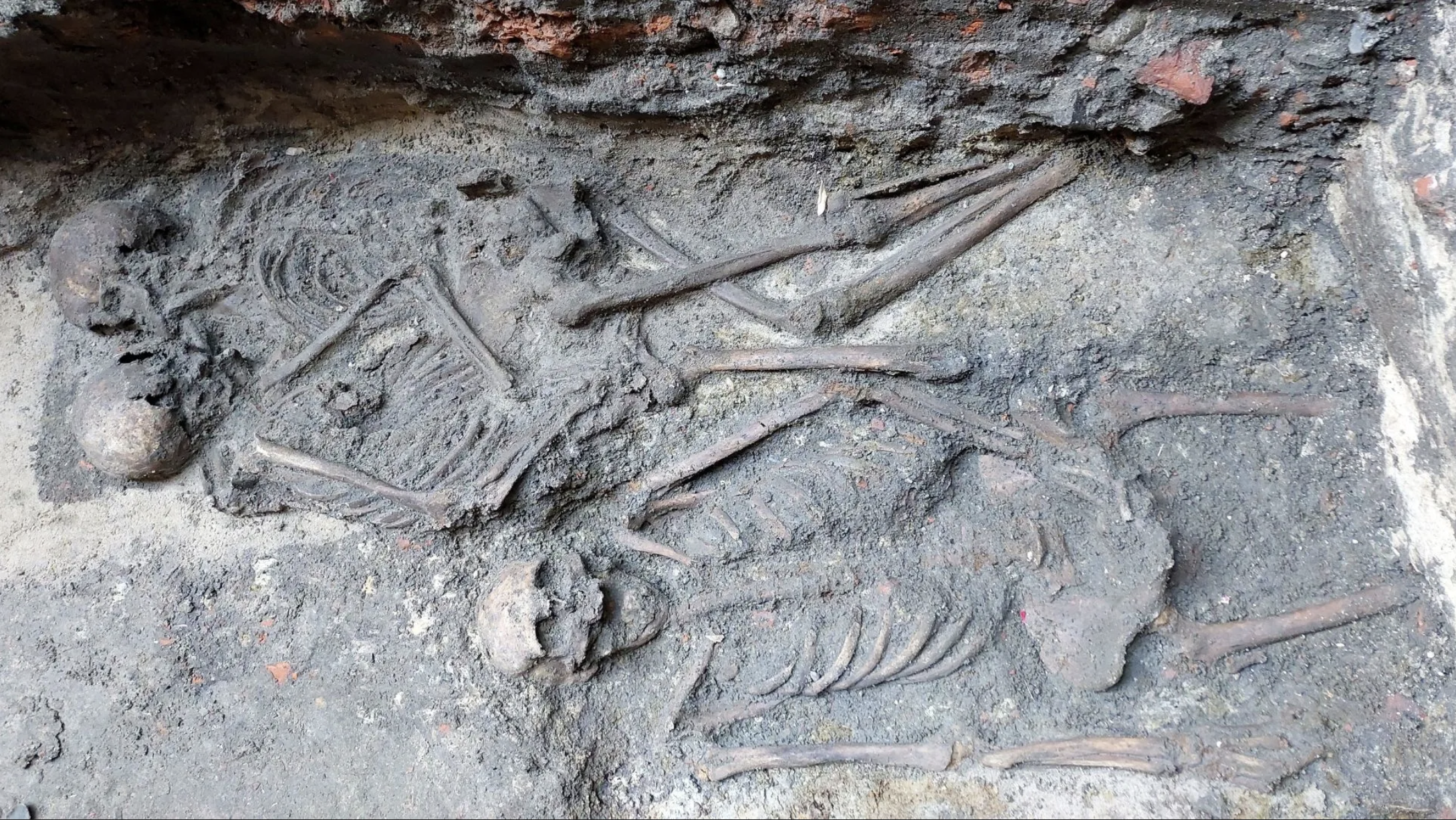
A new DNA analysis of a double burial in Poland in the Journal of Archaeological Science: Reports raises similar questions about what we can know from the embrace of the long dead. Several years ago, archaeologists excavating the Cathedral of the Exaltation of the Holy Cross, in Opole, found a 13th-century church within the cathedral's walls. They unearthed 46 burials, some within the church and others from the church cemetery. All the individuals buried within the church were laid to rest in the medieval tradition: on their backs, with their arms along their body or pelvis. But one grave stood out. It was a double burial of two adults. And while one was interred on their back, the other was interred on their side, with one arm underneath the other's head. It looked undeniably like an embrace. The burial was quickly dubbed "hugging skeletons" and interpreted as lovers, the authors write.
Given the skeletons' positioning, the authors believe the two were buried at the same time. Although the bones were poorly preserved, the researchers estimate they were each about 40 years when they died. The DNA analysis revealed both were female and not closely related, leading to the needlessly confusing headline: "DNA cracks the mystery of hugging skeletons: First same-sex grave of two women who were neither sisters nor cousins."
With June just days away, the discovery of the first same-sex grave of two women who were neither sisters nor cousins carries the patina of queer representation. If the original interpretation of the hugging skeletons was that they were lovers, could that interpretation not still apply to two female skeletons? The scenario might be tempting, but the authors consider it unlikely. Medieval Europe at the time often punished people who were accused of homosexual relationships, and the location of the double burial, which was located close to the church walls—a resting place often granted to royalty—suggests they had high status. (This burial placement also suggests the individuals were not marginalized for any other reason, such as dying of an infectious disease.)
It is tempting, too, to dismiss these archaeologists' conclusions for being staid and heteronormative, indicative of many historians' longstanding refusal to recognize queer or trans identities in the dead even if evidence suggests otherwise; or, as Reductress put it, "Historians Pretty Sure Two Women Who Lived and Were Buried Together Just Friends." According to the historian Judith C. Brown, whose scholarship concerns early records of European lesbianism and loosely (incredibly loosely) inspired the film Benedetta, medieval Europe's understanding of sexuality was entirely phallocentric. Back then, people could not understand what sex might look like without penetration, or what one woman might desire in another. As such, the historical record of medieval lesbianism is unusually silent, though there was certainly medieval lesbianism happening.
But there is no specific evidence pointing to a lesbian relationship between these hugging skeletons. In fact, there is not much evidence pointing to anything at all. The two were wrapped in shrouds and placed directly into the pit. There were no traces of a coffin or grave goods that might have indicated how they understood themselves or were perceived by society, in terms of class, status, or gender. As the authors correctly note, the discovery of a "same-sex burial" refers only to the biological sex elucidated by DNA analysis. But DNA tells us nothing about how these individuals might have understood their gender, sexuality, or other roles in society. There is no guarantee that these individuals understood themselves as women, whatever that meant to people of their time. It is just as likely, the authors suggest, that the two skeletons had no relationship at all. They may have been buried together because they died together, perhaps suddenly or in a freak accident.
So what have we learned from the first same-sex grave of two women who were neither sisters nor cousins? Wanting someone to be a lesbian does not make them so. At the same time, there is simply not enough evidence to rule out any kind of relationship between the two 40ish-year-old women buried together at Opole. Though they may not have lived together, they certainly lay together, flesh dissolving into flesh.