

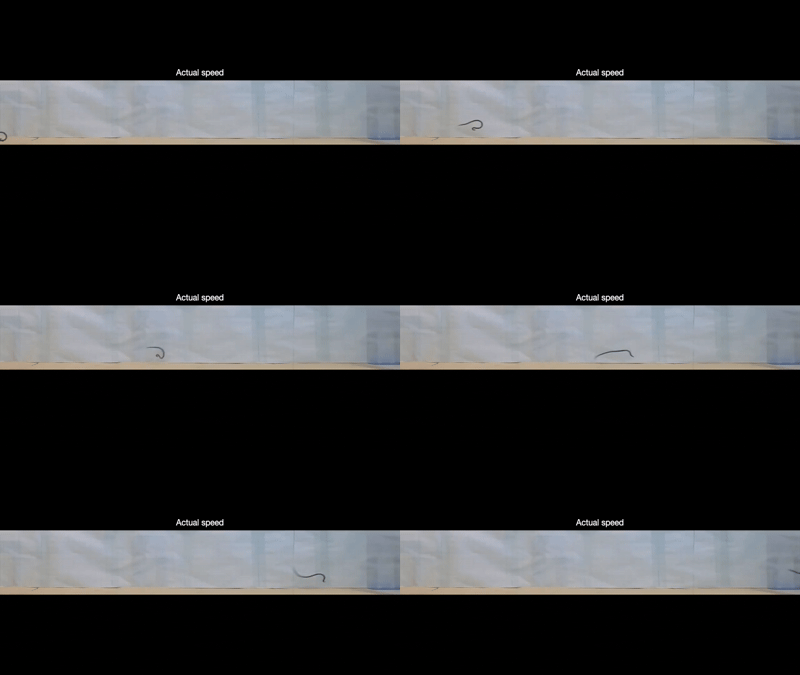
For eons, roly-polies have rightfully dominated the rolling space, at least in our imagination. The crustaceans' astonishing ability to transform from a legged arthropod into a perfect sphere, a behavior called volvation, earned the bugs their nickname. But the bugs are far from the only rollers in the animal kingdom. Pangolins, hedgehogs, echidnas, and armadillos do it too, curling up their bodies into defensive balls. So does the Venezuelan pebble toad, which tucks in its head and tumbles down slopes to escape tarantulas. The Mount Lyell salamander rolls too, coiling itself into a wheel and bouncing down steep rocks. None of these animals become quite as Platonic a sphere as the roly-poly, but they do well enough.
But becoming a ball is not the only way to roll. The dwarf reed snake has found another way to roll away from danger, not by becoming a ball but by becoming something like a hoop. This peculiar motion, the mechanics of which are analyzed in a new paper in Current Biology, raises an important question: What is more sinister, a snake slithering in the grass or a snake rolling itself like a possessed wheel?
The video above might seem to validate the legend of the hoop snake, a cryptid from Northern America and Australia famous for biting its tail like an ouroboros and then rolling like a loose wheel to hunt. Were hoop snake truthers simply seeing the dwarf reed snake do its thing? Unfortunately this does not seem to be the case. Unlike the hoop snake, dwarf reed snakes, which belong to the genus Pseudorabdion, live only in Southeast Asia. So the sightings of the North American hoop snake still remain unverified as of now.
But some very real snakes move in unexpected ways that surprise even the researchers who study them. Southeast Asia is home to flying snakes, which can launch themselves from trees and glide for a few seconds to another. In Guam, baffled scientists observed brown tree snakes that climbed stovepipes by turning their body into a lasso. Snakes are experts at doing things out of our sight. "The fact of the matter is that even in a place with a high density of snakes, for the most part, you don't see them," said Jake Socha, a biomechanics researcher at Virginia Tech who was not involved with the new paper. "They're good at lying low and being cryptic."
Although there had been previous reports of the dwarf reed snake rolling around in circles, the behavior was first photographed in a 2023 paper in the journal Biotropica. Evan Seng Huat Quah, a herpetologist at the University of Malaysia of Sabah who was not involved with the new paper, had heard these anecdotes. But when Quah first observed the snake rolling in the wild, "I was completely blown away," he wrote in an email. "It really caught me by surprise at how much ground a small snake like that could cover through cartwheeling."
When Socha first saw the video of the rolling dwarf reed snake, his jaw dropped. "In today's day and age, my first question was, is this real or is this AI?" he said. "It's definitely real, and that's kind of why it's jaw-dropping. You don't expect that the animal can do that." The dwarf reed snake is not the only snake that can launch itself from the ground; horned adders can use a striking motion to lift themselves off the ground, and some legless lizards are known to jump, Socha said. But these actions are one-offs. By contrast, the dwarf reed snakes manage to roll themselves in a continuous motion. "That's one of the reasons it's remarkable," Socha said.
When Yosuke Kojima, a zoologist at Toho University in Japan and an author on the new paper, first observed the rolling dwarf reed snakes, he "was amazed by the dynamic movement and immediately wanted to learn more about it," he wrote in an email. The researchers went to Borneo to track down some species of reed snake (dwarf) and reed snake (regular.) They found all the dwarf reed snakes were able to roll, although the bigger reed snakes could not. But the movements were too fast to analyze with the human eye.
In the rolling experiments, the researchers placed dwarf reed snakes on a narrow racetrack, a little thinner than a piece of printer paper, and gave them a nudge. Then the snake was off. As Kojima analyzed slowed-down video footage of the rolling snakes, he noticed the snakes managed to keep their heads facing in the direction they were rolling. "So they couldn't simply be rolling their whole bodies," he said. But he couldn't figure out how the movement worked until he watched the videos over and over and mapped them out in three dimensions.
Birds are often thought of as masters of keeping a stable head atop a moving body, but dwarf reed snakes have now proved they can do it too. As the snakes roll, they appear to keep their head stable as their body rotates around it. This appears to help the reptiles stay in control as they flee, but also adds to the movement's "unnatural kind of look," Socha said.
Although the snake might look like it rotates its entire body like one circle, the movements are more complicated. "I was even more amazed by how complex the movement actually was," Kojima said. As it turns out, the snake rolls one side of its body along the ground then swings a bent section of its body toward the ground to continue rolling, a movement the researchers dub a "stroke." By repeating this motion, the snake manages to roll continuously, whipping its body in the air to alternate between hitting the ground with its back and its belly.
What is the point of doing this? Good question. The reptiles moved four times as fast rolling as they did while undulating on the ground normal-style. So rolling is clearly an effective means of escape, in addition to probably disorienting whatever predator was trying to sneak up on them. Considering this, I asked Kojima if there were any drawbacks. Otherwise wouldn't the snakes move like this all the time? "This mode of locomotion may require a lot of energy, but we don't yet know how long the snakes can sustain it," he said. Can other snakes roll like this too? It's unclear if, say, a small garter snake could be found wheeling itself out of the path of a shovel. Socha suspects there is something particular about the dwarf reed snake that allows it to move this way. But "what is exactly is going on with its body and how exactly the snake is doing this is still an open question," he said.
Snakes astound Socha for all the things they can accomplish with a body that approximates a muscular rope. The only thing he can count on, it seems, is a snake's ability to surprise. "I'm out of predictions," Socha said. "My only prediction will be that this is not the last thing we discover."