

To Jan Brueghel the Elder, paradise could not be contained to a single biome. Many of Brueghel's paintings teem with menageries of birds, mammals, reptiles, and fish that would never ordinarily meet in the wild: monkeys from the Americas mingling with birds from Europe and ungulates from Asia. Brueghel's paintings were also striking for their scientific accuracy, as Arianne Faber Kolb wrote in her study Jan Brueghel the Elder: The Entry of the Animals into Noah's Ark. In the 1500s, European exploration and subsequent exploitation of other continents introduced Europe to many exotic new species which wound their way into fine art. Unlike other painters of his age, Brueghel avoided including mythical creatures like unicorns in his landscapes. To Brueghel, the newfound abundance of the planet's species was heaven enough.
Many Renaissance painters illustrated exotic animals from descriptions, leading to fantastical or off-kilter representations, such as Francesco Bianchi Ferrari's 16th-century Arion riding on a Dolphin, which which calls into question whether Ferrari had ever seen a dolphin or a child. But Brueghel painted many of these foreign creatures from life. In 1606, when Brueghel was appointed to be a court painter for Archduke Albert and Infanta Isabella, cousins and co-monarchs of the Habsburg Netherlands, he visited their extensive menagerie and saw animals only recently transported from the Americas. There was a fishpond stocked with tortoises and crayfish. There was an aviary with turkeys, canaries, Indian hens, white and colored peacocks, grouse, pheasants, partridges, nightingales, quails, Icelandic sparrow hawks, a scarlet macaw, and a toucan. There were tiny lion tamarin monkeys, cotton-head tamarins, and marmosets. There were camels as well. Brueghel did not just sprinkle these exotics in his 1613 painting The Entry of the Animals into Noah's Ark; he placed them in situ. He tried, to the best of his knowledge, to illustrate them interacting with each other and the world just as they would in their own wildernesses.
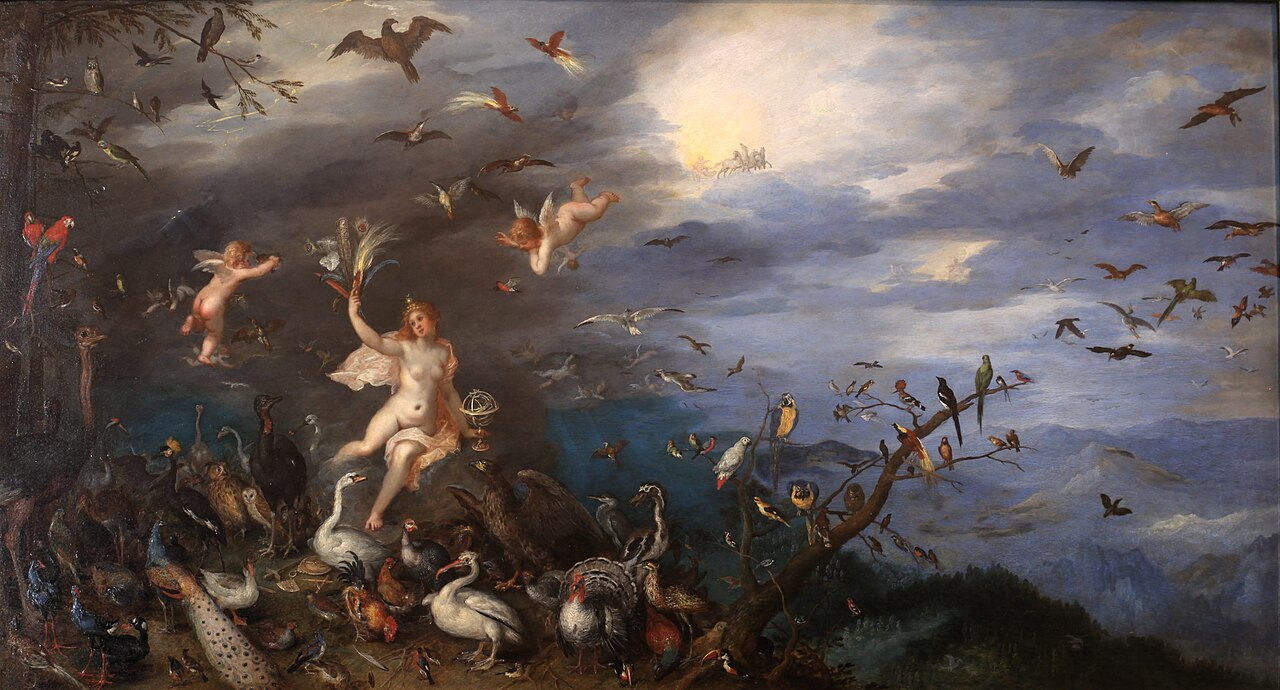
Brueghel's 1611 painting Air represents the apex of such an imagined aviary, with toucans, peacocks, swans, both scarlet and blue-and-yellow macaws, turkeys, owls, and an ostrich. Each of these exquisitely rendered species surrounds the Greek muse Urania, who holds an armillary sphere. But Air is not just the domain of the avian. Four other fliers populate the painting. They are bats, and Brueghel's naturalist bent means the bats, too, are identifiable. The bat in the left corner is a vesper bat, distinguished by its long ears. The two in the middle appear to belong to the family Vespertilionidae. And the bat at the top right looks to be a noctule bat with a bird in its mouth. As such, a new study in PNAS suggests that Brueghel's Air represents the first direct evidence of bird-eating noctule bats.
Last year, Pedro Romero-Vidal, an author on the paper who works in conservation biology at the Doñana Biological Station in Seville, Spain, became interested in what art might have to teach scientists about historical ecology. He started working on a project identifying different species of mammals and birds—"mostly parrots and monkeys," Romero-Vidal said—in paintings across different centuries. This research could help reveal when each of these animals spread across Europe. Romero-Vidal became especially interested in 17th-century paintings by Flemish, Dutch, and Italian artists, many of whom were in the business of painting exotic animals. Of course, the mere fact that a 17th-century Flemish artist painted an ostrich does not mean that an ostrich necessarily made its way to Belgium. Artists could have traveled to other countries or painted off secondhand descriptions of these animals. But the paintings still represent a valuable and underutilized source of historical ecological knowledge, Romero-Vidal said.
Although Romero-Vidal eventually wants to create an AI program that can trawl digitized paintings for evidence of exotic animal species, he has been carrying out his research as simply as possible: going to various museum websites and looking for paintings with animals in them. He was struck by Brueghel's animal-ridden archive and the level of anatomical detail the painter achieved. "You can arrive to the level of species in most of them, so that's really interesting," he said. For example, the macaws, parrots, and birds of paradise are immediately identifiable in Brueghel's work. "Other paintings from the 16th or 17th century also from Belgium or the Netherlands are not as accurate." In Air, he recognized species of birds from South America, Africa, and Oceania. And then he recognized some birds were not birds at all. "In this one, there is also bats," he said.
Romero-Vidal showed the bats to Sonia Sánchez-Navarro and Elena Tena, who are both bat experts and authors on the paper. "I also told them that one was carrying a bird in the mouth," he said. "That was really, really surprising to me." Sánchez-Navarro and Tena told Romero-Vidal that this observation was, in fact, extraordinary. Just last year, they had published a paper in Science describing how greater noctule bats prey on flying migrating songbirds. And now, it seemed, the first evidence of such behavior was recorded centuries ago in a painting from 1611.
The Spanish bat researcher Carlos Ibáñez first discovered songbird feathers in bat droppings nearly 25 years ago. But the scientific community met this supposition with skepticism, given the considerable heft of songbirds compared to the bats' other prey. When researchers conducted a molecular analysis of the feathers strewn in these feces, some of the bird species weighed about half as much as the bats themselves. The scientists had been unable to record proof of this hunting behavior and understand how the bats manage to catch and eat the birds in flight. Bats feed in the darkness of night. And the animals are tiny and lightweight, making it difficult to attach any kind of recording device that could return footage. Researchers tried GPS trackers, surveillance cameras, military radar, and even recorder attached to hot-air balloons. But these methods returned no proof. Finally, ultralight biologging tags did the trick, revealing the bats' prolonged chases and mid-air feasts.
Tena and Sánchez-Navarro had no doubt that Brueghel's bird-eating bat was a noctule, most likely a greater noctule, distinguished by its short, broad, and rounded ears, long and narrow wings, and reddish-brown fur. Although the bat is not found in Belgium, it does live in Italy, where Brueghel was known to spend time. The researchers could not identify the bird that the bat was eating, as it was obscured by the happenstance of being actively devoured.
According to the paper in Science, when a greater noctule captures a songbird in the air, the bat removes the wings and head while still airborne. The bat holds the prey with their feet and use a flap of skin between their hind limbs like a pouch. And then the bat chows down, still flying. It takes up to 20 minutes for a bat to eat a songbird this way, during which time the bat still echolocates and flies normally as it munches on gristle and bone. (The soundtrack of this kind of predation is fascinating, and also gnarly.) The authors suggest Brueghel's painting shows the initial stage of this behavior.
Romero-Vidal stresses that there is no guarantee that Brueghel saw this behavior in person. "It could also be a symbol of something," he cautioned. But he dismisses this theory as less likely, as the painting does not appear to use its animals as symbolic elements, and it would be strange if the bats alone were relegated to such a purpose. It seems far more likely that Brueghel himself witnessed the bats' behavior, heard about it from someone else who did, or even came across bird feathers in bat droppings. "We believe it because he was a naturalist. He was a really good observer of nature," Romero-Vidal said. "So we think that is what he was doing in the painting."
As Romero-Vidal pores over more museum databases in search of strange animals, this practice has changed his relationship to paintings. "I always liked art, but now I'm looking at them in a different way that is also really interesting," he said. Maybe he should take a second look at the macaws and other parrots, just to see if they're up to anything weird.