

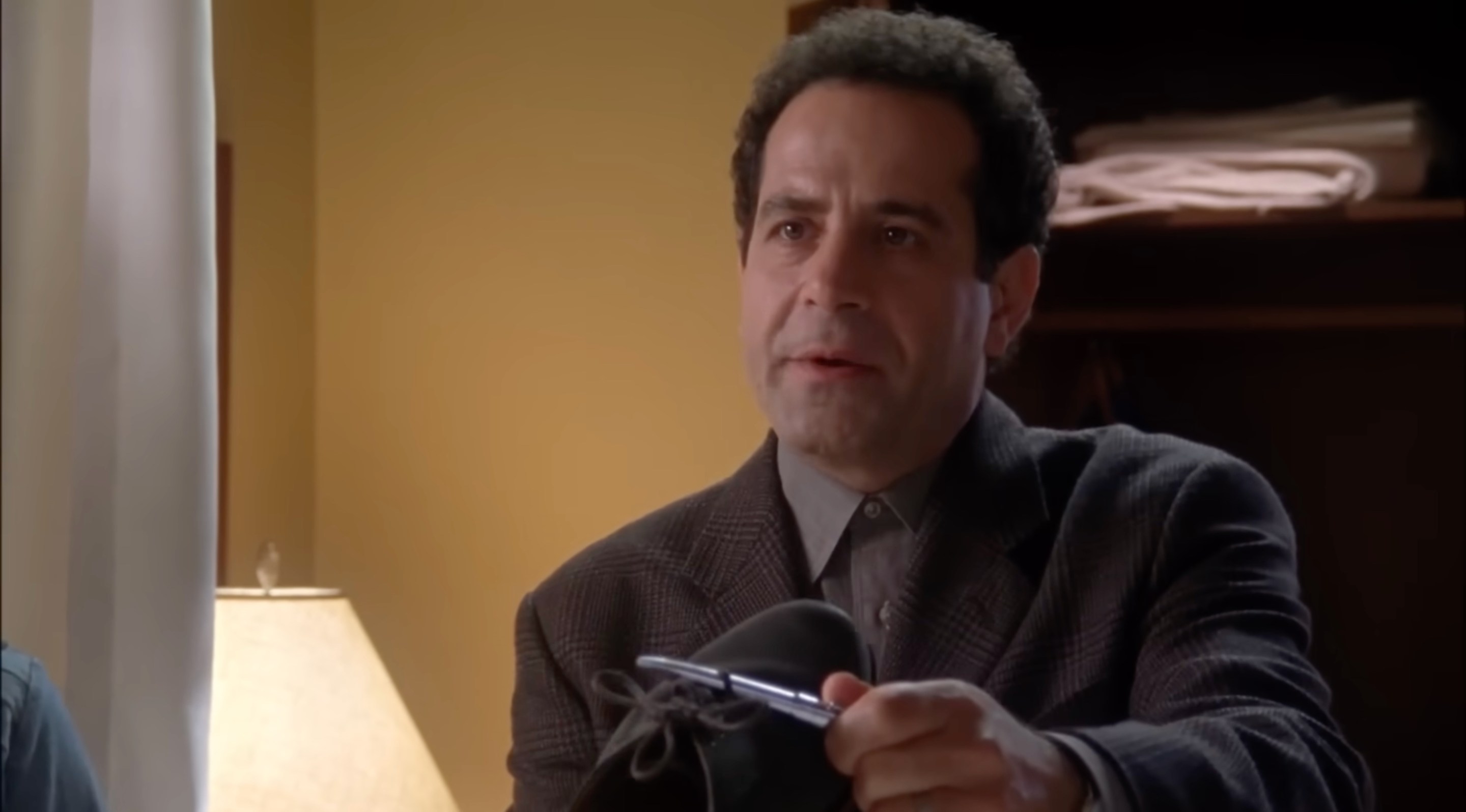
One of Monk's most Monk-like episodes in all of Monk occurs in Season 2, Episode 7: "Mr. Monk and the Sleeping Suspect." Adrian Monk, Tony Shalhoub's impersonation of Eeyore if the donkey had severe OCD, has taken to visiting Brian Babbage, a comatose man and his prime murder suspect, for an unofficial therapy session. Monk's actual therapist is away on vacation, and the private detective desperately needs someone to talk to. "He's a good listener," Monk tells his bewildered assistant, Sharona Fleming.
Monk sits by Babbage's hospital bed and spills his many woes while doing what he does best: puttering around and noticing things. Monk notices Babbage's watch is a couple minutes fast—an unacceptable misalignment in his world—and as he fixes the watch, he notices a bit of glue stuck to the face. "What were you gluing?" Monk wonders aloud. Suddenly, a distant clatter causes Monk to whirl around and knock over a flowerpot, spilling dirt on the floor. Such disorder, the viewer knows, is unacceptable to Monk, who promptly fetches a vacuum to clean it up. Trusty wet wipe in hand, Monk unplugs a white cord from an outlet to plug in the vacuum and starts sucking up the dirt. The noise of the vacuum is almost loud enough to obscure the fact that Monk has just unplugged Babbage from life support. The man flatlines, but Monk plugs him back in and manages to restart his heart with CPR. Monk has, per his modus operandi, both wrecked and saved the day. The scene then cuts to a disgruntled outsider, a nurse, who, like many, disapproves of the Monkness of it all.
Monk's improbable theory—that a man who was literally comatose while the murder happened was, in fact, the murderer—turns out to be right, of course. Brian Babbage had mailed bombs to his siblings so that he alone would inherit their late father's riches. The glue was the clue: The smear on Babbage's watch was evidence of how he glued the bombs inside blue mailboxes so that the packages would drop down and ship months later, after the adhesive degraded. And it turns out that Babbage's near-death experience—his second one, really—actually restarted his heart, allowing the police to confirm his guilt and arrest him.
I have been paying close attention to Monk the man because over the past few weeks I have been rewatching Monk the show, basically from the beginning. I grew up in the Bay Area watching it with my parents, who would often pause the TV to point out some obvious anachronisms, as the show was set in San Francisco but filmed largely in Canada and Los Angeles. Monk and Sharona would announce their intentions to go to Nob Hill, and then in the next scene my mom would shout, "That's not Nob Hill!" and so on. For years, I thought there were only three seasons of Monk, because my parents disavowed the show after Bitty Schram's Sharona was abruptly replaced by Traylor Howard's Natalie. (Similar reasons explain why for years I didn't know there were Nazis in The Sound of Music.) As a child, I exhibited some signs of OCD that now, in retrospect, may have come from overexposure to Monk, who I thought was an extremely cool guy.
I have spent nearly every waking hour of the last two weeks editing my book, a process that drained my brain so exhaustively that each night all I could do—all I did—was make Costco popcorn and watch an episode or two of Monk. My rewatch was spurred by nostalgia, not just for the show itself, but the genre it helped spawn, lighthearted shows that take place in cities whose citizens are apparently unperturbed by the relentless string of unusual murders that require solving. I often struggle with prestige TV, the way storylines tangle and lurk and require close attention. But Monk goes down easy. There are quips, twists, and little to no blood. There's even a sense of comfort that comes from watching a man who has been rendered so miserable by the untimely death of his beloved wife that you do not envy the man at all, not really. You do not covet his peculiar brilliance and all the dread that accompanies it. As Monk often says, "It's a gift ... and a curse."
I'll never be able to see the world the way that Monk does, nor do I wish to. It's not up to me or even Natalie, Sharona, or Captain Stottlemeyer to solve these murders. (I mean, it is up to Stottlemeyer in that solving murders is his job, but in the logic of the show he is usually immaterial to the actual solving.) All we viewers are meant to do is wait for Monk to be struck by his moment of revelation. We watch him frame a room with his hands until he recognizes the significance of a bag of flour, the volume maxed out on a TV, a grammatical error on a suicide note. (Apologies that all of these examples are from the first two seasons; I'm almost to the third in my rewatch.) The inevitability in each episode, that Monk will find and catch the killer, is soothing. The clue is always there, hidden in plain sight because no one besides Adrian Monk would know to notice it. In this way, the show allows me to be a total spectator, a passive participant in the solution of the homicide. It is a kind of escape from the real world, where the things that need to get done will not get done unless you do them.
It was interesting, then, to watch Monk during a two-week span where my only task was to edit, which, like detective work, is a practice of noticing and solving. Editing is not like watching Monk, but rather becoming Monk. As you might expect, this can be exhausting. I envy how naturally revelation comes to Monk. I read essays that I know are not working, then I read them over and over again. When I revise, I am not always sure what I am looking for, an infuriating uncertainty. Sometimes my arguments are thin, sometimes my examples not quite right. What I most often find is that my conclusions are too neat, which almost always means they are not true. In revision, I can see myself growing exhausted by the act of writing an essay, of figuring out exactly what I want to say, so that when I stumble upon some obvious ending, I go with it, even if my gut tells me it's not quite the right one.
This type of thinking is Monk's second great nemesis (the first being, of course, the actual killer). Although Monk is technically a consultant to the police force, he often finds himself in opposition to the cops and their penchant for copping out. In "Mr. Monk and the TV Star," everyone except for Monk has been dazzled by the celebrity of Brad Terry, the star of a hit crime show, who is working with the police after his ex-wife Susan was murdered. Brad's alibi is strong: He was standing outside his house when reporters heard his ex-wife's screams. Besides, Brad is charming and handsome, wooing Sharona and buttering up Stottlemeyer and his doofus deputy Randy by offering them a consultancy and a bit part on the TV show. This dynamic puts Monk in a terrible bind. He knows Brad murdered his ex-wife, although he doesn't yet know how. But Monk realizes this makes him a spoilsport, a role that is all too familiar to him in the rest of his life. So, for once, Monk tries to hang. He drops his case against Brad and watches all his friends throng to the star and bask in his Hollywood glow.
Of course, Monk eventually figures it out. Like other great detectives, he recognized a suspicious sound: the scream that came from Susan as she was murdered was identical to her scream in an old slasher movie she made years ago. Brad had edited one of Susan's yoga videos to be unusually quiet before cutting into that scene of her screaming. Unsuspecting Susan turned the volume all the way up on the TV to hear the yoga, which meant she also broadcast her scream to be heard outside the house, where paparazzi had gathered to ask Brad about a drunken incident from the previous night. When Susan's scream played from the TV, Brad ran back inside the house to kill her. In the eyes of Adrian Monk, what seemed like an ironclad alibi was actually suspicious for its neatness—the serendipity of so many eyewitnesses gathered to give Brad cover as Susan was apparently murdered in the other room. So Brad is arrested, another improbable case closed by Adrian Monk.
I am no Monk. I am often sloppy, in writing and in life, and as such am often tempted by a tidy ending. It is terrifyingly easy, I've learned, to write an essay that seems polished but doesn't actually say anything. This is how I always manage to dupe myself into thinking I've solved my problem. But then there is that niggling feeling in my gut, that old hunch that something is not quite right. In some weird way, I think, Monk gives me permission to believe in that unease.
Monk might be TV's greatest testament to trusting your gut, to leaving no stone unturned in your pursuit of understanding, even if it wreaks havoc on your life, your relationships, and the normal ordering of your body. Near the end of my two-week revision, I realized I had been living not just like Monk, but like a monk. Each morning I drank the same green smoothie for breakfast—my Sierra Springs—and each night I ate a single (large) potato for dinner. I learned many things during this hermitage. To succumb entirely into order and routine can make it easier to dive into disorder, and maybe even start to piece it together. To devote your attention to minute details can lead to moments of brilliance, but it can also make you manic. I had revelations, but at what cost?
I take comfort in the fact that, unlike Monk, I know how to stop paying attention. And it seems fitting that the first place I went after this ordeal was Atlantic City—one of Sharona's former stomping grounds—a land of grime and excess, the very sight of which would cause Monk to short-circuit. I already miss him and his quirks, some of which have imprinted on me; at dinner the other night, I found myself adjusting one askew fork to match its partner. Monk hits different when you are not mired in disorder and confusion, and a little depressed by the eccentric you have become. It feels less like a guidebook and more like a TV show, which means Adrian Monk feels less like some peculiar mystic and more like a real piece of work. Maybe that's why he helped me move through my two weeks of revision, a time when I was so fixated on my book that my mind succumbed to its endless swirl of thoughts and anxieties, which made being with alone them unbearable.
In Monk's first episode, "Mr. Monk and the Candidate," one cop calls him a "living legend," to which another cop responds, "If you call that living." This is the secret of Monk. Although the man is exhausting to be around, the person he exhausts most is himself. It might be possible to write a perfect book, but that also comes with its own cost. So I think it's OK if I can't notice everything this time around, if I can't figure everything out in 44 minutes. Good thing I know someone who can.