
The 1990s and 2000s were great decades for the sports idiot. Movies like Talladega Nights, Dodgeball, Kingpin, and others belong to this subset of the sports comedy, one that explores the unique problem of being good at sports and bad at everything else. With the help of an older mentor, often but not always played by an older Black man, and a supportive best friend even dumber than him, the sports idiot comes up against more threatening kinds of men—richer, meaner, or both—and triumphs.
No matter how old he is, the sports idiot begins their journey in a state of perpetual adolescence. Sports are to blame for his arrested development, and his over-competitive spirit is tolerated by fans and love interests alike due to the same deference afforded to famous divas and tantruming toddlers. And yet—this is the most important thing—sports are also the means by which the idiot will grow up. Becoming a better player will make him worthy of a good woman, will help him survive the loss of a father figure, and will provide him the community that he didn’t know he always needed.
While the Sports Idiot genre never fully disappeared, subsequent years favored more serious sports movies, among them award contenders like Moneyball and the Creed franchise. Meanwhile, the male-centered comedies on everyone’s lips were The Hangover and the collected works of Judd Apatow, which, respectively, focus on competitive intoxication and the game of heterosexual love. But, finally, the lovable sports idiot is back and eager to show audiences that he’s a little less problematic than before.
Folks, we can fix him.
Last summer’s Happy Gilmore 2 tackled this evolution with sly introspection. Adam Sandler’s hockey washout-turned-golf star is married with a loud, boisterous family. “We fight in the basement, not at the table,” he scolds his boys at dinner. And when Happy’s former nemesis (Christopher McDonald) ogles a sexy woman, Happy’s neighbor, an old coot and former golfer (played by real retired golfer John Daly), doesn’t approve. “Hey, we do not objectify women anymore,” he pronounces.
Who is the “we” here, and when did “anymore” start? This is the sports idiot 2.0: still weird, with even weirder buddies, but with a broader coalition and a softer attitude toward difference.
This year alone has seen the premiere of the clever mockumentary-style The Fall and Rise of Reggie Dinkins, starring Tracy Morgan and co-created by 30 Rock’s Robert Carlock, and the less clever, more cringe Will Ferrell vehicle The Hawk, a show with an opening jingle that sounds like an SNL sketch cut for time. You might or might not also count the Taylor/Travis wedding as part of this crop (I do).
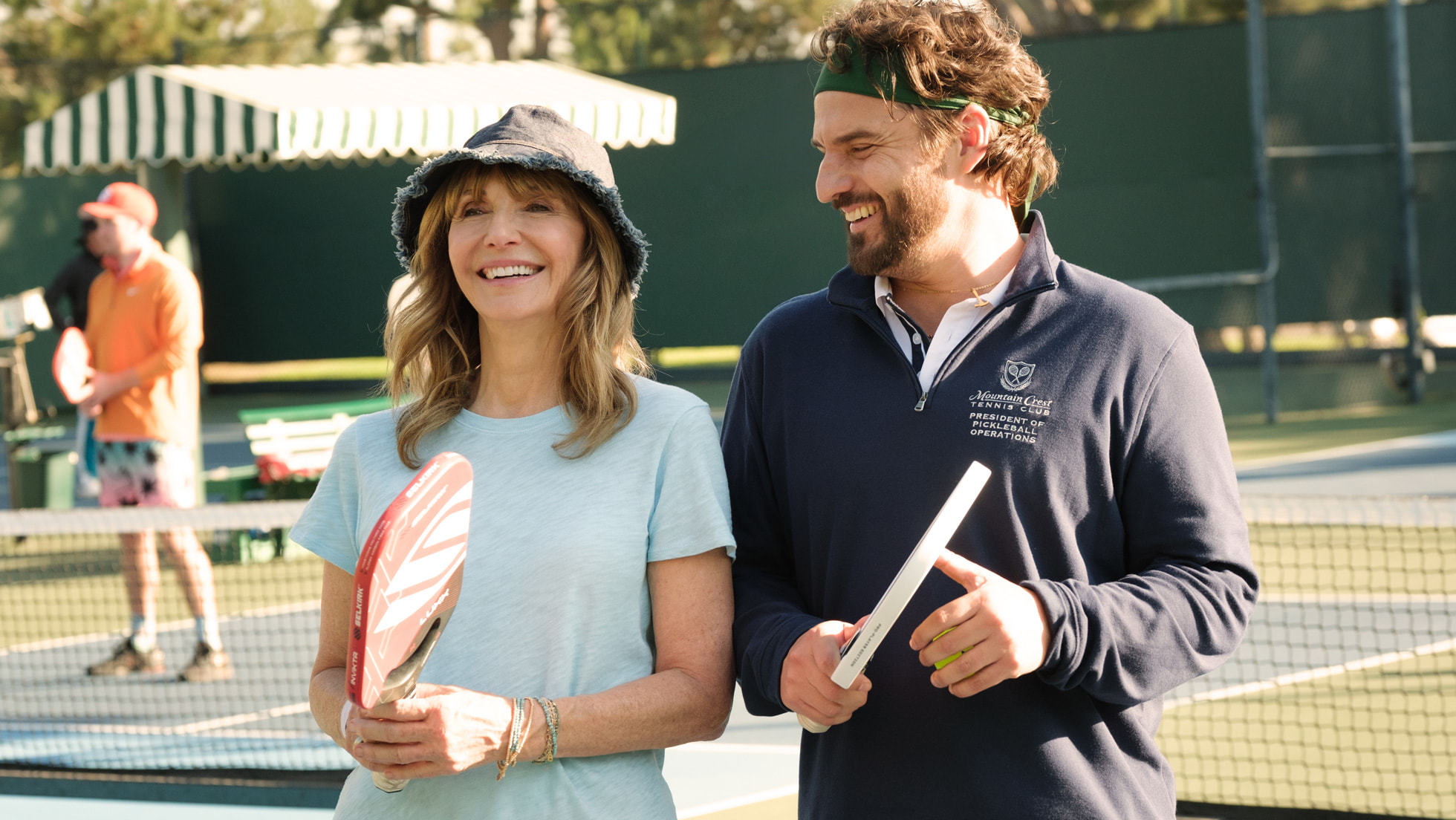
The latest is The Dink, currently the most popular movie on Apple TV. Starring millennial slacker darling Jake “Nick Miller, Nick Miller” Johnson, it follows Dusty Boyd (Johnson), a child tennis prodigy who has since gone to seed as a tennis pro; he spends his days working for his frosty taskmasker father (Ed Harris) at a tennis club and reminiscing about his former glory. Like his dad, he looks down on the rising fad of pickleball, until an injury forces him to try the sport as a form of recovery. It is not giving anything away to note that Dusty learns that the real grand slam is the friends you make along the way, namely a bunch of 70-year-old women and, possibly, John McEnroe.
The premise isn’t particularly fresh, and the execution is solid, not superlative. Still, there is something impressive in how The Dink makes a dated genre feel at least new-ish. It has the will to make the Sports Idiot movie a little smarter than it was before, maybe even a little evolved.
In a low moment, Dusty rewatches footage of the match that changed his life forever. Nicknamed “The Hammer,” young Dusty believed he was going to be tennis’ next big star, until he played against tennis’ actual next big star, Andy Roddick (who plays himself). “It’s moments like this that make me glad I grew up without a father,” an announcer intones—inappropriate, oversharing announcers remain a Sports Idiot trademark— as the recording cuts between the game and Chuck Boyd’s scowling disapproval.
Maybe it isn’t the maniacal commitment to athletics that shapes the sports idiot, then, but a childhood wound that keeps him trapped in the moment of his greatest joy and deepest shame. And for this particular idiot, sports are the symptom, not the cause.
While fathers are overbearing in The Dink, mothers are totally absent. This is not a criticism, just a fact: The Dink is a land without moms. Dusty’s mother, presumably Chuck’s wife, is never mentioned. The film’s female lead, Dusty’s pickleball partner Candace (Mary Steenburgen), never had children with her ex-husband, or just never talks about them. We learn very little about her apart from her post-divorce hobbies and how good she looks in a sun dress. Somehow, the closest we get to a mother figure in The Dink is the figure of Mrs. Robinson, when Dusty and Candace watch The Graduate during a sexually charged friend-hang. “This is a great movie,” Dusty raves. “It should be, like, a classic.”
Dusty, like The Graduate’s Benjamin Braddock, is lost, adrift. And like the sports idiots who came before, sports are what has gotten him into this mess, and sports are also what is going to get him out.
The Dink comes from Ben Stiller’s production company, which fits. Stiller produced Dodgeball, appeared in Happy Gilmore 2, and served as the goofy auteur behind the Zoolander franchise—an archetypal Sports Idiot movie, only missing the sports. Stiller plays the tennis club’s doctor, a neatly dressed, bespectacled horndog who can’t stop talking about masturbation and a website called stickyhoney.com. (A PG-13 level of sexual deviance that belongs not to the sports idiot, but some other ancillary weirdo, is prime sports idiot territory.) Stiller’s presence ties us back to the millennial roots of the Sports Idiot comedy, not to mention its overwhelmingly masculine lineage.
Boy movie births boy movie births boy movie; the genre is a family tree of all fathers and no mothers. No wonder Dusty seems to have sprung from his father’s head, fully formed. The younger Boyd has a lot of growing up to do before he can be a father himself, or even a friend. We know this from the start, as the movie begins with Dusty’s voiceover exaggerating the heights of his success and glossing over the realities of his failures. His best friend and assistant, PJ (Aaron Chen), is suitably awed by how Dusty tells his origin story, asking, “Why does it still give me chills every time I hear it?” The kids he is coaching are bored and surly. “This lesson sucks ass,” the boy snarks, still coming out as the adult in the situation.
Harris plays his role straight, to great comic effect. Beating back the plague of pickleball is about “the decline of humanity itself,” Chuck insists, comparing it to the coronavirus, as the film makes a light swipe at institutional failures and masking rhetoric. And when laying out an arcane rule from the club charter, designed to keep certain people out, clueless board member Kris (Lennon Parham) asks, “Who couldn’t join before?”
“I don’t know, Kris!” Harris snaps. “It’s an old club. I don’t have a whole list in front of me.” The camera pans to the only Black character on-screen (Wayne Wilderson), his face the picture of knowing disappointment.
There is plenty in The Dink that doesn’t hang together. Chen’s sidekick character is a deadpan delight, and the film could have granted him his own arc, however small, and seen him soar. The pickleball ladies are adorable but underdeveloped. Candace teaches Dusty to love country music, but we never learn more about why, nor does this detour pay off. Yes, the best country songs “have a story”... now what?
Many comedy luminaries, including Parham, Patton Oswalt, and Chris Parnell, are given too little to do, even as their presence is part of what makes The Dink watchable. Johnson carries the movie on his able, if slumped, shoulders. It is his movie, and it wouldn’t be half as cool or knowing with a lesser actor in the role. That said, with all the talent amassed and so little time for them to shine, it’s easy to imagine how this movie might have sung as more of an ensemble.
Still, none of these criticisms speaks to the film’s charms, the foremost of which is the generic self-awareness, how it follows Dusty from man-child to boy-man while leaving space for those who are agnostic on the charms of the sports idiot. When Candace describes her ex-husband to Dusty, she tells him:
"[Mitch] was just such a child. He had no aspirations. He didn’t have many friends, just one weird friend, really, who just was, ‘Yes yes yes’ to everything he said. He was sort of a suck-up, and he was always telling these boring, boring stories about his glory days."
What better descriptor is there, not only of Dusty, but of the Sports Idiot generally? “He doesn’t sound so bad,” Dusty offers, glumly. And, at film’s end, when Dusty gets his first taste of his father’s approval, the two embrace, while the son, with a big, goofy smile, admits, “It’s embarrassing how much this means to me!”
Dusty does not narrate the finale, the role falling to closet superfan and lay commentator John McEnroe—really, it would be more surprising if he didn’t cameo. The movie ends, as all Sports Idiot flicks must, with a high-stakes game, here a “good ol’ fashioned dink-off” between Dusty and his lifelong rival. McEnroe roots for our hero, in his words, “not only for the sake of the crowd, but for Dusty as an individual boldly trying to reclaim his identity in his mid-40s, his father’s club hanging in the balance.”
“This isn’t a real sport,” Roddick says of pickleball, calling it out as “tennis but easy.” The film is gently insulting about pickleball, and its defenses of the sport, as laid out by Patton Oswalt’s character, are patently silly: Taylor Swift and Jamie Foxx play pickleball, the Menendez brothers played tennis. And yet, despite all these light effacements, pickleball is presented as so warm and inviting, so full of camaraderie and inside jokes, that a critic would be justified in researching whether one of the pickleball federations underwrote this movie. (They didn’t.)
For the Sports Idiot, it isn’t really about achievement or excellence—an obvious point, maybe, made more apparent when the sport is pickleball. For Apple TV, it’s about deepening the emotionally-damaged-man-finds-self-through-athletics brand they have been cultivating with Ted Lasso and the Owen Wilson vehicle Stick, about a burned-out golfer finding himself through coaching. For the Sports Idiot genre, it’s about retelling the story of the man-child with a little less meanness and a lot more meta-humor, to appeal to a new audience, or a familiar, slightly older one.
And as for the central sports idiot himself? This time, at least, it’s about putting down the hammer, picking up the paddle, and broing down with a bunch of senior citizens. For what it’s worth, without toxic masculinity keeping him in one place, the sports idiot—and his genre—has room to grow.