
The artist in the video is elfin, mischievous. Even at nearly 80, she is taller than many of the assistants who join her chopping lettuce at a long counter. Her index finger is bandaged, perhaps from an earlier chopping incident. In the video it is a cold, wet day in 2012 on New York City’s High Line, and Alison Knowles cheerfully narrates the question she assumes passers-by are posing as they walk past this remounting of her most famous work. “You’re making a salad outdoors and in the rain?” she asks. Then she answers: “This must be an art event!”
That a theoretical passer-by might reasonably leap to that conclusion—that a half-dozen cooks preparing a tarp-sized salad in a public park is an “art event”—is in no small part thanks to Knowles, who in her six decade-plus career did as much as anyone to expand the boundaries of artistic work. Likely no retrospective could fully capture her capacious artistic practice, but “by Alison Knowles,” a retrospective show open at the Grey Art Museum at New York University, serves as an invigorating introduction to a creative force whose questing imagination seems, a year after her death at 92, both sui generis and like a blueprint for the future.
Alison Knowles was born in 1933 in Scarsdale, New York. She studied painting at the Pratt Institute, where her father was an administrator, and was on her way to being, in her words, “the next Helen Frankenthaler” when she took a summer course with Josef Albers at Syracuse. Exiled to the basement of the building because of her refusal to follow Albers’ strict instructions, Knowles vowed to stop pursuing “the traditional methods of artmaking,” as she later told an interviewer. One of her early paintings, “Taxis and Busses” (1959-60), hangs near the entrance to the retrospective; it’s a lively mix of oil-painted circus designs and screen-printed commercial logos. It’s one of only two early Knowles paintings that survive; she burned all the others on the beach just a few years later.
Knowles and her husband, the artist Dick Higgins, were on their way to a delayed honeymoon in Turkey when they stopped in Wiesbaden, Germany, to drop in on some artist pen pals. With Emmett Williams, George Maciunas, Nam June Paik, and Benjamin Patterson, the pair formed Fluxus, a loosely-organized collective dedicated to work in the experimental, chance-based spirit of John Cage, who had taught many of the artists. Knowles was soon performing what she called “propositions,” communal art happenings with simple instructions, meant to expand in unexpected directions. In “Nivea Cream Piece,” performers massaged lotion into their hands in front of microphones. In “Shoes of Your Choice,” audience members were encouraged to tell stories about pairs of shoes that were important to them.
Knowles’ propositions were playful and memorable, and their devotion to overlooked, often quotidian behavior undercut the solemn grandeur with which, say, Abstract Expressionism was being treated. Any everyday action became interesting in an artistic context—specifically because, Knowles points out in a video interview, “most of the people in the audience had done it themselves, without any cognizance of it being interesting.” The most famous proposition, which she continued performing for decades—including at the High Line in that 2012 video—was enacted by Knowles and others preparing a green salad big enough to feed everyone in the room. The work’s entire “score” consists of the words “Make a salad.”
Nothing is more commonplace, and thus to Knowles more interesting to investigate, than the food you put in your mouth every day. A few years later, Knowles was eating in Riss Foods, a divey diner around the corner from her husband’s printing studio, with her frequent lunchtime companion, Philip Corner. Corner noted that Knowles ordered the same lunch every day. Was this not also a kind of performance? Thus was born “The Identical Lunch,” in which Knowles, or people dining with Knowles, or anyone really, eats the following for lunch: “a tuna fish sandwich on wheat toast with butter and lettuce, no mayo, and a cup of soup or glass of buttermilk.”
What was the experience of the identical lunch? It was how it tasted, yes, but also how you remembered it tasting the day before, and how other people thought it tasted, and how they described it to you, and the comfort (and boredom) of eating it every day. For Knowles, a surprising and invigorating part of the artwork was seeing how the lunch’s transformation from unconsidered routine to art event also transformed her in the eyes of the waitresses at Riss, from just another customer to “a completely mysterious object.”
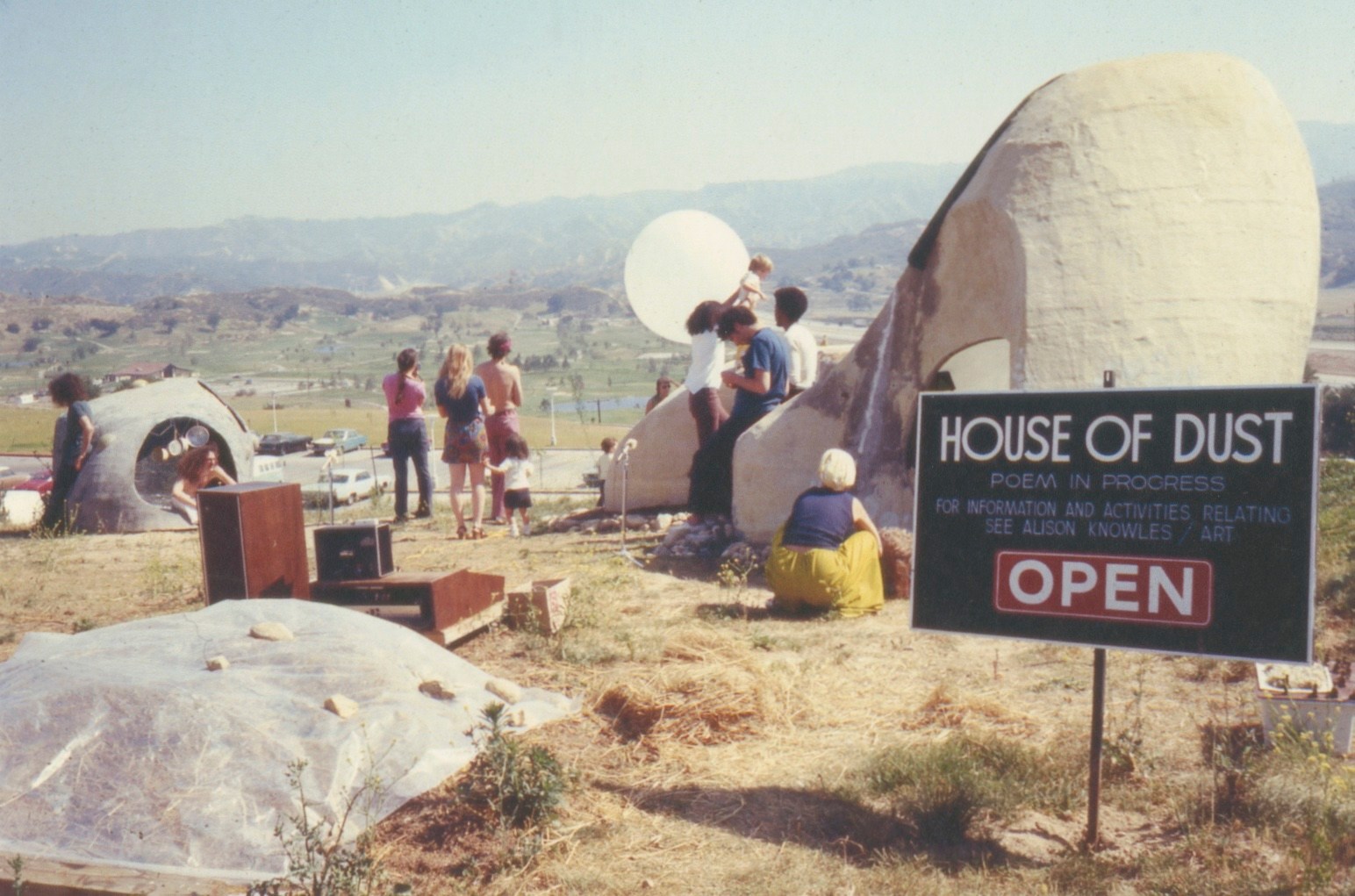
The same year she devised the identical lunch, 1967, Knowles wrote what was certainly the first computer-generated poem, “A House of Dust.” The project later came to incorporate actual physical structures, pedagogical interactions, and even a helicopter drop, but at its heart “A House of Dust” is a randomized creation generated by a very simple algorithm written in FORTRAN by the composer and Bell Labs researcher James Tenney. The program selects a line from four lists compiled by Knowles—a material, a location, a form of light, and a type of resident—and combines them into a four-line description of a house, outputted every thirty seconds or so onto a nine-pin printer.
A HOUSE OF DUST
IN AN OVERPOPULATED AREA
USING NATURAL LIGHT
INHABITED BY LOVERS
A HOUSE OF MUD
IN A COLD, WINDY CLIMATE
USING CANDLES
INHABITED BY VARIOUS BIRDS AND FISH
For another fifty years, Knowles played with forms and structures, making art out of the everyday: beans (a favorite subject), wind, names, shoes. She recorded sound works in the woods; she made clothing out of paper; she created musical scores out of onion skins; she encouraged audiences to bring red objects to a gallery and lay them gently upon the floor. She revisited some of her greatest hits, sometimes tweaking them—in another video in the retrospective, made in advance of a performance of the Identical Lunch at the University of Chicago, Knowles details her plans to use twenty blenders to create a “lunch symphony.” The Identical Lunch, she notes, makes a delicious cold fish soup when blended: “It’s really nice, kind of heavy and fishy and white.”
A question nagged at me as I browsed this retrospective: Why didn’t I know Alison Knowles? I’m no scholar of contemporary art, but I try to keep up, and playful midcentury subversion is certainly my sweet spot. Why did I know the names of other members of Fluxus, but not that of Alison Knowles?
It’s a question that the exhibit tries to address directly: Much of Knowles’ work was evanescent, difficult to collect; she seemed to possess an allergy to self-mythologization and disposed of artifacts—like those burned paintings—when they no longer suited her needs. Nicole Woods, Knowles’ biographer, notes that the artist was likely during conversations to illustrate a point not with a reference to her own work but to that of George Brecht, Carolee Schneemann, Emmett Williams, and other artists she knew and loved.
In the many video interviews studded throughout the retrospective, Knowles seems not exactly self-deprecatory—she takes her own work seriously—but strikingly ego-free and unusually willing to laugh at herself. In an interview about her Bean Rolls, a very funny 1963 take on the art book delivered in an actual bean can, she mentions that she recruited her mother to help with the arduous work of cutting and rolling the scrolls, which arrived in big sheets from the printers. “Let us say,” she says with a wry chuckle, “I got to know my mother very well.”
Knowles’ early work predated much of what we would consider “performance art,” and I wonder if in its domesticity and wry humor it was easy to disregard as more explicitly political performance gained a foothold in the 1970s and 1980s. As early as 1970, Knowles wrote to Dick Higgins about her discomfort when being confronted by younger feminists at CalArts, where she directed the Graphic Prints Lab. Knowles believed that she was shut out of Womanhouse, a crucial feminist installation and performance space at CalArts organized by Judy Chicago and Miriam Schapiro, because she often collaborated with men.
“By Alison Knowles” makes a vigorous case for Knowles as a mother to much of what would follow in contemporary art, and it’s an easy case to make. Yet I also found delightful the many weird cul-de-sacs in which Knowles made herself at home—experiments that went nowhere, necessarily, and inspired no other artists, and ultimately reflected only Knowles’ idiosyncratic curiosity and dogged spirit. Who else would read aloud the names and phone numbers of every person in the New York City phone book with the last name “Bean,” and then issue the result as a commercially produced audiocassette?
The highlight of the retrospective is “Bean Garden,” a reconstruction of a 1975 work that consists of a twelve-by-twelve wooden planter filled with dried white navy beans. After removing my shoes, I stepped into the box like some long-ago winemaker, and microphones under the beans captured and amplified the beans rustling against one another. The sound was everywhere at once. It’s been described as reminiscent of ocean waves but to me it sounded crunchier, like the noise inside my skull when I’m chewing Doritos. The microphones were sensitive enough to capture the cascading effects of my tiniest movements; even when I was not intentionally stepping around in the box, miniscule shiftings and recalibrations of balance that I had never before noticed myself making were transformed, by Knowles’ ingenuity, into sound.
Thanks in no small measure to Knowles, the experience of joining in the creation of an artwork is no longer novel. I’ve eaten candy from a Felix González-Torres; I’ve stood in line to sit in front of Marina Abramovic. Yet “Bean Garden” is so elegantly conceived—so instantly legible to the eye, yet hiding such surprises under its surface—that the experience feels just as fresh as it must have at Brooklyn’s Floyd Bennett Field in 1975. At the Grey Museum, every person I saw stepping into the planter immediately laughed out loud.
“Bean Garden,” uniquely among the works in this exhibit, fully embraces the opportunity to which the retrospective’s wall text refers—offering new audiences the chance to fully experience Knowles’ work and “take up its standing invitation to participate.” It is, of course, difficult to recreate the work of an artist whose most inspired pieces were experiences and not objects—or not merely objects. It is wondrous to watch an ancient Oki Microline printer churn out quatrain after quatrain of “A House of Dust,” making that sprockety racket familiar from my childhood. But it’s a shame that visitors can’t play Knowles’ musical instruments, like the flaxen gong or the bean turners; I was disappointed that the Boat Book, one of Knowles’ enormous walk- and crawl-through “transvironments,” is marked DO NOT TOUCH.
Of course I understand the curatorial and institutional impulse to preserve these archival works—and yet I can’t help but think that Knowles, who tossed tuna fish sandwiches into twenty blenders, might have enjoyed it if visitors could use her works and make her unusual music in a retrospective devoted to her impact. NYU is, happily, hosting an Identical Lunch on November 12; I don’t know if I’ll be in the city, but I plan to make myself a tuna fish sandwich, no mayo (ew), that day.
Knowles died in 2025. According to her biographer, Nicole Woods, in her final days she performed Nivea Cream Piece one final time—that is, along with her daughter and a close family friend, she rubbed lotion into her aged hands. It was an act of care and of connection—but it was also an artwork, and the resulting photograph is beautiful.
Like the similarly moving Ruth Asawa retrospective recently at MoMA, “By Alison Knowles” makes clear the extent to which an artist can allow her art and life to intersect and permeate one another. Not in the dull ways that movies about artists often suggest—she suffered this trauma, so it appeared in her art. No, for Knowles, as with Asawa, art was the way she thought about and processed her life, the way she explored what fascinated her and what was meaningful for her, and as a result she left no opportunity to make art unseized.
The connection was not one-way, life→art. The retrospective’s beautifully designed monograph features an essay by Knowles’ daughter, Hannah B. Higgins, now a scholar of art history. Here and there around the exhibition, Higgins and her sister Jessica show up. They are garbed in Knowles’ handmade paper clothing, “Loose Pages,” which transform the wearer into a book, or they are eating the Identical Lunch. In the essay, Higgins recalls the fate of the hundreds of pounds of dried beans that filled the original 1975 Bean Garden: They “ended up stored in enormous burlap sacks in the elevator shaft of Alison’s loft at 122 Spring Street.”
And then what did Knowles do with those beans, stepped upon by barefooted hundreds, perhaps thousands? “She proceeded to cook them regularly, usually with onions, carrots, maybe a few tomatoes or leftover vegetables, some garlic, and Provençale seasonings or a hit of soy.” Knowles’ life fueled her art, and then her art fueled the lives of her and her children—just another durational, devotional act of cooperative creation of the sort that this remarkable artist devised her entire career. “Eating them several times a week,” Higgins writes, “we finally finished them in about 1995.”