

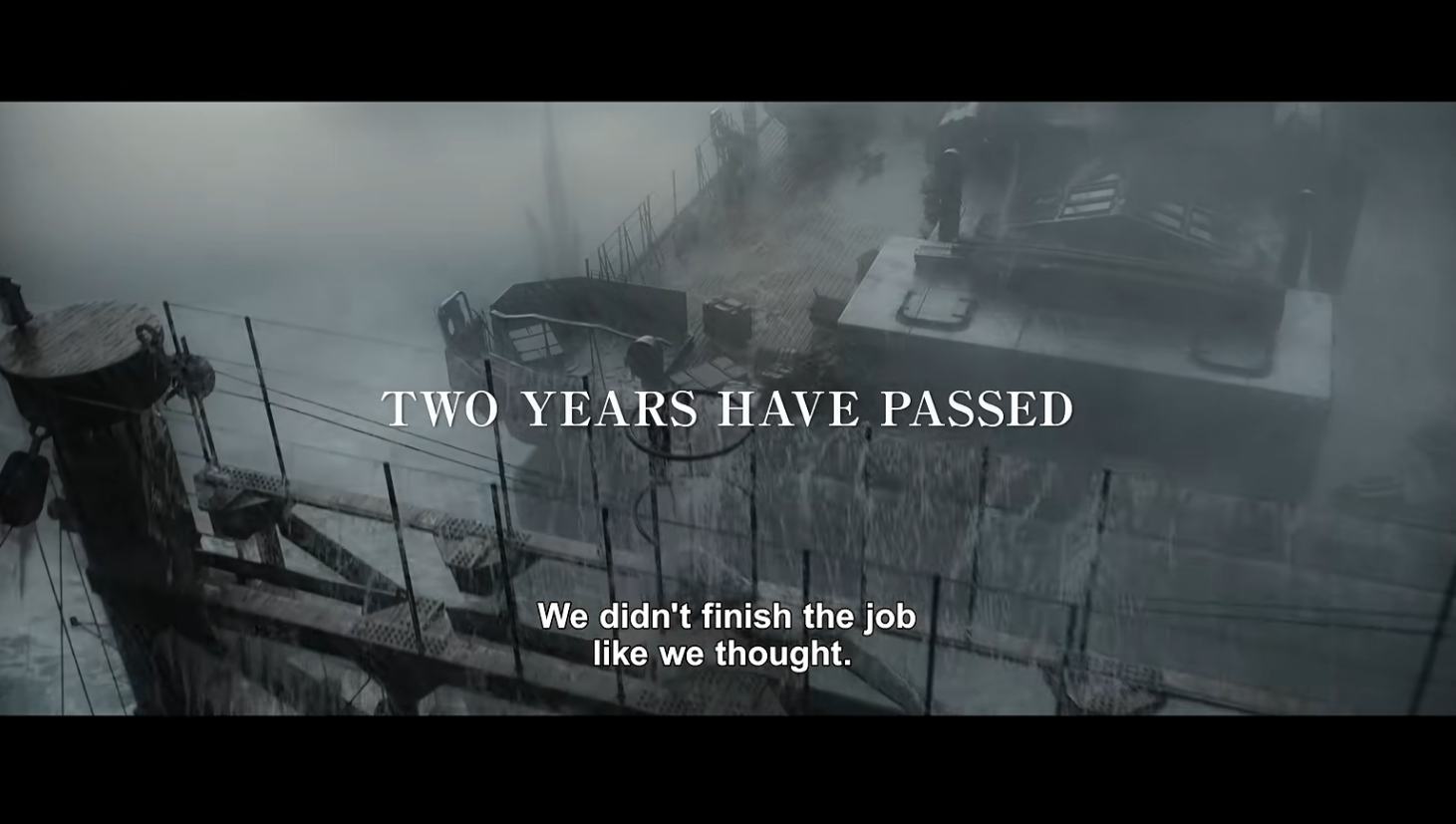
A couple of weeks ago, my friend's sister texted him, insisting that he must go see the new Godzilla movie, Godzilla Minus Zero, which is, naturally, the sequel to Godzilla Minus One. She wanted him to see it so badly that she Venmo'd him, sponsoring the movie tickets, and was checking in every day to ask if he'd seen it yet. So when our local climbing gym workers went on strike on Tuesday morning, trying to negotiate their first contract since unionizing in 2023, we nixed our original plans for the evening, and bumped up the Godzilla Minus Zero viewing date instead. My friend informed his sister that we had bought tickets; ok now that u have tickets, she responded, it's a shit movie.
The bribe was not because the movie was so good that we simply had to see it, but because she knew that it would be disappointing to pay to go see a bad movie, so she was reimbursing him in advance. It was one of the most masterful cons I have experienced in my adult life, and one abetted by the fact that we watched Godzilla Minus One, a legitimately good monster movie, in anticipation.
Godzilla Minus One is set in the immediate aftermath of World War II, returning Godzilla back to its 1954 roots as a metaphor for the hydrogen bomb. All of Godzilla Minus One's characters are still wrestling with trauma from the war, especially the main character, Kōichi Shikishima, who was a failed kamikaze pilot. The ending message is a hopeful and humanist one: that war is terrible, that every human life is precious and worthwhile, that the most important thing is to live. Mostly, the movie expresses this by putting Shikishima through the absolute wringer.
So when everyone survives, and Shikishima is reunited with his situationship-slash-pseudo-wife and the cutest kid ever, it feels earned. Watching the ending sequence, of the little family crying over each other in a hospital room, I knew full well that there would be a sequel, but I assumed that these characters could not figure heavily in it. If they had killed Godzilla for the sake of peace for themselves and their children, then they had surely earned their rest. All that, and they had to suffer some more? Certainly not!
Alas, they really had to go out and suffer some more. And therein lies the fundamental flaw underpinning Godzilla Minus Zero: Nobody, the characters included, can quite wrap their heads around the fact that these people are being asked to fight again. After employing the same, wonderful Bang, here's the monster lack of restraint as the first movie, with dragon-creature Ghidorah (who I would later learn is the figure represented in that one meme) terrorizing the city of Matsumoto, the bulk of the movie is dedicated to overwrought emotional manipulation for the main family to convince both themselves and the audience that they are necessary to the cause. The explanation comes at the expense of pacing or any development of the new side characters. The family's peace was a short-lived one; as per, I assume, the conventions of the monster genre, the problems always must get bigger and worse.
Some of the best parts of Godzilla Minus Zero are in its unchecked maximalism. The needle drops for both Ghidorah and Godzilla's themes are indulgent and absolutely banging, and the kaiju fight sequence—based on the director's cats' personal brawls—is literally jaw-dropping. Everything is more visceral and gory. This is true in the monster battle, when Godzilla tears off one of Ghidorah's heads (the third one, in fact), which tears off Godzilla's arm—gnarly!
The same principle also carries over into the displays of human suffering, at the hands of both humans and monsters. Godzilla Minus Zero introduces an old professor who lived through the nuclear bombing of Hiroshima, and the movie employs no restraint when picturing the burned bodies of his family. It shows the aftermath of the monster attacks in hundreds of wounded swarming a medical facility; a family crying over their dead child in a room of other dead parents and dead children and being asked to mourn more quietly.
But to probably no one's surprise, this maximalism tilts and then topples into the realm of absurdity. After the first-act battle, Ghidorah gets evolved by lightning and grows a gravity ray. OK! Every Godzilla attack in Minus One was significant, but in Minus Zero Ghidorah sort of prances from city to city across Japan, killing thousands. The most absurd moment of the film comes when the characters go back to the office after accidentally evolving Ghidorah—worst day at work ever, am I right?—and while they are trying to process, one guy chimes in and declares something along the lines of, "Also, haven't you heard? Godzilla's back!" This delivery bowled my friends and me over so completely that we silently and simultaneously corpsed in the back row of the movie theater, shoulders shaking with the effort to keep silent. After a minute or so, I thought I had ridden out the worst of it and turned to check, and my friends were still laughing, which killed me again.
One of my friends mentioned afterward that she wished Godzilla, as a character, was written with more depth. This was semi-ironic, but gets at the fact that in Godzilla Minus Zero, even Godzilla seems not to understand why he's back for some more punishment. In the first movie, Godzilla represents horrors on a more terrible scale than humanity can fully conceptualize: a natural disaster or environmental catastrophe, a war, a hydrogen bomb. In the second movie, the horrors simply happen again, and again, and again.
Godzilla Minus Zero tries to pull off the same thematic swings as the first film, but the core messages became tangled. Ultimately, it mostly clearly asks how much you can tolerate. How much Godzilla and Ghidorah, how many gravity rays the audience can suffer viewing on movie theater screens, yes—but also, how much suffering the audience can tolerate in their day-to-day lives. The professor survived Hiroshima, and then he survived Godzilla, and then he survived Ghidorah, and then he had to survive both Godzilla and Ghidorah again. The Shikishima family served their country well, and then had to be called on to do it again.
The burdens of life grow worse each day. There is always more death, more pointless war, more suffering. Why me? Why everyone? Sometimes you can fight every day through the various indignities of earning a living wage, and then, bam, there's also Godzilla. What can you do except laugh?