
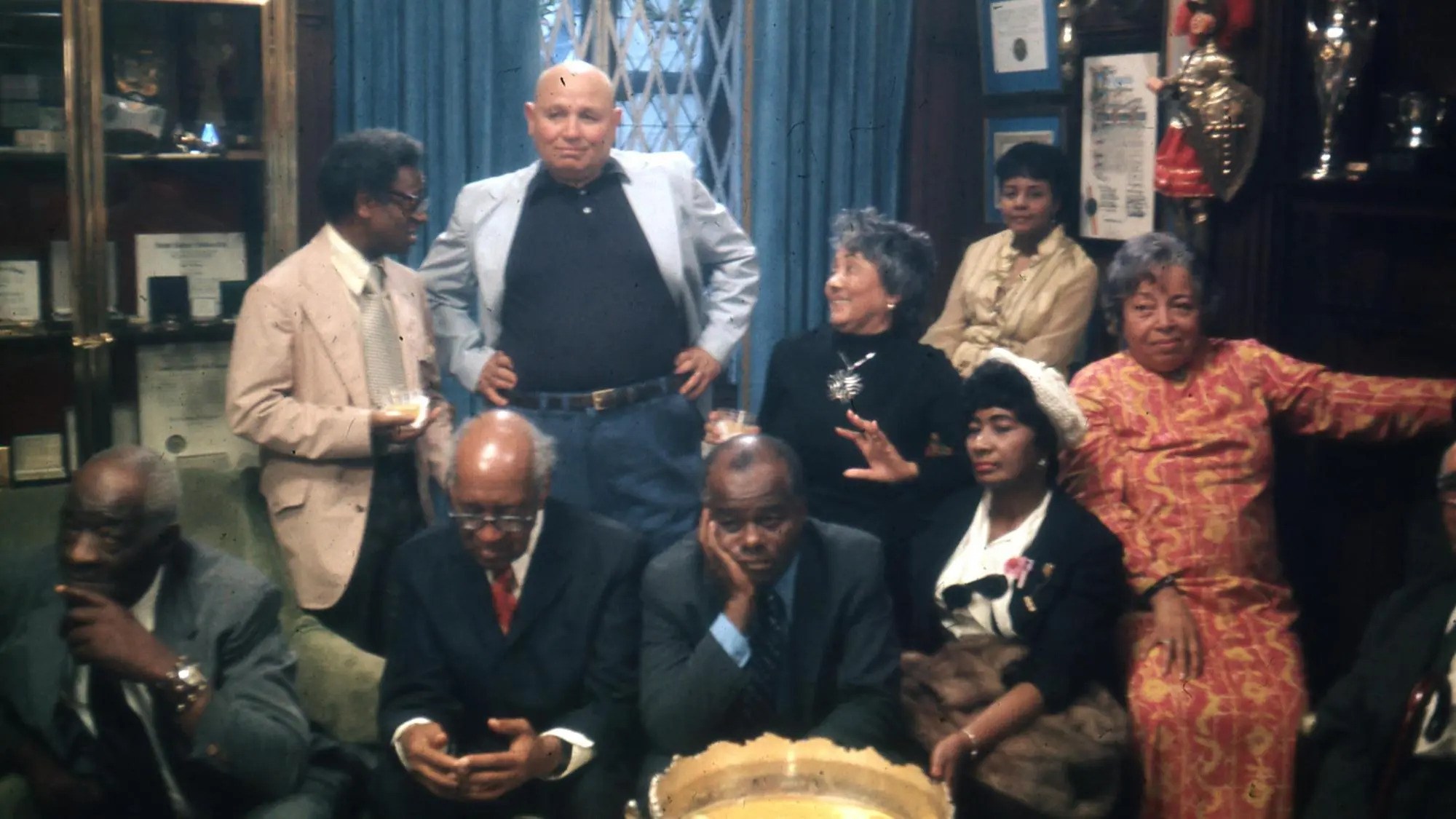
On a hot summer day in August 1972, actor-turned-documentarian William Greaves orchestrated a cocktail party at Duke Ellington’s home. He invited the surviving architects of the Harlem Renaissance and encouraged them to bask in impassioned discussion of the history and legacy of that period. Greaves, along with his son David and two other cameramen, captured 60,000 feet of film of the entire event. Throughout the remainder of his life and career, he wrestled with how to use the footage. At one point he hoped to use it in the award-winning documentary From These Roots (1974), but instead decided to set it aside, giving it room to breathe. Greaves died in 2014 at the age of 87, with the raw footage still unfinished and fragmentary. His son, David, and granddaughter, Liani, then took up the mantle of this important restorative project. They were helped in this effort by Greaves’ widow, Louise Archambault Greaves, who preserved and safeguarded the archive with a grant from the Ford Foundation until her passing in 2023.
Shot on 16mm, Once Upon a Time in Harlem is a work of historical immersion animated by the very participants of one of the most influential eras in cultural history. Over the course of the documentary, the surviving members of a once-vibrant community of Black artists, poets, musicians, and writers from the 1920s—now senior citizens, dressed in their Sunday finest—recollect, reflect, and contest each other's memories and anecdotes of a period in which they not only lived but helped define. By interlacing the party scenes with other interviews conducted by William Greaves, archival material, literary texts, and cultural iconography, David resurrects the Renaissance period they all gathered to recall. Cinema becomes a vault for Black oral histories, to be passed down for generations to come.
Born and raised in Harlem to a working-class Caribbean family, William Greaves grew up at the tail end of the Harlem Renaissance. At the behest of his religious parents, he was introduced to Black performance, poetry, culture, and radical histories. In his younger years, Greaves performed in African dance troupes. He later became interested in acting and worked with the American Negro Theater before transitioning into radio, television, and film. In an interview with the film scholar Scott MacDonald, Greaves recalls an epiphany about discovering the works of pioneering independent Black filmmaker Oscar Micheaux:
“For me, this experience is a metaphor for what my life became and certainly what the life of the black filmmaker has to be in America, particularly when one thinks of America in the early part of the twentieth century, when it was truly an apartheid society… the Black filmmaker has been the precursor [for] the independent filmmaker. From the beginning, the black filmmaker has had to be part of a parallel, separate cinema.”
Greaves’ astute premonitions succinctly describe how Black independent filmmakers emerged through their own collaborative networks. Alongside him were multi-hyphenate creatives like St. Clair Bourne, Stan Lathan, Madeleine Anderson, Kathleen Collins, Camille Billops, and others, all devoted to using cinema to challenge misrepresentations of Black life in mainstream American media. Greaves produced an expansive body of work and served as executive producer and co-host of the television series Black Journal, for which he won an Emmy. Today, he is best known for his film-within-a-film, Symbiopsychotaxiplasm: Take One (1968), which screened decades after its making. His other works dedicated to recording how anti-Blackness reverberates within American economic and socio-political spheres remain frustratingly overlooked. In films like In the Company of Men (1968), a meta-documentary that examines the racial tensions between white managerial workers and underemployed Black workers in a southern auto plant, and The Deep North (1988), a racial psychodrama that explores systemic discrimination in New York City, Greaves masterfully constructs intimate and tense scenarios in which the interlocking dynamics perpetuating social inequities are exposed and filmed unencumbered.
Once Upon a Time in Harlem is no different, but it hinges on celebrating and honoring the ways Black people survive, persevere, and create collectively in the face of white supremacist violence. An essential facet of Greaves' vérité approach is the playful use of free-flowing camera(s). Through this technique, the film is always rolling, capturing all of the luminaries at once, many of whom came to New York from the South as part of the Great Migration, or from other parts of the diaspora. James Van Der Zee opens the film with a tune on Ellington’s piano as a slideshow of his photographs of Black flappers graces the screen. Ragtime composer Eubie Blake and actor Leigh Whipper share stories of how they began in vaudeville and minstrel shows after leaving the South due to the Jim Crow-era policies and intensified KKK presence; artist Aaron Douglas explains how he came to be inspired by continental African visual art and the way it weaves throughout his artistry.
However, the film truly shines when it captures those behind-the-scenes stewards of the movement who helped sustain it. The librarians of the 135th Street branch of the New York Public Library, Regina Andrews and archivist Jean Blackwell Hutson, who later became chief of the Schomburg Center for Research in Black Culture, take center stage at various points to recount how writers and poets Countee Cullen, Langston Hughes, and Claude McKay often frequented the library to work on their craft before attending casual hangouts at Andrews' apartment. Jessie Redmon Fauset, also known as the midwife of the movement, is credited with editing and publishing many of the works of the men mentioned above in The Crisis, which was founded by W.E.B DuBois in 1910 and became one of the first widely distributed publications disseminating Black art, cultural criticism, and literature. The home of society page editor Gerri Major was a crucial meeting place for lavish late-night gatherings, which she describes in the film. Eslanda “Essie” Goode Robeson, the wife of Paul Robeson, is mentioned as a major force behind the communist actor’s success. The Harlem Renaissance was nothing without the reproductive labor of women who were organizing, archiving, and spotlighting the movement’s many cultural producers. Even lesser-recognized patrons, like the philanthropist Casper Holstein, who funded the movement using money from running illegal gambling rings, get a turn in the spotlight.
As the esteemed partygoers became more inebriated and relaxed, Greaves occasionally abandons his fly-on-the-wall cinematic approach to interject with prompts, and fond memories give way to moments of contention. These debates reveal that the movement wasn’t homogeneous, and was like any renaissance the site of many intellectual clashes and political schisms. In 1926, journalist George Schuyler and poet Langston Hughes published essays in The Nation that highlighted how this cultural front rested on sometimes incompatible political ideologies. Hughes’ manifesto, The Negro Artist and the Racial Question, affirmed Black racial individuality as a legible position from which to create art, becoming a slogan for the Renaissance. This was a rebuttal to Schuyler’s The Negro Art Hokum, which challenged the notion of a distinct Black art. At the party, Schuyler remains bitter about Hughes’ counter-argument and dismisses it in a one-on-one interview, but the dialectical disagreement would reappear when folks like writer and painter (and close friend of Hughes) Richard B. Nugent bicker over being called a Black artist, an African American artist, or just a plain artist.
Another major point of contention stems from the outsized impact of Marcus Garvey’s “Return to Africa” movement on the Renaissance period. Richard B. Moore, a writer and activist featured in another Greaves film, Still a Brother: Inside the Negro Middle Class (1968), argued against Garvey’s belief that Black Americans should take a leadership role in African politics, but agreed with his anti-imperialist philosophy centered on the liberation of African peoples. Garvey, who hailed from Jamaica, settled in Harlem and founded the Universal Negro Improvement Association (UNIA) in 1917. The UNIA was a global mass movement that advocated Black self-determination through economic, political, and cultural advancement rather than integration into white America. Garveyism is one of the schools of thought that emerged alongside the Renaissance. Despite amassing major support, including from Greaves' father, it faced backlash from scholars such as W.E.B. Du Bois and the activist A. Philip Randolph, who advocated in favor of class-based politics. These conflicts were the beauty of a period defined by intellectual ambition and rigor.
Toward the end of one of these shouting matches, Moore adds that Garveyism and other modes of progressive Black thought that seemed at the time to be in competition had become vital to the Black power struggles of the ’70s, which they were living through at the time of filming. These tense disagreements don’t linger; they unfurl like chapters cushioned between a rich portrait of camaraderie and historical memory, using Greaves’ quintessential split-screen technique to present side-by-side snapshots of artistic development and debates over political struggle. The film reminds us that the movement flourished in such a way because socialists in the 21st Assembly District, like Richard B. Moore, pumped economic and educational resources into the Black working class, laying the foundation for great artistic and intellectual development during one of the most violently anti-Black periods in American history.
In a moment when Black studies is being rolled back in U.S. universities, the right’s concerted attack on DEI is exposing its hollow liberal premises, and the Trump administration is working to sanitize American history by targeting African American museums, Once Upon a Time in Harlem feels like a bright light amid the darkness of fascist destruction. Not only because the film is a living, breathing document of a great movement, but also because it is a template for how we can collectively create and build our own movements rooted in the same values and principles they espoused. Everything about this film, from the way it was conceived, shot, archived, and protected through generations within the Greaves Family and local Black institutions, to the fact that it is now receiving theatrical distribution (which many of Greaves' films did not receive), ultimately emphasizes that, in spite of the continuing pervasive climate of anti-blackness, Black knowledge and cultural production will never cease.