

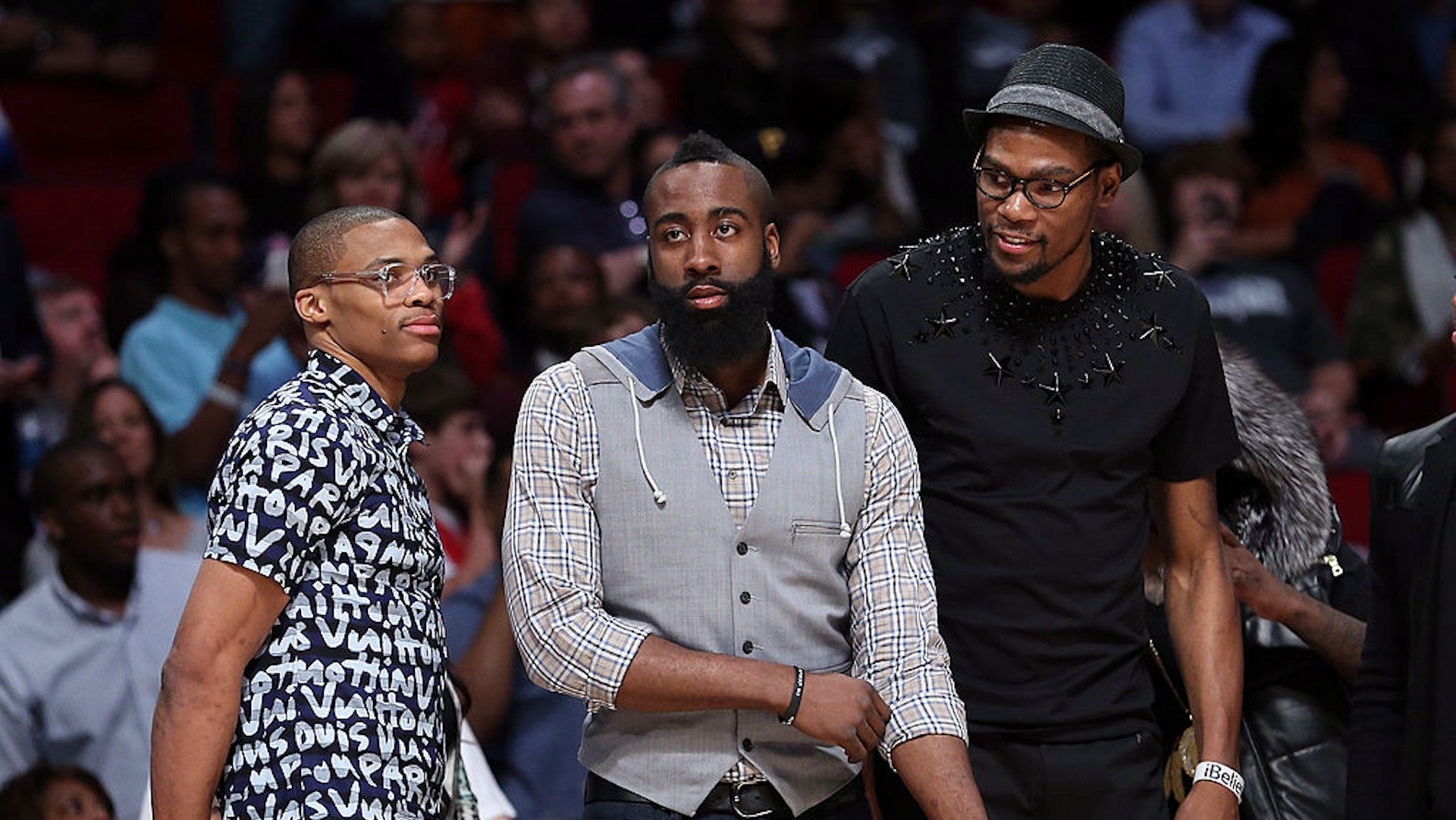
From 2007 to 2009, Oklahoma City Thunder general manager Sam Presti selected future NBA MVPs Kevin Durant, Russell Westbrook, and James Harden in three consecutive drafts, securing the fledgling team an otherworldly core. The results were brilliant and tumultuous. The Thunder started out 3-29 in 2008, but within a couple of years rounded into a fearsome squad that gave the 2010 Lakers a scare, and eventually reached the 2012 NBA Finals, where they went toe to toe with LeBron James's Miami Heat and lost. Then Presti traded Harden, setting in motion a future that would scatter the trio around the league. As they broke apart, they'd help mold the league into its modern shape.
Jonathan Abrams, a New York Times culture reporter who began his career covering the NBA and has written about it extensively at the Los Angeles Times, Grantland, and Bleacher Report's magazine, is out with a new book, When We Were Young and Fearless, about these players and their importance in modern NBA history. At Grantland, Abrams wrote longform profiles and oral histories, in which you could relive the Malice at the Palace, become familiar with the particulars of how an almost-dynasty fell apart, or learn that the Orlando Magic came disturbingly close to being called the "Juice."
It's that style of dedicated reporting and patient storytelling that enlivens all three of the book's protagonists, whom Abrams refers to only by their first names. When We Were Young and Fearless leaves the reader with a fascinating image of what the 2010s Thunder could have been, but its greatest feat is perhaps the sympathy and complexity with which it imbues three of the greatest players of the 21st century.
I interviewed Abrams by phone about his book last week. Our conversation has been edited and condensed for clarity.
While reading this book, it occurred to me that all three of your protagonists have characteristics that people like to laugh at. You have KD's burner accounts, Harden's foul-baiting, and Russ's jump shot, or the way he treats the media. You touch on those things, but really don't poke fun at them the way a lot of NBA media does. Could you tell me a bit about your storytelling approach to the NBA in general, and then more specifically these three?
I started covering the league in 2007, and I think from the beginning I always wanted to try to look at players as people and not caricatures. A lot of the time, professional athletes can get reduced into those types of tropes. I always wanted to stay away from that and look at the humanistic portrayals of athletes. With these three guys, they're so talented and so different and so disparate. For a time, they came together in Oklahoma City and really bounced off of and bettered one another. As time went on, their games and personalities clashed a little bit. That's what I wanted to show. I think it's easy to perhaps show a two-dimensional portrayal of an individual, and to not even poke fun at, but just go into that narrative that's already been crafted. I think it takes time and reporting to go in a different direction and provide more of a 360-degree [view] of a person.
I revisited a couple of the oral histories you wrote at Grantland, and I kind of noticed that there was a common thread with a few of them and this book: a great team that seemed primed to dominate, and then something happened and got in the way. What compels you about the what-if?
I think that's one of the greatest things in sports. There's all these alternate timelines, where the Sacramento Kings are the NBA champions, or Penny and the Magic won one in Orlando, and Shaq never goes to the Lakers. There's all these twists and turns. So you can pull on all these different threads, and really examine: What would've happened if one minuscule thing turned out differently?
With this Thunder team, there's, like, 25 what-ifs. If one thing went differently, I don't know if the NBA looks the same way that it does now. As a reporter, that's a dream scenario, being able to ask, If this didn't go this way, what do you think would've happened? I think that's what sports boils down to. You're in a bar, and 45 minutes later, you're still arguing about it.
Of those 25 for this Thunder team, what are a couple of the biggest, and what do you think we missed out on?
If you go back and look at that Finals in 2012 against the Heat, the Thunder lost that series 4-1. That was back when the NBA was 2-3-2, so the young Thunder spent those three middle games in Miami. You're coming from Oklahoma City to South Florida, and it's a much different atmosphere, more things for young players to get into [laughs] when you're there for that long. I feel like that really messed with them. The league changed back to the 2-2-1-1-1 scheme pretty soon after.
Even in Game 2, that game was really, really close. Kevin got fouled at the end, but you don't have the coach's challenge in place then. That could've changed the series. The first four games of that series, the total point differential was maybe five points. In those individual games, there's so many what-ifs. And then the greatest what-if of all is obviously James getting traded. There's a lot that went into that situation that wasn't just black and white. In 2009, the Thunder traded for Tyson Chandler, but that trade got rescinded because of Tyson's toe, and then Tyson went on to become Defensive Player of the Year, and an Olympian. He would've been great for that team, and that forced the team to try to get a big man, and they traded for Kendrick Perkins and traded out Jeff Green, who was one of the young Thunder players. I could go on and on. [laughs]
I got into the NBA recently, but one of the most interesting parts of this book for me was that even with my limited knowledge, I could kind of feel the echoes of these guys in the NBA that I'd watched the last couple years. There's a page where Troy Weaver is talking about how they wanted Harden to be Manu Ginóbili, but he was too good to come off the bench, and I thought of Dylan Harper and the Spurs. Were you thinking about the echoes of the present while you were writing?
Without a doubt. I think the lesson that remains true then and now is that the window is so short for an NBA team once it opens that you need to do whatever you can. You never know when it's gonna close. I think even in '25, that championship Thunder team was built on the scar tissue of what happened with James and Russell and Kevin. That window closed so fast, they rebuilt that team, but even Thunder 2.0, that window may be closed because of the injuries. You just never know. When you have that talent, you need to utilize it and squeeze through that window while you can.
It's kind of unbelievable to think about where the Thunder are now compared to a year ago when they were 24-1, coming right off a championship.
This league can change so, so quickly. You go back to 2016, that summer after the Thunder gave up that 3-1 lead to Golden State. Nobody thought that Kevin was going to leave, and then everything shifted so suddenly.
I think the section of the book on him leaving for Golden State is one of the most interesting and emotional parts of the book. In the process of reporting that, what stood out most to you?
Talking to Kevin about that decision was enlightening. He offered some of the most introspective quotes about leaving that I'd seen before. It just seemed like he wanted to experience a different type of basketball, and he felt like he had reached the peak and limits of what they could do in Oklahoma City. I think it was still shocking for everyone to see him leave for a team that had just beat them in the playoffs, but he wanted that validation from those players and his peers on Golden State. Troy Weaver said something that really resonated with me—he was No. 2 in the Thunder organization after Presti—and he said, "At the end, we were trying to recruit him on an experience that he'd already had. What could we offer? We couldn't offer anything new that everybody else could. Once he'd already experienced something, he was on the other side of the fence."
As you write, him going there ruined the balance in the league for a while. But it did seem sad and even a bit cruel to me that there was pressure for him to get a ring, and then he does it, and everybody's kind of like, "Actually, that doesn't count, because we don't like the way you got there."
Today's discourse over pro basketball comes down to rings a lot of the time. Charles Barkley's gonna hear about it forever that he doesn't have the rings Shaq has, or any. I think at a certain time, [Kevin] just wanted to check that mark off his resume. In the end, I don't know if it was as fulfilling as he would've hoped, but he has it checked off now.
Another quote that stood out to me was Kirk Lacob saying, when people win a ring and then they're not quite content after, it's either a bit of depression following the cathartic achievement of a lifelong dream, or you realize it wasn't about the ring, it was about the people you did it with and the journey. Do you think, for Kevin, it was either of those two, or if not either, what do you think it was?
I think I read Kevin that quote from Lacob, and he disagreed with that assessment. He said that the championship was everything he dreamed of, and he celebrated it. Then he turned back to getting better, because the work doesn't stop, so he wanted to win another championship. In Kirk's defense, I think the team personnel and the people around him did not feel the same unbridled, universal joy that they saw that first season together in Golden State, when they just tore through the league.
Later in that chapter, you write that a big part of why Kevin joined the Warriors was because they seemed like a family. Then you conclude that the family presented to Kevin when the Warriors made that pitch was real, but he didn't feel like part of it. I thought that was so sad.
I think there's something to be said for it being more than just basketball that goes into these decisions. All the ingredients need to be in place for it to work. For the first couple seasons, it was beautiful basketball being played, and it was great. I think that team and those players were just exhausted by the end of that run. The last Finals just seemed like a team running on fumes.
About Kevin's restlessness, I'm curious if you think that's just who he is as a person, and he might've been that way had he never played basketball, or if it's a manifestation of rings culture and the way people reacted to him going to Golden State.
That's a good question. I hesitate, because I don't want to psychoanalyze him; he's his own person. I feel like what makes Kevin almost endearing is that there isn't this big guard up. You're not gonna get those canned answers, typically. You're not gonna get, "Both teams played hard." You're gonna know whether he had a good day or a bad day heading into an interview. He's gonna be a person, he's gonna show it. So I think that answer … with him, it may depend on what day you catch him, to be honest.
Another quote, and I think this might've been about the Jeff Green trade … he said, "The sentiment everybody had was, We're gonna grow together, grow old together"—I found that striking, marriage-esque language for a basketball team—and then he says, "All that sounds good, but the business is way bigger than us, and it's some stuff we can't control." Obviously it applies to the NBA, but I think that's also just a great description for life. You have dreams, and stuff gets in the way.
One of the things I wanted to make clear in this book is that you have to think back to that NBA before League Pass, supermax salaries, before social media, really. This team is forming in this new place, new city. These guys don't know how good they're gonna be. It was literally just about basketball, getting better at basketball, and growing in that capacity every day. And then you start to get better than you thought—they started 3-29 in Oklahoma City [laughs]—before long, you're a playoff team. Then all this other stuff starts to come in. Social media comes, and shoe contracts and money and brand deals. This was before players were looked at as brands, when these guys got together in Oklahoma City. The game was growing monumentally, and I feel like these guys' priorities …they had to shift, because they were introduced to all this stuff that they didn't know.
One of my favorite parts of this book is Shaun Livingston talking about how James Harden was so amazed by the car Shaun Livingston had, and wanted to borrow his car, because he'd never seen anything like it. Shaun is like, "He had no idea of everything on the horizon for him."
Kevin plays video games with local kids! It was almost painfully innocent.
Yeah. I remember in 2009, I was working for The New York Times and doing a story on the Thunder. The book opens with it: Kevin literally drove me around Oklahoma City a little bit. He went to the airport and got out the car, and nobody recognized him, approached him, stopped him. At that time, I don't even know if people were taking pictures with their phones. It's hard to believe that, but I saw it with my own eyes. It's a different NBA, a different place and time.
On balance, do you think all those changes have been for the better or the worse?
That's another good question. The game is more popular now. It's more global now. It's more profitable now. I wouldn't necessarily say that it's a product that I enjoy watching now more than I would have a couple decades ago.
Since you turned in the book, has there been a detail from it that your mind won't let go of, or a plotline that's emerged since that you wish you'd been able to add?
I think the easy one is that Russell retired. [laughs] I wish that was something that could've gotten into the book. One of the things that sticks out to me in working with my editor on this book—Russell didn't talk to me for this book, no matter how I tried. The funny thing was that maybe a month after I turned in the book, I went to a play on Broadway, and he was sitting just a couple rows in front of me. My editor was like, "Reading this book, I felt one way about Russell, and I feel a completely different way about him now because of the portrayal you were able to bring in talking to his former coaches and teammates. You were able to really paint that picture." That meant a lot to me.
With Kevin and James still playing, what are you watching the last phase of their careers for? What is still out there for them?
James, obviously, whether he can get that elusive championship. I think, for Kevin, to see if he can be part of a championship and not necessarily the anchor of a team again. And to see Kevin still climbing up that scoring chart, where he winds up will be interesting. These are two of the most prolific scorers to have ever played the game, and the game, offensively, has been influenced by them tremendously since they joined the league.
I'm curious why you wrote this now, and not after those two had also retired. They can't be all that far from it.
You're right, but who knows when somebody else is going to get the idea? [laughs] For the most part, their careers are what their careers are gonna be, right? Twenty-something years into their careers, I think most of it is written. And with both of them still playing, there's still attention to them on-court. So I think this was a good time to do the book.
I agree with you. I think you've also just jinxed it, and now James is gonna explode for 50 points in Game 7 of the Finals this year.
[laughs] There's been thoughts for the last week on whether Russell's gonna come back out of retirement for Oklahoma City, so, you know.
We maybe touched on this a bit earlier, but it really seemed like all three of them enjoyed the early days of just trying to improve so much, before financial and ego stuff complicated everything. I'm wondering if you think there's a better way for the league to do all this, and keep teams together, or is what happened to these guys just part of life?
I think that's part of the push and pull of trying to put together a team. If you're that good at drafting players, the consequences are that they're gonna be inevitably expensive to keep together. Oklahoma is currently experiencing that again. The league wants the wealth to be spread across it. I don't know if there's a better way to do it—there probably is—but there's always gonna be ways that creative, insightful general managers like Sam Presti are able to figure it out and manipulate the system for their benefit.
I didn't listen to it at the time, but I went back, and you went on the Longform podcast in 2013 or 2014.
Oh, man. [laughs]
You said you always asked players what they wish you had asked them, so I'll ask you that now: What do you wish I'd asked you?
Oh man, my own ploy against me. I don't know, I think you did a good job.