
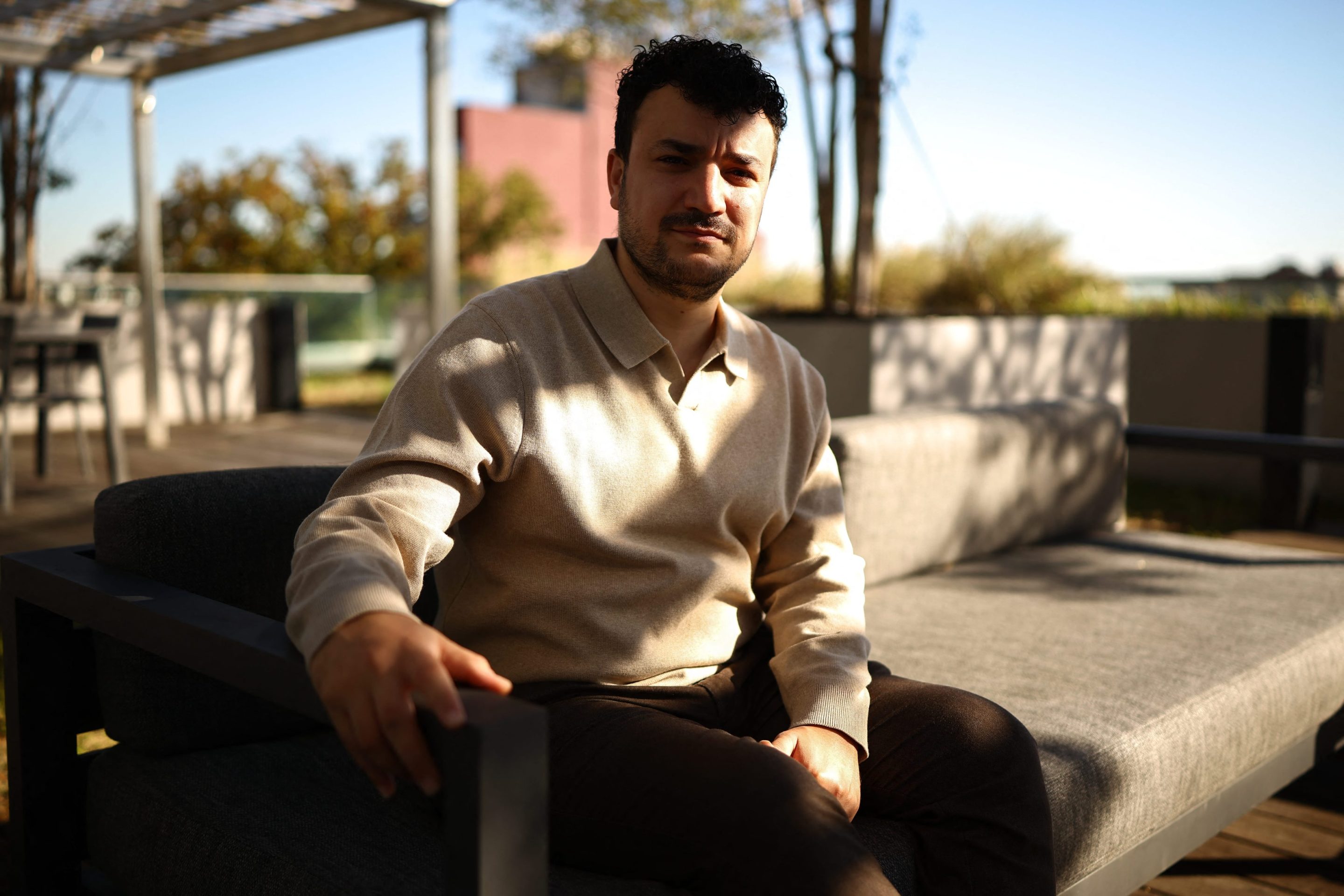
I remember the pit in my stomach as I woke up to the texts telling me that Mahmoud Khalil had been kidnapped. I remember the terrifying 48 hours when we had no idea where he had been taken—just that the President wanted to make an example out of him. I remember crying on the phone to my dad, telling him I had lost all hope. It was difficult to relive, and in preparing for this interview, I wanted to do Mahmoud justice.
Mahmoud was central to the community of activists at Columbia University. He was the person we looked to for calm and guidance in the midst of upheaval. When he was taken, we all felt his absence. We were mostly kids. We struggled not just with the question of how to push back against the intensity of encroaching fascism and the weight of the federal government's crackdown on free speech, but how to do so without Mahmoud. He knew the university rulebook front and back. He knew all of the administrators and had a friendly rapport with them (or so we thought). He would calm us down when it felt like everything was falling apart. All of a sudden, he was thousands of miles away at a detention center known for inadequate medical care, unsafe food and living conditions, and abusive tactics by guards. And we remained inside the gates of the place that had allowed it to happen, as the retired Homeland Security Secretary, former IDF intelligence officer, and war profiteers who made up the administration and board of trustees wrung their hands and told us they were powerless.
Mahmoud’s book No Land to Stand On is a devastating and essential story of his time in ICE detention, his childhood in Syria, and his experience as a negotiator at Columbia. In typical Mahmoud fashion, he insists that there are people far braver than him, who have made more sacrifices than him. He wants you to know the stories of the men he was detained with. They too were separated from their families and held without any charge.
In his writing, Mahmoud turns every moment into an opportunity to advocate for others. With honesty and lyricism, he takes on the daunting task of drawing out the connections between struggles—the movement for Palestinian liberation, the fight for the immigrant’s rights, and the battle to protect free speech—turning the seemingly separate issues into one: the struggle for a society in which people hold the power. He takes inspiration from black and Palestinian writers, listing Edward Said, Angela Davis, Mahmoud Darwish, Ta-Nehisi Coates, Mourid Barghouti, and Susan Abulhawa as some of his influences. While writing this book, he told me, he was reading Mohammed el-Kurd’s Perfect Victims and began each day reading James Baldwin.
On Oct. 15, I spoke to Mahmoud over Zoom about our time at Columbia, the role of higher education in laying the groundwork for attacks on free speech, and the importance of community movement building, among many other things. Four days later, his legal team submitted an appeal to the Supreme Court. Until the court makes a decision, he cannot be deported or detained and can remain in the United States with his wife and son. This interview has been edited and condensed for length and clarity.
As I've been talking to people about your book, I've noticed a split between people who were at Columbia and people who weren't in their level of shock at one specific sentence, which is “Had Columbia itself possessed the power to deport me, I have little doubt it would have done so.” As someone who protested at Columbia, I've had my fair share of dealings with the administration. I understand this. But for readers, could you expand on some of the actions or lack of action that Columbia took that led you to write that?
I wrote it not as an exaggeration. Columbia, since October 2023, investigated its own students, brought private investigators—they technically harassed them with that—and also brought the police four times. And the last time they brought the police on campus for protest activity was in the ’60s. So the level of brutality, the level of violence that Columbia brought on its students has been tremendous. Students at Columbia were hospitalized because Columbia's own public safety officers attacked them. They took degrees from people, they expelled students, suspended students, and literally upended their own students' future. They changed the future of so many of their students. That's my realization around deportation. If Columbia knew that deportation was something they could use, they would have done so.
I think when we talk about Columbia and their complicity in what happened to us, it's not only that they were deliberately indifferent. No, they actually—whether directly or indirectly—contributed to the environment that led to my detention. They laid the groundwork for my detention. In some of the court proceedings, the government cited Columbia's own statements where they falsely portrayed students as violent. They falsely portrayed the protests and the rhetoric as dangerous, when in fact it was the total opposite.
When I say Columbia, it's the board of trustees and the top administrators. And for these people, they were happy that this administration was coming after protesters to do the dirty job for them.
Did they make any effort, publicly or privately, to help you during your detention?
No, I think the opposite. Even when we requested that Columbia submit to the court something as simple as “he's a student in good standing,” they refused to do so. Again, it's not about just indifference. It is about actively trying to harm me and harm the movement. Through all the violence and brutality that they brought on campus, they couldn't stop the movement, so now they have the Trump administration to do that. They don't want to undermine that in any way. They rewarded a lot of the faculty, the students, and the staff who actually came after us, who harassed us, who provoked and intimidated the Palestinian students and their allies, wasting tens of millions of dollars on shameful settlements.
I want to pivot to higher education in the U.S. more broadly. I don't know if you've been following the news that's come out of Cornell about the administration's mishandling of a sexual assault case, but as I've been reading the news, I keep thinking about one specific quote from your book: “Columbia did not fail to protect its students. Columbia chose which students to protect, on what grounds, against whom, and then dressed the choice in the language of safety.” I'm wondering if you see any connections between how these institutions of higher education use mechanisms that are supposedly to protect students against those students.
Absolutely. If you look at the Board of Trustees of Columbia, it's an extension of—whether it is the federal government or the capitalist system in this country—the oligarchs that are trying to control everything in our lives. I had that same feeling when I learned about the Cornell 7, about how Columbia put so much money into coming after the pro-Palestine students while ignoring other cases of discrimination and harassment on campus, because to them it's a simple calculation. It's not about the safety of the students. It was never about the safety of the students. It's about the ideology that they're trying to protect.
Do you think higher education can be saved from this point? How would it live up to these ideals rather than these interests of the board of trustees?
This administration in particular, and the right-wing attack on higher education, is very calculated, because by dismantling higher education, they would be dismantling a big part of democracy, free thought, and freedom of inquiry. So that's why the focus is higher education, and that's why the fight should be around “How can we democratize these private institutions?” Why in hell do you have this board of trustees who continue to choose other billionaires [for positions of leadership in the university] who do not necessarily have anything to do with academia? That’s the first fight around democratizing these institutions. The board of trustees should be elected from the students and from the alumni, faculty, and staff to represent the interests of the school, rather than the interest of the market. These trustees control billions of dollars in investments that they invest where they feel they should invest. Columbia, although it argues it's a non-profit, is a for-profit real estate empire that's using the campus for money and branding.
I don't think it is late, but I think it might be too late in a couple of years to save higher education, and so I think a lot of our effort should be around how we can protect these institutions. The conservative establishment is trying to dismantle these institutions because they see it as a threat to their ideology of subjugating everyone. Trump touts that he wants the uneducated. He loves the non-educated. There are other universities, like in the U.K., who have a more democratized governance system, but I think it's a big question around money. Columbia gets most of its money from not only donors but the programs themselves. The research is around AI and around the medical school, and very little from the humanities, and they're not willing to invest their endowment in these sectors.
It's also interesting that you talk about this democratization, because Columbia kind of had that after 1968. They instituted the university senate, which was a way to share power between trustees, students, and faculty, and they're basically trying to do away with that.
But it was more cosmetic. Because it was convenient for them to maintain it, they maintained it. But when it was difficult to maintain, the trustees still culled the power. They give the senate some responsibilities, but it is nominal power. While in fact the trustees had the actual power of where the money would go, of how things should be run, and as long as it’s convenient, let the senate lead it. But when things matter, what do they say? “Let the adults in the room take action.” And that's what they did. Now we're facing these forces who are trying to have a society where everyone is a subject to produce profit, not necessarily to produce knowledge.
You made a similar realization about this focus on profit when you learned that the detention center you were in was operated by the GEO Group, which is a for-profit corporation. How did this realization change how you saw the United States legal system and your detention?
That was very shocking to me to learn about for-profit prisons, that actually you have a company where you buy shares to imprison people.
When you put it like that …
That's how it is. GEO Group is a publicly traded company, where our pensions are invested in the company, and the shares get higher when there are more people imprisoned. I don't know how to answer your main question, really, other than it is really shocking, and that this is happening at a time where this country is supposedly championing rule of law, justice, liberty. The incarceration system is a big part of this country. I think the deficiencies of America revolve around always monetizing everything. The pain of the people, the misery of the people—they always just monetize, monetize, monetize. That takes so much away from our humanity.
While you are in ICE detention, you're in this place where, as you say, your humanity is being stripped, and so are your rights. After you write your letter from ICE detention, you achieve this almost celebrity status, and you talk a little bit about the weirdness of this and how you're being turned into public property. How did you handle that experience of those two opposing things that were taking away your sense of self, and the pressures of being this test case? How did you hold on to a sense of self during that?
I felt everything about me being dissolved into a symbol of the Trump administration’s targeting of Palestine, but also a symbol of resistance to that effort. It's not only one. It’s two contradicting things. I write a little bit about why in reality, I only cared about getting better food, about whether my wife is safe, whether my son would be born safely. I still really reflect on that a lot, because to me I'm not a perfect person, and I'm not trying to go and present myself as a perfect person or as a symbol and an icon, because to me—and you know better than anyone—there are much more courageous students out there who put more risks out there, who invested more time, more effort in the movement. To find myself in a place where people may consider me as the symbol of the movement, to me, that's not right. I feel like a fraud at a time where I know that there are students who really sacrifice much more.
But I did not choose this. ICE did. Since I have this platform, I take it with responsibility. I want to present my views on the Palestine movement as well as possible, while not ignoring the fact that I'm not perfect. I don't want people to idealize me, but also it feels very weird that people look up to you for things. You don't want to disappoint people, but you know you will disappoint people. My life experience, growing up in Syria in a refugee camp and working in Lebanon, shaped a specific person that’s not necessarily very legible to everyone in the movement here.
At the end of the day, I have my own thoughts about so many things, and I want to be able to express these freely without disappointing people. But I knew that this administration wanted to make an example out of me to chill the speech of others, so that gave me more purpose: I shouldn't cave, I should fight till the end. Whether I win or lose, that's a different story, but at least to fight as much as possible, because now it's way bigger than me. This is not only about whether I get to stay in this country; it is whether anyone in this country, citizens or immigrants, can speak up and not fear being punished for advocating for Palestine or advocating for anything else.
Something that I found really beautiful in this really awful place is the gestures of support and solidarity that you got, like other detainees making you a cake when your son Deen was born, or even outside of detention, the community that came to support your wife Noor. How do you see the role of that community building in sustaining movements?
What made the Columbia movement in particular strong is the amount of care, and cross-movement solidarity that was there—things that are not public. A lot of people just look at the protests, the encampments, but they don't look at how these students really cared for each other, despite the drama that's inevitable. That’s a part of my story, growing up in a refugee camp and then moving to Lebanon and working with mostly underprivileged communities that made me relate more to people going through injustices—whether it is people who share my background or characteristics, or anyone who's facing that. In detention, in that one dorm, there were at least 15 nationalities who were united in their survival. What's happening to them? That's also another part of the Palestine movement, where we say it's a movement for every human being. You don't have to be Palestinian, because it's a movement rooted in equality and justice for everyone, rather than just superiority or privilege.
It’s interesting that you mention at Columbia the care, and the things that people didn't see. Sometimes the worry that I have is that the lesson that people take away from the encampment is that the spectacle of it was the success, rather than all of the work that went into building that community, making sure people were educated, and I wonder how you feel about that.
No, absolutely, I think that's something I also face a lot. People only know about Columbia, the protests and the encampments, but they don't know the sessions of Palestine 101 and Gaza 101 and all these teach-ins that were happening, the mutual aid that was not only mutual aid for people in Palestine, but mutual aid for the students themselves who were undergoing hardships. That the students trusted each other to take such big action did not happen in a day and night. That explained the longevity of the movement at Columbia, and that required oligarchs and billionaires to make WhatsApp groups and go after these students because there was that sense of community. That's one story the media doesn’t want to look at, because it doesn't serve the purpose of portraying the students as angry kids who don't know anything and just wanted to protest for the sake of protesting. It's the total opposite. These were very highly educated kids and knew everything they were doing, for the most part.
I think if I had just wanted to protest, I probably wouldn't have chosen something that would get me arrested like that.
[Laughing] Yeah.