If you've read Nicholas Russell, here or elsewhere, you've gathered that he is thoughtful, erudite, and extremely curious. In addition to approximately 1 million reviews and essays here at Defector, he's published more than a dozen interviews, and they've ranged all over: politics podcasters, a film critic, an indie musician, a veteran foreign correspondent, a cruciverbalist, an English professor and Toni Morrison scholar, and the retired WNBA journeywoman Carolyn Swords. By now, you have probably also picked up on the fact that he is uncommonly driven. Reporting is hard. Interviewing, or at least doing it well, is hard. Freelancing is hard as hell. Russell churns out excellent freelance work while holding down a day job as a bookseller, in addition to writing short fiction.
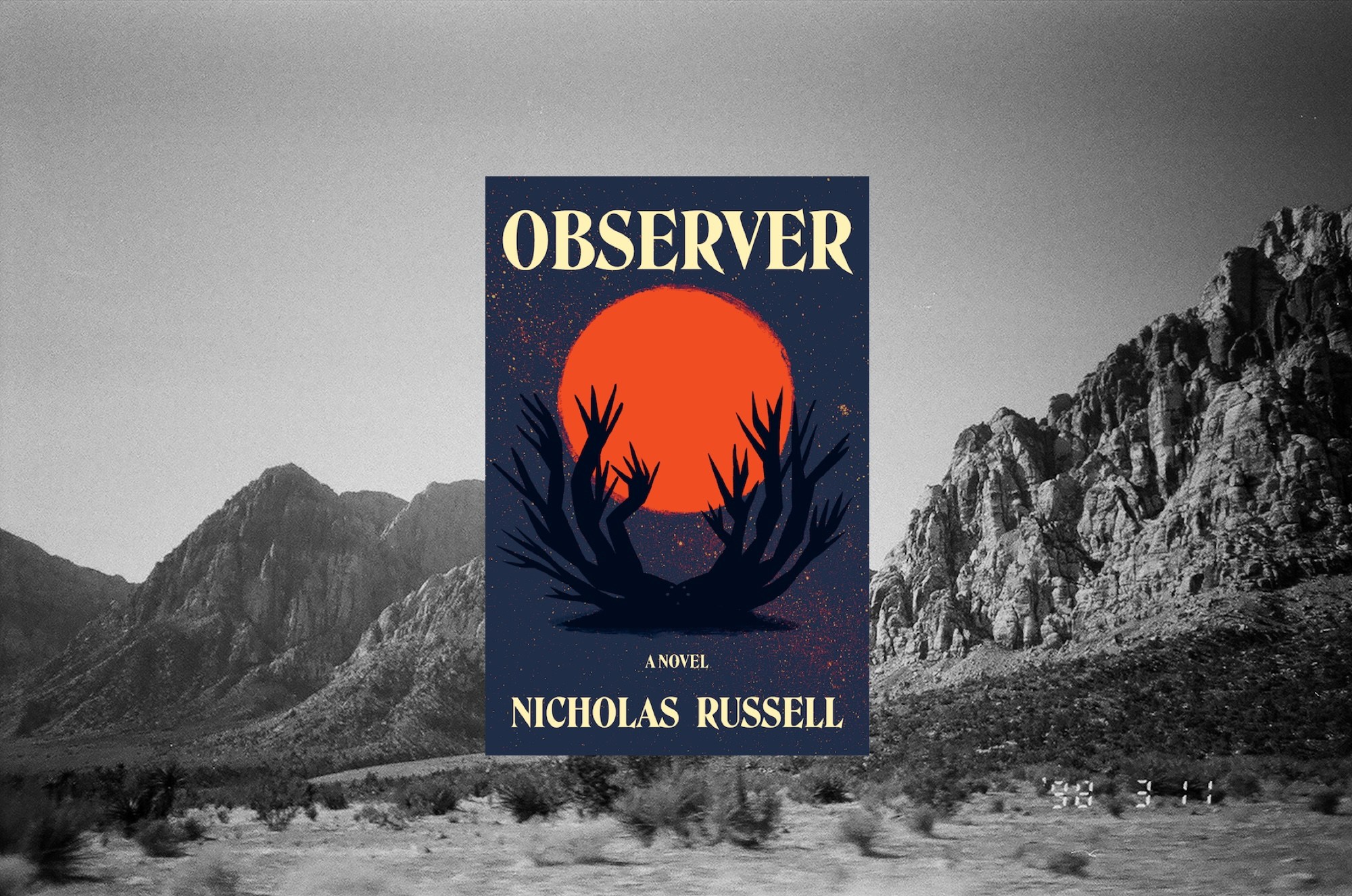
Now he is also a published novelist. Here's something else you might've noticed from reading Russell's stuff: He is a bit of a horror sicko. His novel Observer, which will pop up soon in the horror section of your coolest local bookstore, is what you get from a thoughtful, erudite, extremely curious, and uncommonly driven horror sicko. Set largely in the remote Nevada desert, Observer charts in overlapping timelines human encounters with some deeply weird phenomena and menacing non-human lifeforms. In the 1990s, an emotionally remote and difficult scientist named Corinne arrives at an astronomical observatory in the outpost town of McNairy and witnesses up close the shocking and calamitous destruction of the facility and its various projects. In the present, Corinne has disappeared and is presumed dead, and her estranged adult daughter, Renata, takes possession of a chaotic trove of Corinne's possessions. Renata begins from that mess to work toward an understanding of this enigmatic void of a parental figure. And both Corinne and Renata endeavor to make heads or tails of the writings of Francis Brown, an early 20th-century prospector whose journal entries describe the discovery, in the depths of an unexplored desert cave, of something impossible.
Observer is a couple of different kinds of mystery: Its characters are groping around for comprehension, both of the disaster and wreckage above McNairy and of one another, but Russell is disciplined in his doling out of information, resisting the temptation to swoop down with huge blundering author hands and scratch clues into tree trunks and so forth. Remoteness, that specific gritty and standoffish remoteness of desert habitations, is so essential to Observer's narrative that it might as well be a named character; if it's hard and thorny to reconstruct a complete understanding of some of the most spectacular and studied disasters of modern history, imagine trying it in a forgotten and decaying Southwestern town where everyone, human or otherwise, wants to be left the hell alone. It's a real strength of the novel. You can go in some pretty surprising directions if you set your story in a place where eons might plausibly pass without this or that creek, canyon, or cave getting a very close human inspection.
I spoke to Nicholas about Observer, about making up bizarre cosmic abominations, about Nevada and the desert and its inhabitants, the daily mysteries of knowing other people, and about how the hell he wrote an entire novel while working a day job and freelancing all over. Attempts were made to avoid spoiling the book. This interview has been edited and condensed for length and clarity.
First of all, it's amazing to me that anyone ever writes a whole novel, let alone while holding down a day job and freelancing all over the place. So congratulations! What has this experience been like for you?
Thank you! I've freelanced for a while now, and I've always had a day job at the same time. I work at a bookstore here in Las Vegas called The Writer's Block. I started freelancing at the end of the blog era, basically just as the dream of staff writing was starting to die at a lot of different places. There were just fewer and fewer of those opportunities going around. Having worked a day job that whole time was beneficial, I guess, because you just have to get used to managing your time.
It's been a long and circuitous process. Fiction was what I wanted to write back before I began freelancing, which came along sort of by accident. I started writing for a local magazine here in Vegas, and then I was in film school for a little bit, and so I started doing film reviews for places, and the ball started to roll that way, but I was also writing short stories at the same time and trying to be published and chipping away at that when I could. Eventually it became difficult to justify working on fiction, because it wasn't really paying the bills, which was kind of sad, because fiction was still the kind of writing that gave me the greatest sense of fulfillment.
By the end of lockdown, I'd had a few stories published in some places and I was still a columnist at Gawker, and an agent suddenly reached out to me about this piece I had written. It was a piece about this novel called Happy All the Time by Laurie Colwin, and the agent was like, "Oh yeah, I really love this book, I don't usually see people talking about it." We talked and I sent her some short stories—essentially the first draft of a short story collection that will be coming out next year—and she asked me if I was working on anything longer. And I was! And, basically, this is how I got an agent.
At this point, I had started working on Observer, but didn't really know that it was going to be a novel. I had these little, like, sketches, and I'd been doing a lot of research about telescopes and astrophysics, but it hadn't coalesced yet. I didn't really want to admit that it was a longer thing, because I had no intention of writing a novel. So she told me to just send her what I had, and I sent her, I think I had like a couple chapters and some notes.
Wow, she sniffed it out. A literary agent's superpower.
Yeah, she was like, This is cool, you should keep working on it. Thus began a process spanning years, where she would check in every few months and I would tell her that I was still chipping away at it. There was a period of time, of maybe a year or so, where out of necessity I was freelancing a lot, like just paying the bills, but also I had this weird feeling that if I wasn't knocking on every door that people would forget about me. I eventually reached a point where I just felt that I needed to have a book out, like this is the next step for my writing. Around this time, an editor reached out to my agent, from a publisher who will remain nameless, and they were interested in working on an essay collection. I felt like I had to move on that, so I was like, OK, cool, let's pitch an essay collection, let's do that now.
We spent a month or two getting a pitch together, a collection of essays about the Southwest. We had some meetings with people, but the longer into this process we got, and the more rejections we got, it just became very discouraging. We would hear from publishers that the idea sounded interesting, but with irritating tweaks. We have a book about California coming out, so can you not write about California? By the end of this process, I realized that the book that people were willing to let me write was not the book I wanted to write. And even when someone did say yes—and this is basically signing up for a two-year process of researching, writing, editing, all that shit—I realized I actually don't want to do this.
After all of that, what I really wanted was to go back to fiction, and to work on my novel. It's a long answer, but hopefully it helps to explain how, in addition to the normal demands of writing something novel-length while working and living my life, there was also the mental process of deciding to take the story seriously as something that could be prioritized and finished and published.
That's nice: The storm of ambition passed, and you found you'd been swept back to the friendly shores of fiction. Did this change anything in your attitude about the work itself?
I think the whole process maybe helped to prepare me for what comes after the writing, and to reorient my priorities. There was the process of writing and editing the book, and then once I handed it off and it was basically finished, I was like, Oh, OK, now it's gonna become something else. It'll now be something that I have no control over: what people think of it, whether or not they pick it up, whether they finish it. Now it becomes an object. I'm sure it'll be very funny to walk into my local bookstore and see it on the stand. Who the hell wrote that thing?
I'm curious about that part of it, especially with a story as out-there as Observer. How much did you concern yourself with the idea of selling a novel? Are other people going to vibe with my weird story? And then later in the process, as you finally had to turn it over and let it become someone else's problem, have you had to fight off any protective instincts?
It's interesting, I think this is probably where it's very important to have the right agent. She saw some potential in what I sent her and helped me to take it seriously as something that could be published. I would send her chapters, before we sold the novel, and her input was mostly just, like, "Keep going," but with no deadline or impatience. She wasn't giving me specific feedback, what she wanted was for me to push through and eventually to have something that is finished. I could go back and change it later, but first just get a finished draft.
I think if you had the wrong agent, the wrong person in that role, or the wrong process, or the wrong set of expectations, I think it could really go bad. I was never interested in getting an agent. The process, as described by others in the business, can be really unpleasant. There's this whole subculture you're expected to join, and, like, a playbook: These are the things you need to do, these are the books you need to read, these are the blogs you need to subscribe to, it's a whole ecosystem. I was just like, Fuck that, I don't have time for that. I got very lucky, I haven't had to do any of that stuff.
I had a very strong idea of what the book was, and also, as a bookseller, I even had strong ideas about where I wanted it to be shelved.
Horror?
Horror! I wanted Observer to be in the horror section! This was always how I saw the book, as a horror novel, genre fiction. I think that also really helped frame the way that we went about selling the book, like, which editors were interested, and it helped to weed out the mismatches, because there were some that didn't really get what the book was, who saw it more as an allegory or something, or like a very classic sort of like metaphor or whatever, where the supernatural elements are actually not real. And I was like, No no no, you're misunderstanding it, this is a horror novel, set in the desert, where the creatures are real, and are not anthropomorphic, and are not things you can reason with! Sure, there are thematic elements that we can get into, in terms of Renata and her mother, and stuff about family, but the people who saw it as a sort of grand kind of allusion to something, or a stand-in for another idea, those are the people that made it very easy to be like, OK, no, you're not the kind of partner I want to shepherd this.
I'm glad you held the line. You do encounter, in horror, a lot of heavy-handed allegory, and it's not hard for me to imagine there being a certain amount of pressure on authors to kind of justify their monsters as devices for commentary.
Something related that I found really exciting in Observer is all of the parts of it really seem sort of freshly imagined. It avoids—well, "avoids" might be the wrong word, but there's a refreshing absence of horror tropes, and horror can be a very trope-forward genre, like romantasy. Did you ever feel tempted by genre conventions? Did you make an effort to specifically avoid horror tropes?
Not consciously? I mean, certain genre tropes work really well, and they can be familiar to readers in a good way, right? Like, they can make a reader excited to be like, Oh, this is usually the part where this happens. I would say if there's any avoidance of tropes, or subversion of tropes, it comes at the level of evaluating what made sense for those two characters to go through. I had ideas of body-horror elements, and eco-fiction elements, and I threw some of that stuff out when it wound up not making sense for what Renata was going through.
I spent a really long time figuring out the Corinne character, because originally she was going to be the protagonist. The more I wrote about her and from her point of view, the less the narrative seemed to fit what I wanted for the story. I had to move one step away from Corinne, and that meant having someone to look at her, someone who is trying to find her or to engage with her. That was when Renata became the protagonist, and that switch really helped to frame what I wanted to do with the novel.
Obviously, I am the author and I can decide what my characters do and go through. But once the characters were constructed, I couldn't then force them to behave in ways that they simply would not. I wanted their decisions to be coherent and to drive the narrative, rather than, Oh, I want this crazy thing to happen in the fifth chapter and I need it to go a certain way, and then steering the characters sort of awkwardly toward those story beats or elements. I wanted there to be cool, sort of shocking and resonant scenes and sequences, but ultimately I felt like what made this novel special to me, and hopefully to readers, is the sense that whatever is happening originates with the characters and their choices, that they are authentically moving forward in the narrative.
Who these people are and how to understand them is central to the mystery. There's mystery at the plot level—what happened to Corinne, where did she go, what happened at the observatory—but hopefully also a secondary level. How much of what you're being told in the epistolary sections of the book is actually true, what is being left out, and the sort of fundamental mystery of trying to understand another person. A big part of Renata's journey through the novel is not just gathering information but making decisions about how to assemble it into a history, or a profile of a person, and then learning to accept that there are parts of history or reality that simply cannot be known or understood. No matter how long you've known someone, no matter what you've been through, there is always an element of decision in your comprehension of them. I mean, there's intense scary stuff in Observer, obviously, but hopefully it all feels connected to the central idea, which is very fundamental in cosmic horror, but on a larger, less personal scale: the basic unknowability of things.
Writing this novel while also having a job and doing a lot of contract writing, and only being able to work on it in free spaces of time around your obligations, I imagine it could've been really hard to find your way back into the appropriate headspace or mood, or to recover momentum from a previous writing session. Do you think starting off with a really strong sense of your two characters helped with that? Like if you couldn't necessarily summon the vibes of a sequence, you at least had these two people who you knew really well and could easily relate to how they might be thinking or feeling?
Yes, definitely. Once I figured out Renata and Corinne, which happened early in the process, I was able to write through them and get a few parts and chapters in the bank, such that the voice and tone I was trying to go for was really strongly locked in. And then, too, because the setting is Nevada, it was very easy to come back to the setting, because it's where I'm from and it's where I live. I spent a lot of time figuring out in my mind what the town of McNairy, a fictional place, looked like. I drew a map, I worked hard to get the geography right, so that I did have a very strong spatial and almost sensory understanding of it. That work up front, to really grasp the setting and the characters made it a lot easier to set the story down and then pick it up again.
Corinne was fun to locate, as a mood. There would be days where I was feeling pissed off about something, or maybe a little low, and I could write, for example, some of her diary entries, and channel my feelings into her, because she can be very abrasive.
The hardest element, for me, was writing the character of Francis Brown, the early 20th-century surveyor, out on the Colorado River. My concept from the beginning was for him to have a kind of old-school, sort of recognizably gothic vernacular, and his diary entries are written in a much more formal way. It really took a while for me to figure out what he sounded like, and then it would be hard to slip back into his voice after a break. I would go read some Wilkie Collins or Ambrose Bierce, or Algernon Blackwood, some classic old weird fiction or cosmic horror. Or even Poe. Just to get back into the Francis Brown state of mind.
I liked Francis's sections, and I thought it was a real strength of the story that you established that there's this huge messy trove of journals in a garage back in Las Vegas, and the reader is only getting to see a slice of it. There's always this sense of more detail and lore just out of reach.
I felt the same way about Nevada itself, as Renata has this sort of confined life in Las Vegas and then begins to read and grow curious about this weird remote town and its abandoned observatory. There's a sense of this grand opportunity for surprise and discovery. I was really pumped when she finally hit the road and headed out for McNairy and the off-grid parts of Nevada. I'm curious, what parts of Nevada made it into your vision of the book's setting?
I'll start with this: I had no interest in writing a book about Vegas. I've written enough about it in my freelance career that I have nothing to say in fiction about the city. For Observer, I really wanted to tap into the essential mystery of the rest of the state. Nevada is really big, it's easy even for me to forget that, especially because so much of it is government land and difficult, logistically, to see. There's all these small little places where people are literally parked in the middle of the desert and living their lives, with nothing but these vast stretches of blank desert between them.
I love the desert. I think some people can have a very narrow idea in their heads of what a desert is, what it looks like, or think that once you've seen one stretch of desert you've seen it all. But it can be so varied! It can be kind of dizzying sometimes just to drive through Nevada, because there's a very striking variety of land formations and microclimates. It was fun to bring some of that into the book, to put its main setting in a place that might feel brand new and surprising to someone who hasn't seen all that a desert can be.
I really wanted McNairy to incorporate a lot of the different kinds of landscapes you can find in Nevada. There's a place not far from Vegas called Mount Charleston, some of the upper parts of the McNairy peak are drawn from there. Other parts are from Tecopa, a tiny little desert place along the border with California. McNairy is situated in Nye County, so that's getting into the lower half, close to the middle part of the state, where there are really beautiful mountain ranges and canyons, where it's not quite so dry, there are forests and it snows.
The book starts in summer, it's really hot, and I did want to communicate that aspect of living here, because it shapes the way you live and your relationship to your environment. Vegas is a place that is built sort of in opposition to its environment, and in a way that doesn't make much sense, and I wanted to start there and then to go to somewhere where everything really opens up, with fewer people around, where the reader maybe gets a certain sense of relief, as you've described, when Renata gets out on the road. At the same time there's maybe a sense that she's traveling back in time, to connect with archival information and learn from the history of this town, which stretches back to the late 19th century. It can't be found in a museum and isn't being preserved, necessarily: It's out there, rusting in the desert.
Is there a sort of cultural template for McNairy? I mean, I've driven past some weird, threadbare habitations in the Arizona desert where I, a normie, could believe almost anything about the place's history and the backstory of its founders or present residents. McNairy has had some deeply strange times in this story, and I'm really curious to learn how you went about imagining those traumas into its present-day culture.
For the most part, the idiosyncrasies of McNairy and the people who live there are pulled from what I've observed of people who live in the Southwest and live out in the desert. You just meet a lot of really weird people, and maybe they're weird in part because they live in a place that allows them to be that way. I think a lot of people escape into the desert, into these remote places, because they want to be left alone. There is obviously often a libertarian aspect of that, where people are trying to live in a way that they feel is unencumbered by a certain kind of scrutiny, or regulation.
I've met people at weird little roadside gas stations or gift shops, at these really random blips on the map, who have had such expansive lives, and it's always fascinating to learn how they ended up here of all places. Some people are drawn to the landscape, either because it's so strange and fascinating to them or because it feels familiar and, in a way, like home to them. A lot of what I was trying to build out with McNairy was the sense that it is its own little secret.
I think that's where McNairy's DNA comes from, not from the idea of a place but from pulling together these sorts of very strange individuals that I've met in these areas over the course of my life, where you're sort of baffled to think that they can exist at all, who have concluded for one reason or another that they don't make a lot of sense in regular society. That provided a natural clash, in the 1990s sections of the story, with this contingent of scientists who are working at the observatory. These are people shipping in from different parts of the world, who are strange to each other and have their own little culture and range of idiosyncrasies, and who certainly think of themselves as very brilliant, and maybe have a very superficial sense of their superiority among the weirdos of a remote desert town.
A key to the story is that things in the remote Nevada desert can go unencountered by humans for really vast stretches of time, and the story presents surprising and bizarre ways that a sufficiently ancient thing could be suited to the desert. How did you go about picking out and settling on the qualities and capabilities of the story's monsters?
It started with a determination to avoid a kind of creature that could be seen as in any way human. I really did not want to anthropomorphize them, I didn't want them to vocalize, or communicate, or have faces in a way that could allow any easy empathizing with their motivations. I wanted them to be totally strange, like a person encountering them could only guess at how to proceed, and could not easily read anything as basic as "good" or "evil" into their actions, or pick out the nature of their intelligence.
I am interested in how a survival-based intelligence might function in creatures that exist for lengths of time so vast that they can hardly be fathomed, and that experience dormancy, and have other survival adaptations that would render their thought processes basically incomprehensible to a person. And what would it take for a creature to survive out in nature for eons, through massive environmental upheaval, while remaining basically totally undetected by humans? How could that be possible? All of that went into the building of the story's monsters.
I want them to be formidable, of course. But are they maybe also vulnerable? If they're concerned with their own survival, it must be along lines that are totally bizarre to a human observer. One of the horror elements of the story comes down to one of their survival adaptations. I think I arrived at a place that sort of subverts a common element of alien science fiction: the moment, especially in movies, where a person comes face-to-face with an alien and they look each other in the eyes. Aliens always have eyes, and even if they are arranged strangely, they are always able to exchange meaningful glances with humans.
The eyes are always the origin of some sort of understanding!
I wanted to take that off the table, absolutely. It's harder to have that E.T. connection to a creature that can't reach out with a humanoid finger.
The point in Observer where Renata finally encounters the creatures reminded me of Solaris, by Stanislaw Lem, those bizarre Symmetriads that just completely overwhelm the reader and utterly defy a person's ability to form a complete visual image. I love to be confronted, in science fiction and cosmic horror, with creatures that genuinely cannot be understood, where the most you can say is that it is possibly concerned with its own survival, or possibly just the continuation of its kind, maybe.
I think a lot of what the book is about, to me, is learning how to live with ambiguity, of accepting ambiguity as a fact of existence. On the other hand, it's horror, so the reader has to be scared, and hopefully there is tension and anxiety in Renata not knowing what she's getting into and not understanding the things that she encounters.
Uncertainty was important to me, maintaining the sense that things could go in any direction. Uncertainty makes for better narrative tension. So a character going into a house where the reader already knows there is a killer in there, yes there can be dread, but it can also sometimes be deflating, like you know what is coming, from a narrow range of potential outcomes.
That can be fun, but in Observer I wanted to avoid, or maybe just to deploy judiciously, those Brain Off moments. Because it's also fun to have no idea at all what might be coming. If there's an inevitability to where Renata is going, there can still be a lot of discovery in what happens on the way there, what she learns, and how what happens and what she learns affects the decisions she makes. I wanted to keep things unpredictable.
I appreciated that toward the book's climax, Renata was still behaving in ways that were fascinating to me. She's in this very dark and remote mountaintop observatory, and she encounters this terrifying thing, and her response to it surprised me, so that rather than feeling confirmed in some possibly trope-based ideas I'd formed of her, I felt like I was still learning about her, right up to the end of the book.
I wanted the climax to be very active. I wanted there to be a sort of culmination of all these decisions Renata has made, and I wanted to put her in a situation where she now has to make survival choices in the moment. She is no longer exploring and learning, she is reacting, and that's when she kind of enters a horror movie and makes dramatic and maybe ill-conceived decisions in order to continue living.
I also wanted the observatory to finally become like a haunted house. You've spent time learning about it, about the culture there, the kinds of people who worked there, what it looks like, what it felt like, etc. By the time Renata gets there it's completely derelict, almost a mausoleum. But it's not completely lifeless, right? There's a different kind of life there now. And Renata finally just has to take everything she's learned and settle on something: On an understanding of the meaning of the journey she's been on, on a position vis-à-vis the monster directly in front of her, and also on a way of finally comprehending her mother.
Yeah, and on the meaning of her own life, and on a vision for her future, in a way. There's more than just reptile-brain survival, there's a clear sense of Survival, but for what? Perhaps not to return to a crappy job in Las Vegas, but for a chance to continue forward with this lunatic journey.
The things that she does at the end of the novel, she has emerged on the other side of these revelations, and the experience shapes the person that she chooses to be. I knew that Renata was searching for catharsis of a certain kind, but from the beginning I knew that she was never going to get exactly that. She was going to get something else.
I didn't want there to be an easy conclusion. I felt like the things she is encountering and her own set of decisions lead away from that kind of tidy finish. Hopefully that's as exciting to read as it was to write.
The writing of the finale was a lot of fun. By the time I got there, I had the sensation that I'd set up all the dominoes, and now I was just knocking them down. It was a blast. And I was excited to end the book in a way that hopefully, for a certain kind of reader, keeps the creatures in your imagination after you've finished.
OK, yes, my experience of that: After I finished Observer, I wanted to go online and find some old crappy conspiracy website with deranged testimonials about close encounters with the book's creatures. Surely someone has seen these things and lived to tell about it.
I'm glad to hear that. I wanted to kind of tap into the story's rabbit-hole potential, where there's epistolary stuff and archival stuff and news stories, so even though it is a directional novel—Renata leaves Las Vegas, goes to McNairy, climbs the mountain, goes into the observatory—I wanted there to be a sense of a bigger world and more to learn and to experience, so that where you end up in the story doesn't feel like the only place you could've ended up.
Will you keep up with horror after this?
Yes, and the story collection that I have coming out next year is horror. It's even arguably more horror-y than Observer is. The story are a lot darker and weirder.
Weirder?!
That's the fun of short stories! You can just follow a weird idea for a while and see where it goes. I once had an idea for a story about a society in which people cut off their own limbs in order to measure things.
I do that. That's normal.
Sometimes that kind of idea is just how things start. And then by the end, you wind up in some totally unexpected place. You would never have been able to guess that you would end up there, but there you are.