

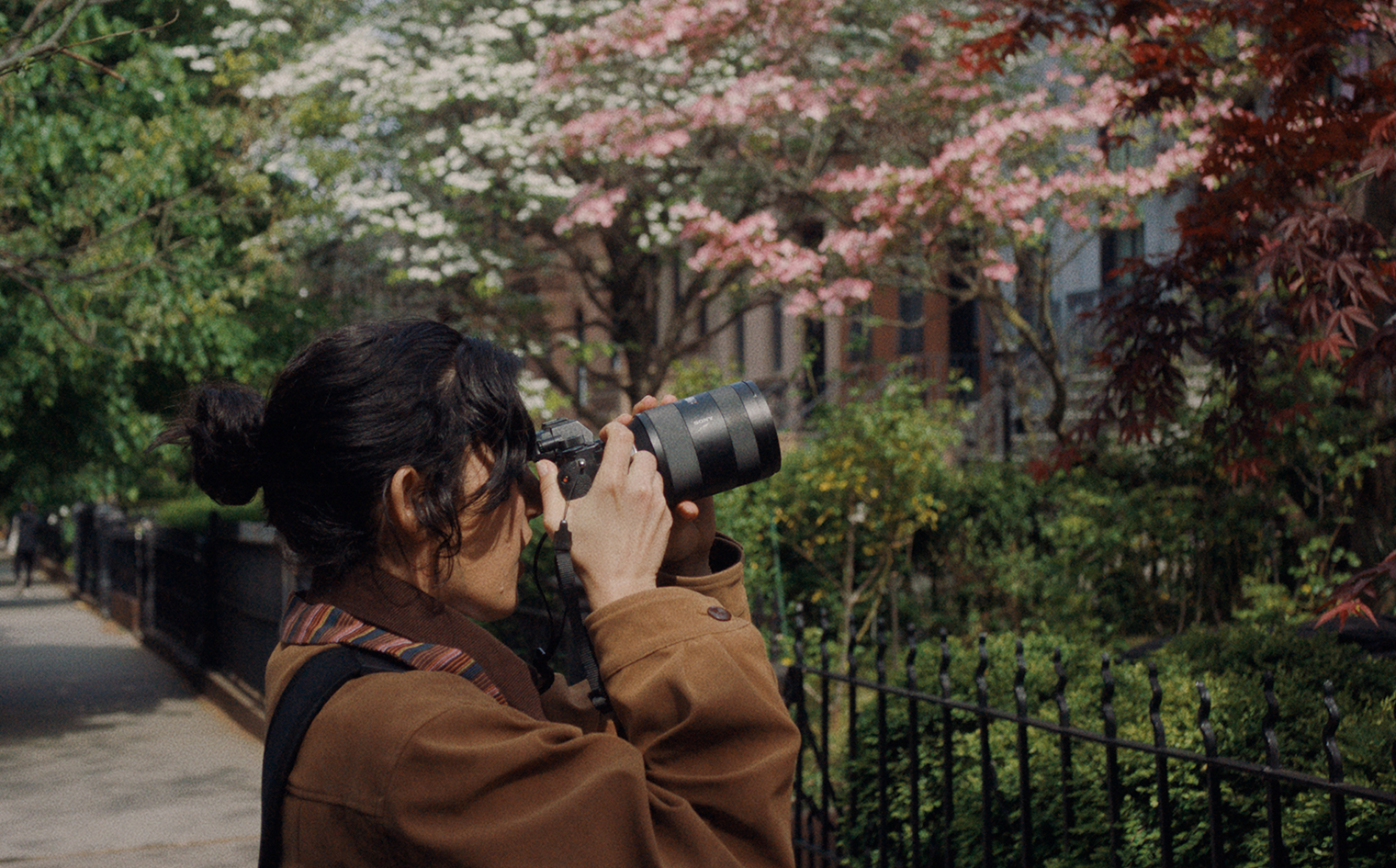
Sofia rises early to drive from Brooklyn to the Manhattan production office where she works as a location scout. She’s tasked with finding spots in which to film an upcoming television pilot: a few apartments and, randomly, a fish store. Her day brings her around the city and in contact with a variety of people—a tech guy who shows her how to hack the system to avoid parking tickets, an old friend she hasn’t seen in years, a man who insists on dinner as recompense when she shows up late to scout his store, whereupon he will not shut the fuck up about his Moby-Dick ripoff novel. This is The Scout, a loosely plotted but deeply resonant portrait of modern New York as related through its inhabitants and their spaces.
Writer/director Paula González-Nasser based the film on her own time in the trenches as an NYC location scout for TV series like High Maintenance, Broad City, and Search Party, as well as movies like Never Rarely Sometimes Always. Appropriately, she served as her own scout for this film, which has raked in plaudits since premiering at last year’s Tribeca Festival. Ahead of The Scout’s theatrical release, I sat down with González-Nasser over Zoom to discuss her time as a location scout, how it informed the film, and how she charted a realistic journey through New York. Our conversation has been edited and condensed for time and clarity.
Jacques Rivette said that every film is a documentary of its own production. That’s especially relevant here, because every time we see Sofia scout a place, you previously had to do exactly that in that space. Did anything that happened during your scouting make its way into Sofia’s encounters?
The production of this film was at least a lot less stressful, a lot smoother and more flexible than Sofia’s day. But we took a lot of cues and little tidbits from homeowners. We hadn't locked the script when we started looking for the locations, and everything was still malleable. And of course, I did that knowing location scouting is so hard when you're up against a timeline, and how you’re expected to make something that maybe doesn't even exist appear out of thin air. So we allowed ourselves some flexibility.
We met certain homeowners who had tendencies that made me go, God, that's a lot better than anything I could write. There were some logistical things—like with the software developer’s house, I found it fascinating that they’ve owned that house for a few years, but it's split in two, and the other half still belongs to the wife’s family. Little things like that made it into the dialogue and characters.
You also drew on your prior experiences as a location scout. Did anything from that time make its way into the film? The fish store guy explaining the plot of his novel feels so specific.
There were definitely a lot of times when I was scouting that I'd have to hear conspiracy theories or sit down for tea for an hour and listen to someone's thoughts about life. But that scene was all written. I like the actor who plays the fish store guy, Matt Barats, quite a bit, so I wrote a character in his voice—not very self-aware, a little bit insufferable. He plays that character well in a film he made called Cash Cow. I thought it would be fun to write a story that felt like something that could happen to me.
The script has a canny way of instructing the viewer about how Sofia’s job works. It starts with her going to the production office, giving us the context for what she’s doing. Then we see her putting up flyers on various brownstones. Then she goes to the old woman’s house, and because that character isn’t savvy about the film business, she gets to explain clearly what she’s doing.
The film is inherently explicit, in that it's meant to show you the nuts and bolts of what this job entails. I think by hyper-focusing on every aspect of the job, even if it's super mundane or repetitive, you get this third meaning, which is what this job brings out: In such a highly connected city, there's such a disconnect and a loneliness to this character. I think that only by focusing on what this job is and hitting you over the head with every part of her day do you understand that it's not really about the job. It's more about this meaning for her and a lack of connection in this job, which to other people sounds like a dream.
What misconceptions did you find that other people had about your work as a scout? What did it seem they imagined the job was like?
I think they hear that I wasn't working in an office 9-to-5, and that the production rents you a car or you get to use your own car, and you're in different parts of the city every day, meeting cool business owners and seeing all these beautiful homes. And that part is really cool, but what people don't see is the demands of production and how little time there is—especially on a TV show compared to a film—to find a location that will do.
And it’s not as creative as people imagine it to be. I think people watch Succession and they're like, Wow, that's so cool. All of these spaces say so much about these characters. But what they're not seeing is the production timeline, which is just like: We have to shoot three episodes in four weeks. You’re dealing with multiple directors, line producers, and production designers who you never even meet; you just email and hope they email back and like whatever you found. I think people think it's glamorous because anything to do with film and movies seems like art. They think you must be getting to be creative at all times of the day, when it's really a lot of email exchanges, scheduling, chasing down a homeowner who doesn't want their home filmed but the director has fallen in love with it. It's just people management at the end of the day.
How much detail is a scout given on a scene? Does a production provide an in-depth list of requirements, or is there just a vibe they request? Does it vary? How much input does a scout have on it?
It varies from production to production. Typically, a TV show will be a lot different than a film. I have found that film directors, for the most part, are extremely involved in the details they give. You get to read the script and make assumptions about where you think a character would live, along with the location manager. And sometimes a scout is the location manager. I've had film directors who will send me lookbooks of every location, with details about color palettes and what they want the character to embody and feel in these spaces, and that's really helpful. Of course, it's also daunting. Sometimes you're like, Well, that doesn't exist for the price range in our budget. But it's nice to be able to live in the headspace of the creative team.
For TV shows, for the most part, it's a lot of logistics and less creative. We have to pair one scene with another and shoot them on the same day. So if a scene is in a coffee shop, they’ll say: “Please find the nearest coffee shop. We don't care what it looks like, we don't care if it has white walls; we'll add stuff to it.”
Most of the time, you're going off of instinct and the places you already have relationships with. I know one homeowner is really easygoing, while this other location looks cooler but is going to be a hassle—it’s on the fourth floor and the load-in is going to be a nightmare.
When you watch the finished shows and films you worked on, can you only think of what happened to you when you scouted the locations for those scenes? Oh, I had a nice conversation over tea in that house.
Oh yeah, it happens all the time, in the same way I'm sure a director of photography watches their work and just thinks about how they shot it, what they were doing that day, any obstacles they faced. I did some scouting for Eliza Hittman's Never Rarely Sometimes Always. I scouted the house where the main character lives in Shamokin, Pennsylvania. We found it in Yonkers; it was in the process of being sold and just sitting empty. We were trying to find as many locations as quickly as possible, because it was an independent production, and it was a really stressful day. This was November 2019, when this crazy snowstorm came out of nowhere, and none of the roads were prepared for it. It took me four hours to get back to Brooklyn from Yonkers. The house was perfect for filming, but the production’s eventual location manager had a hard time clearing it. Tracking down the owner was really tough—all these meetings with real estate agents. I love the film, but the first time I watched it, I couldn't quite enjoy it. I have a hard time disengaging in that way.
You can chart the journey Sofia takes on a map of New York. Did you have her route in mind and look for places that would fit it, or did the locations you find shape her day and the narrative? Was she always going to get her car booted in Manhattan, for example?
I think maybe because I've been a scout, it was very important to me that her journey was realistic. Sometimes I'm watching a movie that's set in a certain part of New York, and then the next scene is somewhere else, and I'm like, That is the Upper East Side. That does not make any sense, storywise. I wrote this story and the logistics of her day very specifically.
It starts in Crown Heights—which is coincidentally where I live, and where I had most access to locations. And most often, a production office is somewhere in Midtown Manhattan. It’s cheaper to rent office space there than even in Brooklyn or Queens. So I wanted her journey to go into the city. That's how a scout usually starts their day: They meet with the production team, they get feedback, and then they go back out. But since it's a New York movie, I thought it would be a shame if we didn't see a little bit of Manhattan and the chaos that adds to a day, especially at rush hour. So that made its way into the script for the third act, when she scouts the fish store. That’s the only place we shot where it's not scripted in, since it turns out there are no fish stores actually in Hell’s Kitchen. So we shot the store in Dyker Heights and then mixed it with the exteriors of actual Manhattan. Some people can tell, some can't. It’s nice to see when we can get away with it.
The script is structured like a series of short stories. Was that always the idea, or is that the shape it took that made sense for the film, the way Sofia relates to each person she meets? I was especially struck by the sequence where the apartment she’s scouting turns out to be owned by an old friend.
My friend Melina Valdez joked that when she was writing her first feature, she didn't know what she was doing, so she would have the protagonist be somewhere, and after 15 pages, just have them pack up and go somewhere else, and that was a good writing hack. I felt the same way: A more traditional three-act structure was daunting when I wrote the script, and it was easier to write vignettes. At least if it didn't work as a whole, I could have these short films that I could make something out of.
But something was missing for the audience to access her internal world, because we're kept at a distance for so long. That's when the idea of Sofia meeting somebody from her past came in. If it's someone she has history with and there’s tension from their friendship growing apart, that could let us visualize what her life has been like in the last few years. Mimi suggested casting Otmara [Marrero] because they're good friends and they had had a growing-apart phase too. So they brought a little bit of their own experiences into that.
One article about the film mentioned that you were once led to a room full of dead birds while scouting, but it didn't elaborate. What’s the story there?
I was working on the last season of Search Party, so this was spring 2021, and things were coming back into production from COVID. I was scouting for an apartment and met this man through flyering. He called me and left a rather abrasive voicemail, which I found interesting. I wasn't thinking at the time; I was younger and naive about being alone in a home with someone.
As soon as the door closed behind me, I realized, Oh, no one knows I'm here. This is kind of dangerous. He showed me different rooms, and it became clear that this man was maybe not doing well mentally; he was a bit of a hoarder. He had a room full of living cats that had not seen the light of day in a long time, and there was a closet full of dead birds upstairs. He stood in doorways behind me the entire time, so I couldn't leave. Much like with Sofia, there's not a firm stand where she's like, I don't want to do this. I would like to leave. You just have to ease your way out and avoid a confrontation. Needless to say, we did not film there, and I blocked his number.
That was one of the seeds of my realizing that this job was taking a toll. And what's interesting is that on that day, I just kept going. I kept working. I had three more appointments, then I went back home, uploaded my pictures, and didn't really talk to anyone about it until days later, when I was like, Wow, I don't feel so good. I've talked with my location manager at the time, Julie Sage, about it since then. She has stories like that from her own scouting days. She found a dead body one time.
Holy shit.
It was crazy. She was working on the Mildred Pierce miniseries. On the day of a shoot, she found the homeowner had died. We all have these traumatic stories that we don't tell people, because production just begs you to keep going and not stop and reflect.