

Adam Wingard opens his new movie, Onslaught, with a brainrot history of the military industrial complex, a slipshod compilation of combat footage, political speechmaking, and behind-the-headlines conspiracy that (semi-)convincingly situates the origins of the American century in Operation Paperclip and the importation of Nazi scientists at the end of the Second World War. It rules. Set to a pounding synth score and employing the kind of queasily associative quick-cuts that would make even a 9/11 truther blush, this sequence anticipates something hard-hitting and sharp-edged, the sort of action movie that weaponizes its gristly bad taste for subversive means.
I wish I could see the movie that this credit sequence foretells. Instead, I saw Onslaught. The setup is blessedly simple: Celeste (Adria Arjona) once served in the U.S. Army as a killer sniper; now, she manages a trailer park in the New Mexico desert. Every day, a helicopter flies overhead, triggering her PTSD as it ferries third-generation Nazi scientist Dr. Hans Kammler (Dan Stevens) to the secret defense industry laboratory where he has spent six years transforming a trio of GWOT casualties into unstoppable super-soldiers. Tested on the battlefields and perilously refined in a lab, they are the image of confidence without thought, force without purpose. Once they’re set loose, we’re told, nothing on Earth can stop them.
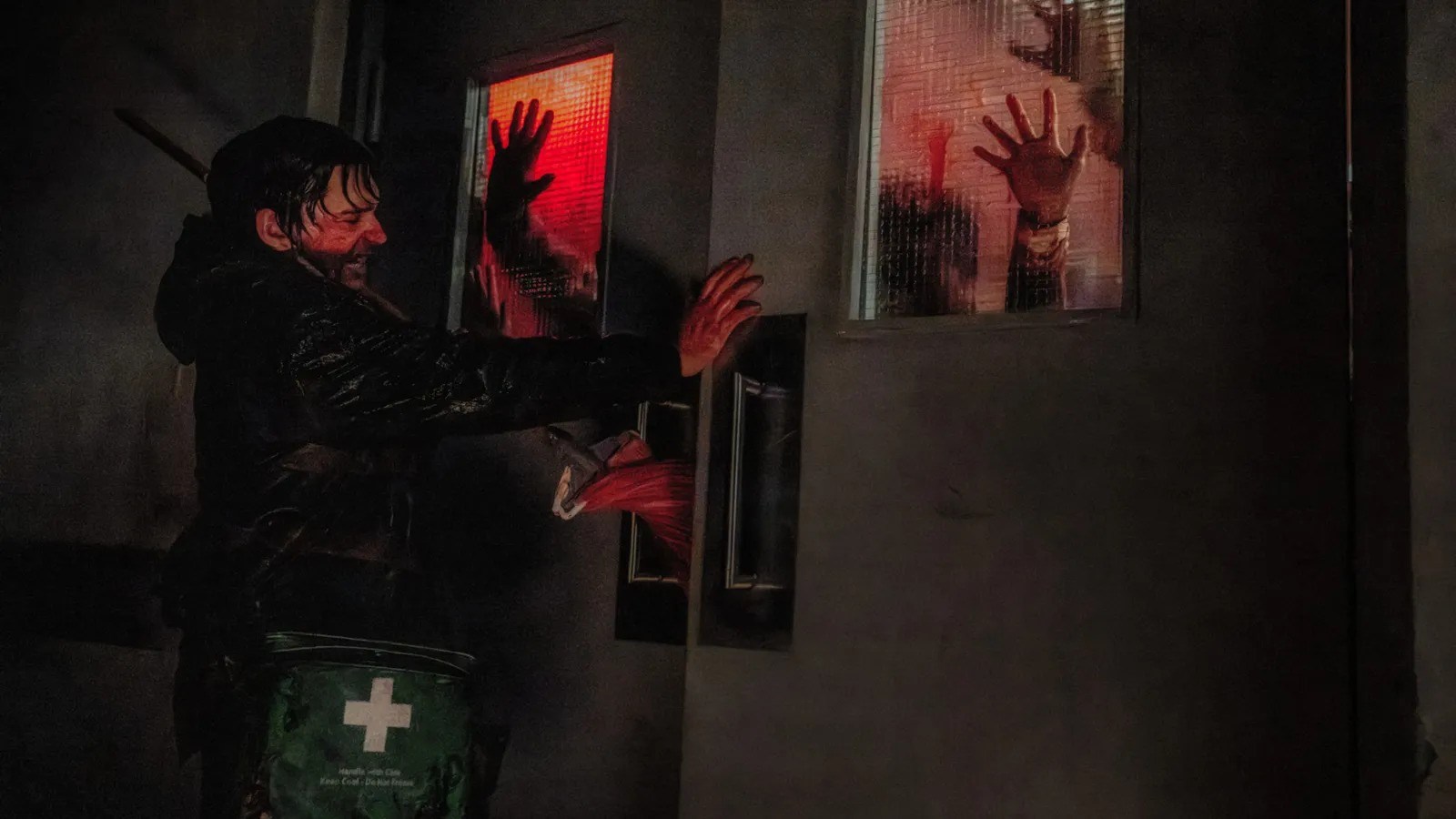
With their glowing eyes and rippling physiques, these killers act like a cross between American Sniper and The Terminator—and the same might be said of Onslaught. Produced and distributed by A24, this is meant to be a superior sort of action flick, marrying the low register of sadistic violence with the high of well-taken (if well-worn) political commentary. Celeste’s trailer park is a home for loners like Josiah, a Vietnam vet played by Die Hard cop (and sit-com dad) Reginald VelJohnson, people screwed over by their government and abandoned by society. Kammler’s super soldiers were chosen for their legacy of overseas brutality, and then engineered to reorient their violence toward the home front. After killing their captors and escaping the base, they assault a truck stop, a sequence that Wingard stages as a combination military raid/mass shooter incident. The results are uncomfortable—some might say tasteless—but they are undeniably potent. No American has to go to the movies to know what this looks like.
Wingard has spent the past decade-plus producing essentially the opposite. After a run of low-budget action-horror movies like You’re Next and The Guest, he got sucked into the studio mines, pumping out anime adaptations and horror remakes and multiple movies where Godzilla beats up on King Kong. Whatever their minor virtues, these were clean, bloodless projects, so you could forgive Wingard for the glee he seems to take in Onslaught’s overkill. With its pulsing score, conspiratorial overtones, and besieged-fort finale, the film invokes a slew of past termite auteurs, none more so than John Carpenter. Celeste is introduced shooting at jack-o-lanterns, and with their glowing eyes and streaming, back-lit costumes, the super soldiers look more than a little like the ghosts from The Fog.
Yet you can’t just slap a synthesized beat under a Precinct 13-style assault and call it an homage. Basically every iconic element of Carpenter’s oeuvre, from his synth scores to his economy of language, emerged out of necessity. Having arrived too late to make Westerns, he directed every exploitation scenario as if it were made by John Ford, working fast and cheap and finding efficient means of sublimating his preoccupations—greed, guilt, Vietnam—inside fool-proof, diamond-hard scenarios. Even on his biggest-budget production, Carpenter’s talent always outstripped his resources.
Wingard has long suffered the opposite affliction. Even without kaiju-scaled resources, his storytelling instincts run toward the inflated and expository, and he devotes preposterously little of this film’s scant 93-minute running time on the actual battle between Celeste and her adversaries. Worse, he botches the basics of action filmmaking, failing to establish a coherent geography among the many identical-looking trailers and shooting just about every encounter in a frantic handheld style so dark it risks unintelligibility. Perhaps all this, like the film’s easy-bake iconography and the surprising vulnerability of the core villains (Dr. Kammler apparently did not give much thought to windshield thickness), is meant as a kind of commentary on the genre, or the times, or whatever the fuck. But so much lore-treading leaves you needing more than a few underlit, over-active moments of physical contact.
Trapped somewhere between Tarantino-style genre gentrification exercise and workout regimen for a director fattened from his time in the legacy IP cage, Wingard’s film promises throwback drive-in thrills and delivers just enough cool lines and sick kills to con violence-starved viewers into an opening-weekend matinee. This old-school bait-and-switch, with its pitiful proportion of setup to payoff, is probably the only genuine note played once the credits end and the story itself begins. Maybe they should have called it Nonslaught instead.
Thankfully, those searching for a high-toned, goofy-hearted thrill ride from a tony independent distributor have other options. Hope, from The Wailing director Na Hong-jin, is as clear and assured a piece of action filmmaking as I have seen in years, a triumph of pure technique at the expense of such piddling things as character, story, and taste. Reportedly the most expensive production in the history of the South Korean film industry, it begins, like The Wailing, as a small-town mystery. A group of hunters come upon a large dead bull outside the town of Hope Harbor, on the water near the DMZ. The creature has been gutted and gouged by some creature with massive claws, and neither the poacher Sung-ki (Zo In-sung) nor his cousin Bum-seok (Hwang Jung-min), the local police chief, can identify any possible culprit. A bear? A Siberian tiger? Perhaps even a North Korean intruder?
Na maintains this suspense for nearly an hour, cutting between the forest where Sung-ki and his friends come across a swathe of past destruction, and Hope Harbor itself, which soon becomes the site of an apocalyptic confrontation between a militarized populace and the unseen but unstoppable creature. On his car and then on foot, Bum-seok bumbles through scenes of extravagant and seemingly practical wreckage: flattened bodies, torn-up trucks, buildings cored out and their occupants torn limb from limb.
Na and cinematographer Hong Kyung-pyo cover this as a series of fluid tracking shots, carrying the viewer and Bum-seok both down alleyways, through culverts, under bridges, and on truck beds, sustaining an unbroken atmosphere of mystery and discovery for something like two-thirds of Onslaught’s entire running time. I genuinely cannot think of the last time I saw a director deploy the basics of action filmmaking with such clarity and intimacy; think the best sequences in Children of Men, but without Alfonso Cuaron’s long-shot durational gambit. Watching the first hour of Hope, you are in the hands of a master.
And then you see the villains of the picture, and the tenor of the film changes severely. Na’s film debuted at Cannes, to a disastrous reception. Critics savaged the pacing, the crude humor, and most of all the visual effects used to realize the aliens who, it is revealed, are causing all the havoc in Hope. Between May and the film’s July 15 release in South Korea, the director re-edited the film, trimming four minutes from the story’s midsection, finalizing the sound mix, and, most importantly, finishing work on Hope’s CGI creatures.
Created using motion-captured performances from western actors like Alicia Vikander and Michael Fassbender, the results are … odd, to put it politely. Where most modern blockbuster filmmaking degrades the visual palette until it matches the poor quality of CGI on display, Hope creates a (perhaps purposeful) mismatch between Na’s impeccably lit and gorgeously framed earthly images and the sometimes janky, sometimes intriguing, and always goofy aliens that rampage across them. That first monster we meet, played by Cameron Britton, has green skin and bouncing dreadlocks, and looks a bit like if the Predator was rendered inside a PS3 copy of Resident Evil. From the moment he smashes one man to death with another man’s body, Hope changes permanently, transforming from a high-gloss genre play into something much pulpier—it starts as The Wailing, and ends as Independence Day.
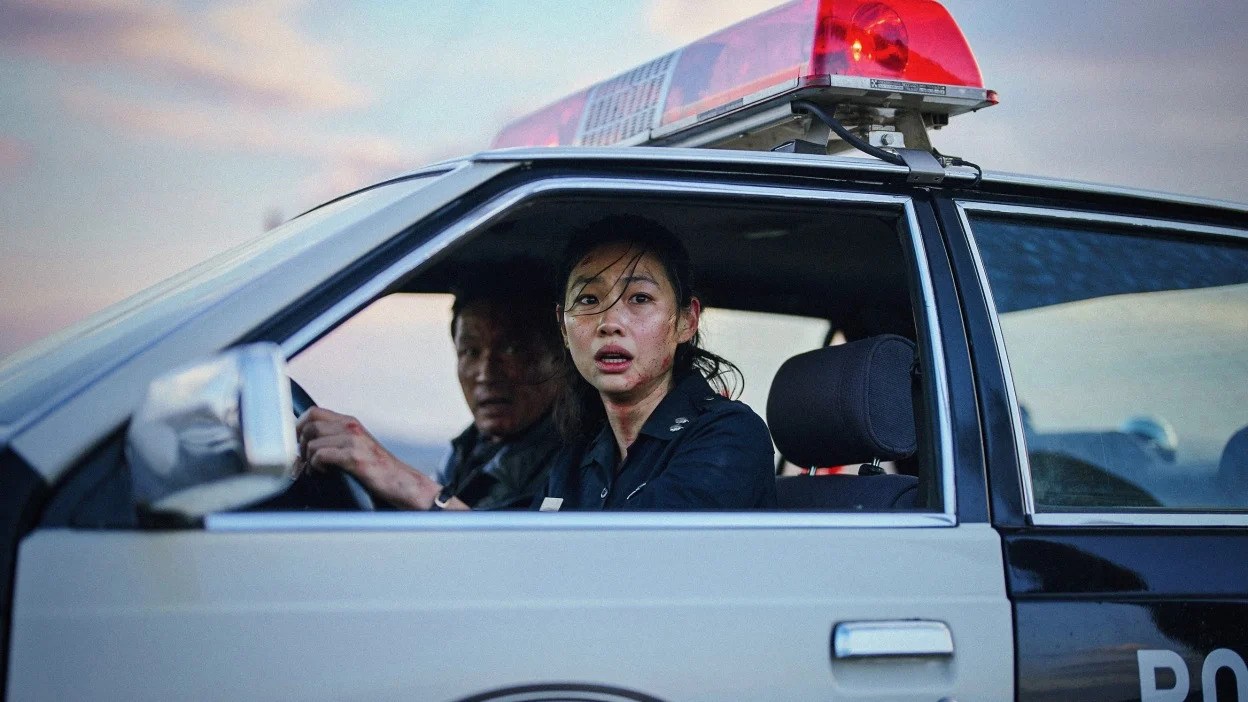
Or perhaps Avatar: Fire and Ash. Na is up to some serious world-building—or world-colliding—here, including a nonsense-language dialogue between CGI creatures on the fate of their own species in a harsh universe. He is certainly channeling James Cameron, another micro-budget-made-good legend whose preternaturally fluid command of the camera gave him perhaps too many ideas about the future of cinema. And like Cameron, Na knows to ground his sci-fi ambitions (and his ambiguous politics) in physical, tactile action filmmaking. Hope is first and foremost a chase movie, with the characters, among them a perpetually stunned deputy played by the mononymic model Hoyeon, racing toward and then away from danger in cop cars, on horseback, and finally, desperately, on foot, lugging the kind of heavy artillery perfect for jacking up an audience’s heart rate, but ultimately useless when arrayed against an intergalactic threat of almost inconceivable scale.
Na’s films tell stories of masculine impotence, of cops and pimps and hitmen who fail to exert their authority over the world. Hope extends this across an entire community of people so paranoid about an invasion from across the border that they miss the greater threat crashing down toward them from above. These are real social concerns, yet as in the best films made by genre heroes like Carpenter and Peter Hyams, these concerns are largely subterranean, depicted but never emphasized. Unlike Wingard, Na doesn’t stage his themes in the foreground of his movie; rather he leverages them against all the blockbuster silliness, implying via a collective narrative of failed solidarity what we might stand to gain from the real thing.
So yes, it might run a little long, and the effects might not always convince. But up through its final moments, Na’s film continues to evolve and expand and put every last dollar on screen. The experience might not always be perfect, but I will take it to Wingard’s over-promise, under-deliver ethos any day. The action movie might once have flourished in Hollywood, but today the inheritors of both Carpenter and Cameron come to us from outside the American system, refracting the genre’s grit and grandiosity through vastly different aesthetic and political frameworks. You can yearn for the glory days alongside Wingard, or you can hope for something more.