The second project is probably always the hardest. This is especially true if it follows a successful debut. You make something great, and by some act of the gods it catches fire and becomes the new, hot thing—a one-in-a-million shot. But then comes the next thing, the followup to your great big deal of a project. It’s a haunting and intense proposition. When I was at NYU for an MFA, I met a lot of famous and successful authors, and I remember one of the pieces of advice was to just write the next book as fast as you can. The more you put it off, the more you will paralyze yourself.
There’s no question that Rivers Cuomo felt some paralysis after Weezer's 1994 self-titled album. Known colloquially as The Blue Album, it is a true achievement of '90s power pop-punk. Ten perfect songs, produced by The Cars' Ric Ocasek, full of nerdy irreverence and offbeat songwriting that manages to stick like it’s the fucking Beatles or something. But on top of this newly signed band releasing a well-constructed album, they became MTV darlings thanks to Spike Jonze's videos for "Undone (The Sweater Song)" and "Buddy Holly."
Of course, this kind of success ended up being a bit of a double-edged sword. A big part of Weezer's success in the post-Nirvana shaped hole in alternative rock was a sense of irony. With the Happy Days-referencing videos and the strange sonic manipulations and playful chorus of "Undone," people mistook Weezer's nerdy/slacker style as a committed stance of ironic distance. Not everyone did this: Even from the beginning, Weezer had a strong core base that understood the band and genuinely connected with the music's vulnerability and longing as well as its sharp humor. But you don't make it big on MTV because everyone is paying strict attention.
On top of all that, Cuomo was not adjusting well to touring and being the new hip band of the moment. For Cuomo, the rockstar life was a lot of strange hotels, Taco Bell every day, meeting 200 strangers a night and being so, so lonely—only able to communicate through letters because collect calls cost too much. It put him in a darkened headspace, and the reactions to The Blue Album alienated him further, as listeners didn’t always seem to get what he was putting down all the way. He knew for Weezer's second album that he wanted to go in a different direction, something wildly unexpected and unique that would keep his creativity fresh and zig-zag from being typecast as these Gen X alt-rock stars.
His idea was a synth-poppy, new-wave rock opera about love and loneliness titled Songs From The Black Hole. It would be a concept record harkening to '80s new wave music but also to the ambitious records of his '70s rock forebearers. But the songwriting went nowhere and his ideas were muddy. Only making matters worse, Matt Sharp, Weezer’s bassist and co-vocalist, released his own new wave-inspired album Return of The Rentals with his own band, The Rentals, to critical acclaim. Rivers felt stuck. Making matters even worse, after an extended year of touring he had spent the summer fixing his legs, as he was born with a deformity that made one slightly bigger than the other. It involved a painful procedure and a long recovery that had him cooped up in bed and surviving through pain meds for months.
So what does a lonely introvert struggling to connect with people and suffering from writer’s block do next? Well, he goes to Harvard—further away from fame and the demands of a rockstar, but also away from family and friends that he has already alienated. It is the introvert’s tendency when faced with loneliness to double down, to think, Well, I'm already alone, why not be even more alone? Why not run away from everyone I’ve ever known and live as some kind of wizened monk banished from society? Sorry, I’m reading a lot of bro literature lately.
Anyway, at some point between his first semester at Harvard and his return to Weezer, Cuomo finds himself moved by and fixated on Madame Butterfly, the three-act opera by Giacomo Puccini, about a U.S. Naval Officer simply named Pinkerton who marries and later impregnates a 15-year-old Japanese girl named Cio-Cio San. "Butterfly," he calls her. Pinkerton eventually leaves his pregnant wife, and for three years she faithfully awaits his return. When he does finally return, it is with his new American wife. He decides to take the child he had with Cio-Cio back to the States, but Pinkerton does not even have the guts to say anything to her face. He asks his American wife and Cio-Cio’s sisters to deliver the news. Cio-Cio San says goodbye to her child and kills herself with a tanto knife. It is an opera, of course, so it is very maudlin, very dramatic and extremely emotional, and Cuomo has an emotional reaction to such a vulnerable story about how ugly and gross these feelings inside us are and can make us be, especially to one another. Suddenly, Cuomo is brimming with creativity, and he has a new idea for Weezer’s second album. He takes some of his favorite song sketches from Black Hole and reinvents the project to be a semi-concept record about Madame Butterfly, but mostly a record about Cuomo’s own ugly emotional vulnerability, particularly in the past two of the loneliest years of his life.
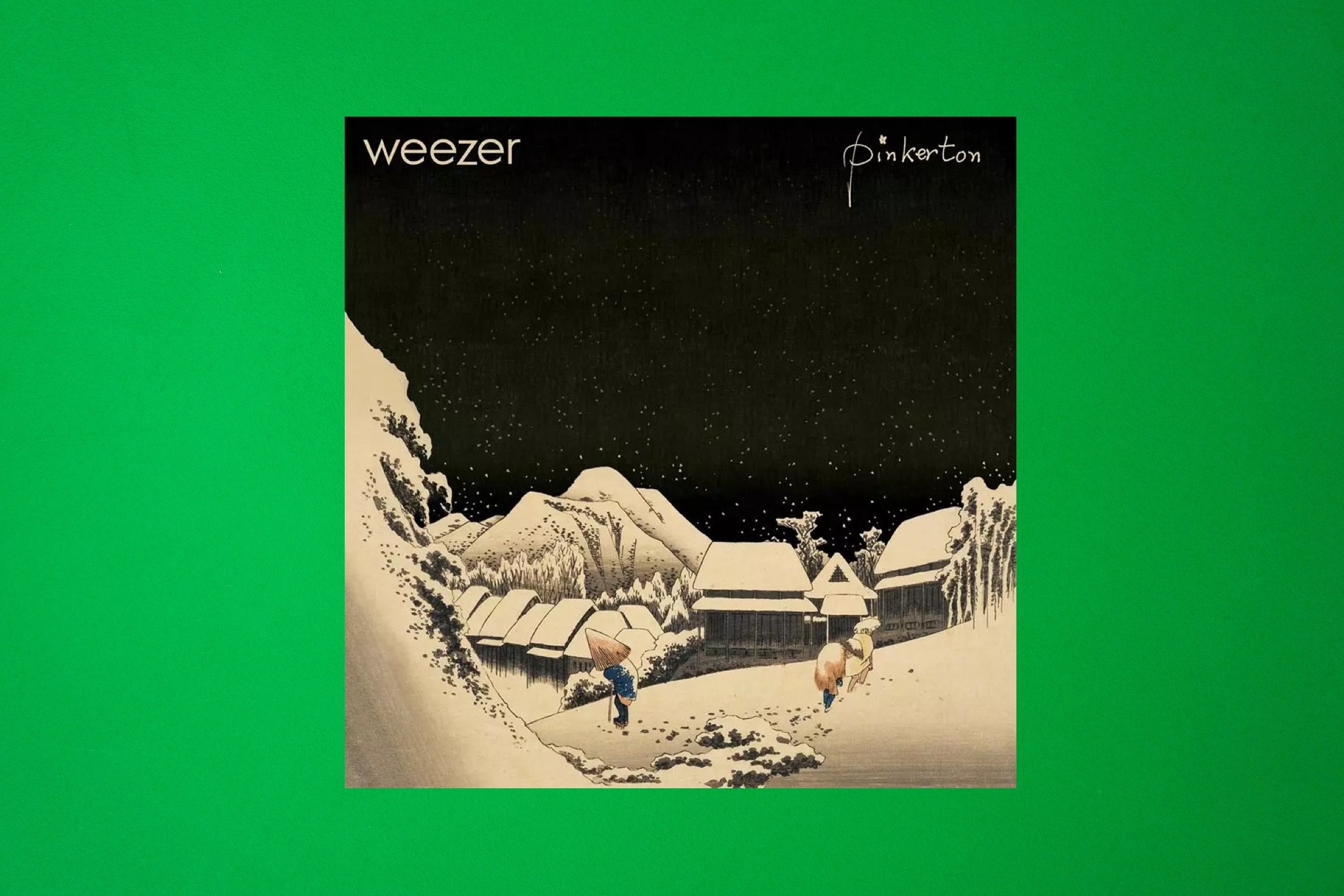
That album was Pinkerton, which celebrates its 30th anniversary on Sept. 24. It's the "at the time" disappointing follow-up to The Blue Album—the proverbial sophomore slump. It tanked commercially, and it was downright eviscerated critically. The non-Rivers Cuomo portion of the band would never have said it directly, but they also seemed to hate it in the moment. They had less input into the songs and the album as a whole. Cuomo had something he needed to get off his chest, and his bandmates were little more than ornaments, there to do what they were told to do—as opposed to Blue Album, which felt more collaborative. The Rivers Cuomo portion of the band would go on to directly hate and shit on this album for almost 20 years, long after the album had become a reclaimed darling of pop punk and the burgeoning emo rock scene that would soon have its own moment in the MTV sun.
Some albums are loved in the moment and then forgotten about; some are completely, obviously brilliant but take a long time to build success; some are hated or feel disappointing but eventually grow on you. It is rare for an album to be so widely decried—for its orientalist fixations, for its uncomfortable lyrics about women and sex, for its overt horniness—only to become adored later on. What is that about? Was everybody actually wrong then? Is everybody right now?
Funny enough, I can trace a lot of my feelings about this album back to each decade of its life. In 2006, during its 10th anniversary, I was a senior in high school. I had spent all of my high school years becoming a big Weezer fan: loving The Blue Album, appreciating The Green Album for what it is, defending Maladroit and listening to the non-"Beverly Hills" songs on Make Believe. And then there was Pinkerton. While I would not say it dethroned Blue Album for me, as a perpetual emo kid, I was pretty close to obsessed with it. I could identify with its deep well of emotional raw nerves and desperation to be loved and wanted. I was also into its jaded disassociations with sex and fame and coolness. I loved how noisy and droney it was. I loved that obnoxious buzzing guitar that opens "Tired of Sex." And I loved the double down of discordant noise rock on "Getchoo." In my young mind, this is where Weezer lost a lot of the stuffy rock-critic community. It was a clear distinction being made between the charming pop melodies of Blue and the messiness on display here. I felt Pinkerton’s messiness was its strength. Everything was ugly and beautiful at the same time. The playing was ugly, the noise was ugly, the feelings were horrible and embarrassing and cloying and so clearly my shit at 17-years-old. "I'm beat, beet red/Ashamed of what I said." Same, Rivers, same.
"No Other One" is a perfect example of the difference between Blue Album and Pinkerton. There's probably a version of "No Other One" where the lyrics are the same but the sound and the instruments are cleaned up, glossy, and well-produced by an Ocasek to make it perfect for radio and MTV play. But the flaws of the version we have are not only left legible, they are heightened, which underlines its lyrics of emotional dependence and toxic relationships. There’s just no way to be a lonely teenager and not relate to a psychotic degree to songs like this and "Why Bother?" and, yes, "Across The Sea," which … well, we'll get to that one soon. The emotional volatility is its point: It is confrontational, but it succeeded for me at the time because people relate to being emotionally volatile.
In 2016, for its 20th anniversary, Rivers was no longer mad about how everything with Pinkerton went down. He was suddenly playing some of the songs live. He was more open to talking about it and its influence in positive terms. Sometime around then, I realized I hadn’t heard Pinkerton in full in a while. Maybe it would be good to revisit it and feel 17 again. So I did just that, and … whooo, my God did it make me recoil this time around.
Look, I don’t want this to be a whole thing about Woke and what it tried to take from us in the 2010s or whatever. This wasn't an intellectual attitude or a moral question. At 27 years old, Pinkerton genuinely made me FEEL uncomfortable. The best way I can describe it is when your friend is getting too emo and personal on Twitter at 1 a.m. and you feel the need to text them and tell them to stop, for their own sake. Going back to "Across The Sea," it's impossible not to flinch and scrunch up when you get to: "I wonder what clothes you wear to school/I wonder how you decorate your room/I wonder how you touch yourself and curse myself for being across the sea." Not just because it's "too horny, bonk," but because it's literally gross and inappropriate. And while that's partially the point of the whole thing, it's discomfiting to revisit when you've grown up a bit.
Pinkerton is an endless cascade of the kind of dark inner thoughts that you're usually trying to drown out with drinking, at worst, or getting into running or whatever healthy people do at best. I had grown up enough to know that poor, nerdy, sensitive Rivers Cuomo isn't just some rock deity meant to interpret our feelings for us—he's a man, a flawed man that, yes, does have a responsibility to consider how his feelings and thoughts affect others. That’s the kind of thing you're supposed to learn in therapy, at least, which is something I was doing a lot of. So while a teenager might find his openness about falling in love with an 18-year-old Japanese fan through her letters to him admirable, a grown-up should see how creepy all of that is and no amount of vulnerability really counters it. And as perfect as "We were good as married in my mind, but married in my minds no good" off "Pink Triangle" was to me, this song about Cuomo’s desires for a lesbian woman comes off not as problematic, just kind of lame and embarrassing. A real "You could’ve just been quiet, bro," moment. Of course, Cuomo understood this to an extent: "It's a bit like waking up the morning after a party where you got drunk and spilled your guts—you feel kind of stupid the next day," he said in the aftermath of its failure. It’s not that the album suddenly sounded bad. Rivers Cuomo is one of the great rock songwriters—sorry, he just is. And even on this messy fucking record, the pop sensibilities of "Getchoo," "No Other One," "El Scorcho," and "Falling For You" really shine through. But it is an album of cringe, as the kids say. The critics were kind of right in pointing this out in 1996. And I understand Rivers, in the face of immediate rejection, also recoiling at himself and deciding from that moment forward to never be personally vulnerable again.
Here we are now, another 10 years down the line for Pinkerton’s 30th anniversary. What can you make of this album? Is it Classic or Trash? Has it "not aged well"? Maybe, but it's also still beautiful in a way that I can't fully quit. I did not recoil or laugh at how grossly overbearing and nakedly vulnerable it was this time around. Instead I thought about its source text … basically for the first time ever, to be honest. Growing up in Tallahassee, you don’t exactly get to see a bunch of operas. Madame Butterfly is one of the all-time great ones. It’s a story of love, loss, heartache, shame, cowardice, and catastrophic violence. It is an emotional roller coaster that runs the gamut of the darkest things humans can do to each other. It is also a story of colonialism and manifest destiny. I mean, maybe the opera doesn’t say that explicitly, but that is essentially what it's about: white men, army men, conquerors who traveled the world and raped and pillaged and spread their seed about to prove they could. To prove to themselves that they were men. I’m not particularly interested in whether Pinkerton actually loved "Butterfly"; that seems besides the point. You don’t marry a 15-year-old girl because you love her, you do it because you can and because it serves you until it doesn't. Until you find the American wife you were looking for. And what’s to be done with all that damage that's been left behind?
Pinkerton has always been presented as a semi-concept record, more of a theme record than anything, inspired by the feelings tackled by and created from Madame Butterfly. Listening to it again, I’m struck by how much of Madame Butterfly is in the actual lyrics. Even the easy to malign "Across The Sea"—which has always been presented as being about Cuomo’s fascination with young Japanese girls writing fan letters—is mostly a thinly veiled summation of Pinkerton and Cio-Cio San’s affair, except with a slightly aged-up female protagonist. I’m not saying Cuomo is totally exonerated, but there’s a clear attempt at storytelling happening here, hearkening back to the opera. In fact, the song I now take more issue with is the album closer "Butterfly," a deeply maudlin solo guitar ballad about Pinkerton’s shame for leaving Cio-Cio, stealing their child, and prompting her suicide. At 17, this song could make me cry. At 27, I suddenly thought it was too overwrought. Now, I appreciate its earnestness, but I am left cold by the song’s attempt to work through Pinkerton’s emotional turmoil.
I guess it's understandable for Cuomo to identify with a man’s shame and pain at being a complete cowardly asshole. I mean, who hasn’t been that guy at least once? But I find myself a lot more interested in Cio-Cio San’s emotional turmoil, especially during those years she spent isolated and lonely and in denial, certain her beloved would return to her. A lot has been made of Cuomo’s deep depression and loneliness that informed this album, so it is strange to me that her loneliness is never voiced at all. But these feelings are ultimately narcissistic. They are Rivers' interpretation of the world around him, in which he is the Christlike figure on the cross. It can only be that way because that is part of the emo magic. It is easier for a young man to imagine himself as the Pinkerton.
But I don't recoil at this kind of narcissism anymore. I can't really afford to. We are in a new age of narcissism, where everyone is exposing their lives, their darkest secrets, their horniest inner thoughts, all while being more closed off than ever. A new world full of people shouting, Look at me, but please don't stare too long. I am often disgusted by a lot of it, but I also feel so much more empathy—for other people and also for myself. I had so many disgustingly cloying emotions and urges at 17. I was so wound up and so full of detached, too-cool-for-everything jadedness at 27. I feel for those two people I once was, they couldn't know much better than they did.
Rivers Cuomo likes to say today that he never hated Pinkerton. This is just not true, though, and we know that because of what Cuomo did in the ensuing years. In 2001, Weezer released their third album, The Green Album. At the time, Cuomo and the band were proudly open about the fact that it wasn't personal at all. Just a collection of great pop songs. And you know what? He's right! The Green Album is a genuinely vapid, good-vibes time. Every song sounds lovely and interesting, but is ultimately about nothing and no one. Cuomo spun the pendulum the other way for himself; he didn't want to be at the center of the music, and didn't want to share himself and his feelings ever again. And for the most part, he never really has. Every post-’90s Weezer album has its charms and its pitfalls, ups and downs, and they have crafted an identity for themselves as ultimate nerd rockers, but Cuomo is still kinda missing all these years later. Is this the better alternative? The overwrought emotional melodrama of Pinkerton was obviously too much to sustain past that album, but to close yourself off completely, like all of our fathers have done before us, doesn't strike me as the better decision.
I can't tell you what you should do with Pinkerton in 2026. You're grown adults; that's for you to decide. But I still have a lot of admiration and tenderness for it in all its messy, uncomfortable, gross splendor. There is a part of me that admires Pinkerton in the same ways I admire Frank Ocean's Blonde, or the films of David Lynch, or Neon Genesis Evangelion: the human experience beautifully exposed in all its ugly crassness.
It is a disgusting cycle to exist and to be out in the world trying to connect with other people. As Arthur Schopenhauer said, it is the Hedgehog's Dilemma, this reaching out for human intimacy thing. To choose life is to deal with this turmoil, and sometimes something beautiful can come out of it, but often we are just left with ourselves. Cuomo chose to reflect on all of that on Pinkerton, which is why it has ultimately stood the test of time. Was I right to wholeheartedly identify with it at 17? I don't know, maybe. Was I right to utterly disavow it at 27? I don't know, maybe. Life is just a mess of contradictions you cannot neatly resolve, but ultimately you trust in yourself and in the art that affects you the most. But ask me again in another 10 years.