Like all people not gravely deficient of soul, I teared up a little when I heard Dolly Parton died. I am by nature something of a patch of soft pavement—easily impressed upon—and so there’s not much surprising here. What was odd came a bit later when, attending to the funerary rites proper to these exhaustingly online days, I scrolled through one performance after another. There was an inner tumult, an upwelling excess. Soon enough I wasn’t merely damp-eyed; I was choked up; I snuffled; I was, you would have to say, losing some real quantity of my shit.
Here’s the odd part: More or less the whole time I was thinking of my mom, an Italian-American lady from the East Coast in her middle-80s who is very much alive, and isn’t much at all like Dolly Parton. Except, perhaps, for how she is.
About a decade ago, when she was 75, I talked to my dad about how maybe it was time for mom to retire already. She’d been an office worker, a school teacher, an at-home mom, a substitute teacher—and then there was a hiccup. When her father died, she and her sisters began the elaborate project of caring for their mother, Philomena, which for years involved the four of them sustaining a rotation of nights spent sleeping over with her in their childhood home. When at last it became clear this was no longer viable, and that my grandmother would need to go into a nursing care facility, my mom got herself a job there. She stayed for 25 years.
But 75 was too old to still be working, I was telling my dad—she was older than a lot of the clients! It wasn’t that my dad disagreed. But he had a different sense. Having been married to my mom for more than 50 years at that point, his was not an uninformed position. “I know, but it’s like church,” he said. “Your mother likes a place to go, and a reason to get dressed up.” There was no arguing this point.
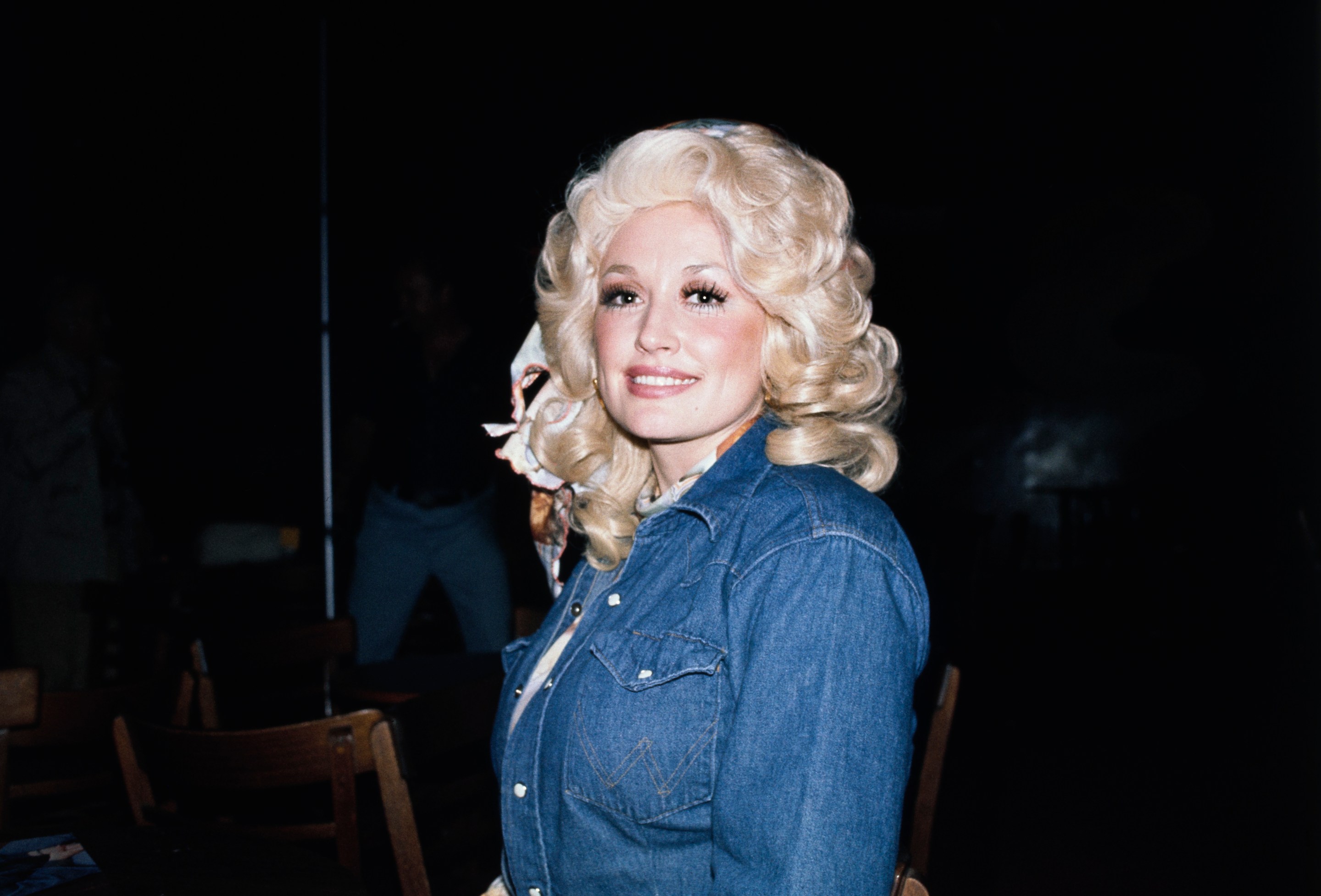
It is a pleasure to my mother to sparkle. Here, well into her next decade, she still goes to mass a few times a week and is always—always—“done up.” Her makeup is exquisite; her hair (an auburnish “blonde” for decades now) is just-so; her ensemble is sharp, and colorful, and possibly in one facet or another glittering; her earrings are mandatory. She isn’t at all like the “Westport ladies,” as we call them, bedecked in a kind of wealth that, while restrained by social custom, is sufficiently ostentatious to make the tax-bracket point. Most everything my mom wears comes from Marshall’s. Nor is she like Dolly in a commitment to acrylics, wigs, surgical intervention. Her turn-out is considerably more muted, even if leaning deliberately toward the glamorous. She just likes, she says, to sparkle.
Like Dolly, she will have a smile and a bright word for everyone there. Also, as with Dolly, everyone knows her. How could they not? As she says, not at all boastfully but with a kind of merriness, as if still bemused by it, “I’m noticeable!”
Dolly Parton was born in 1946, the fourth of 12 children, in far east Tennessee. Josephine Coviello is a little older, born in 1941, the eldest of the formidable Scognamiglio sisters, and the first of the family to speak English, which she learned how to do when she went to grade school. Dolly’s poverty was of a different order and scale—and so, in the future, were her political commitments. (Here I would like to beg the world of commentary to dispense with the description of Dolly Parton as “nonpolitical”—she was characterologically non-injurious and professionally wary of party affiliation, which is hardly the same thing, and if you can’t see the breadth of her commitment to the fates of working people, of women, of queer people, and of the dispossessed more largely, not even to mention of literacy and public health, the fault is not hers.) In a lot of ways, my mom’s story is more familiar because it is more conventional: that of first-gen white ethnic assimilation, and of a relative but real mobility achieved and, in a modest way, reveled in. I used to hate the way my parents bought bumper stickers and swag from the universities I attended, and made merciless fun of them for that grasping garishness. As my great and also Italian friend pointed out, I did this because I was young, and so very much still an asshole.
In truth, though, this is all a little to one side of the matter. My mom did not and does not sing; she bequeathed no theme park; though a beauty, she was not the occasion for nationwide joking and titillation; she made no generational fortune. But then, if you think these are the things you’d cry for in the passing from the earth of Dolly Parton, you too may be looking to one side of the matter.
Not quite 50 years ago, in an obituary that would itself become its own kind of famous, legendary rock critic Lester Bangs said that the devastating thing about Elvis’s death wasn’t his vanished talent, the crazy arc of his career, the galactic scale of his charisma, the exigencies of his weird fame, his youth, even the time-smiting vastness of his influence. No. “I can guarantee you one thing,” is how he concludes. “We will never again agree on anything as we agreed on Elvis. So I won’t bother saying good-bye to his corpse. I will say good-bye to you.”
Demolishing, for sure—but was he right? Never again? There’s an agreement of sorts brewing up around Dolly, and perhaps most of all around the remarkable and even bewildering way her embracing non-divisiveness managed somehow never to be without principle, emphatic worldly devotion, stands taken and made. “What has long been clear is that Parton represented the lasting good that’s possible in America,” is how Craig Jenkins put it in New York magazine.
Now, I don’t know about that—less because her distinctive and twangy Americanness is arguable than because I disincline to credit this poisoned, blood-bespattered garrison state with much of anything, beyond leaving just enough room for some extraordinarily brave and fortunate souls not to exemplify but to overcome it. But then that’s just where my head’s at, and perhaps yours too—and that, finally, might have a lot to do with why I can’t stop choking up when I run into “Islands in the Stream” or whatever, on some unspooling reel or aggregator.
The truest and deepest fact about Josephine Coviello, at least for her youngest son, isn’t that she’s glamorous, or a Catholic both devout and uninvidious, or even that she is by committed practice kind and welcoming to everyone she encounters. The world she grew up in was not an especially easy one. Her parents were separated, by an ocean and by a language, from most everything that was familiar about life; they were poor; they had all the difficulties of family life, intensified by these deprivations. But as my aunts tell it, Josephine was determined—though that is a stupidly diminishing term for the degrees of tenacity and devotion in question—to build around the four of them the possibility for happiness. They would make a life, a series of lives, they would make them for themselves and for one another, and there were to be in them wider and brighter horizons. And I ask you: What could be more remarkable, more humanly admirable, than the impulse to create a world of happiness for the people you love most, and to do so without any workable model to draw on, any inherited template for how that would work and how it would be done?
For a lot of years, people asked me how I got into queer theory, of all things, a straight Italian Catholic boy like me? The answer was easy. What could feel more natural, more wholly at-home, than a scene of people improvising entire worlds of love together, and making them vivid and sustaining, despite the want of much in the way of official sanction or established precedent? That’s what I would say about my mom. For as long as I’ve known her, perhaps the central animating fact of her life has been the conviction that no one should be deprived in that particular way, that there must and shall be enough love, always, for everyone.
So it isn’t the vulnerability of “Jolene,” the grandeur of “I Will Always Love You,” or the absolute-banger pure pop perfection of “9 to 5” that catches me up about Dolly. Go watch the videos, the performances, the interviews. Like almost nobody else, Dolly Parton made goodness—actual humane large-hearted unbelittling funny filthy gregarious workaday decency—seem like the most natural thing in the world, an ordinary habitude, as easy as stepping off the bus. It shines off her like a cloak of light. And if she is so radiantly good, and that goodness is so unstrained and ready to hand, shouldn’t we all be able to access it as well? To find that deep flowing river of it murmuring along somewhere inside us?
Here I’ll speak for myself: I do not find it easy, no. I am clotted and clogged. I am rather like my mom—so it pleases me to think—but I also feel such toxifying quantities of unrelieved anger at the world all the time, am filled with such garish and extensive visions of what Emerson called secret retributions, that I legit startle myself, some phone-stricken mornings on the train. Let me speak less just for myself: I cannot believe, not for a living hour of the late-imperial American day, that this is unique to me.
The difficulty isn’t even that I think any of that’s wrong, or that it’s ill-considered to be seized upon in this way by the many lesser angels of rage. It isn’t, I don’t think, for me or for you, however little I enjoy it. The nearer difficulty, I think, is that my mom is 85. She won’t be here forever, which is a fact as plain as it is comprehensively unacceptable. It is absolutely the case that crying—and crying, and crying, and crying—over Dolly has given me a way to stage the total breadth of that impossibility, and to take its terrible measure. Art can do that sometimes, and that in itself is still another reason to feel, toward everything Dolly is and has done, an incalculable gratitude.
But it turns out that the measure of it includes something more than the intolerability I’ll just have to find a way, one day, to tolerate. All that arrives, too, with the awful sense that, whatever I learned of goodness from my mom, and whatever my devotion to that goodness having been among the largest and greatest facts of her, I, her second son, cannot live it out. I cannot make it mine, not in its proper breadth, not here, not today. And what kind of bumbled inheritance is that? What kind of disappointment? What kind of betrayal? You’d cry too.
As perhaps goes without saying of my Italian mother (and, in truth, in my experience, most all Italian mothers whose names are not “Livia Soprano”), “disappointment” and “my sons” are concepts that do not reside for her in the same postcode, or in any communicable proximity. I can’t think of a moment in the whole of my checkered 55 years when I did not know, with a certainty as absolute as gravity, that my mom loved me, and was proud of me, which is I realize is a piece of huge and preposterous good fortune, a blessing of incalculable human magnitude, though it’s also an ordinary fact.
But there are all these tears, mine, yours, everyone’s. So maybe you feel it too: not the exonerating consolation of Dolly Parton’s undisputed goodness—look how decent we can actually be as a people!—but the quiet bite of it, something just a little more off-center and chastising. I just mean the hard dull ache that opens up in the distance between that stupendous breadth of open-heartedness, the one you see across the whole archive of Dolly Parton’s singular life, and the narrowing bandwidth of poisoned feeling you’re left with, out here in these cruel and ruinous days.
I listen again to the classics—every song from “Trio,” from 1988, will shiver straight down into your nervous system—and I think it must be the case that Dolly’s right, and Josephine too: There must and shall be enough love. You might cry right along with me, because that is surely beautiful, some of the best of human aspiring, the groundwork for all sorts of transformative art and for that matter transformative living. Then again, you might cry too just because, right now, even the idea of it seems painfully remote, and really fucking hard.