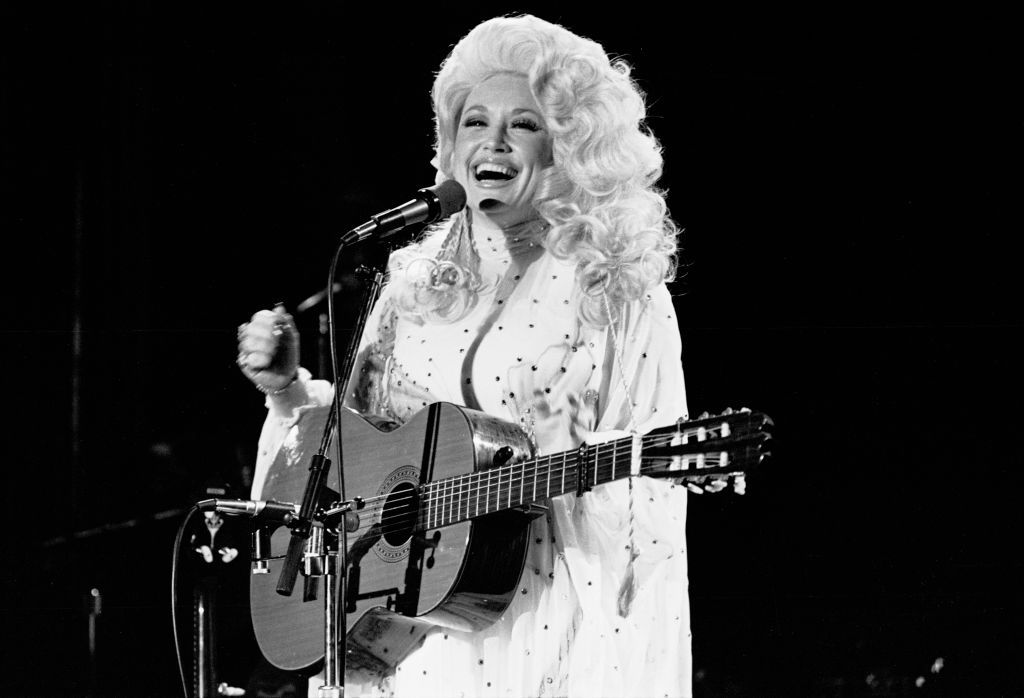
Following Tuesday's news of Dolly Parton's death, the Defector staff convened to remember some of our favorite performances by her.
"High Sierra"
On Tuesday, in the moments after I heard that Dolly Parton had died, I returned immediately to "Light of a Clear Blue Morning." It's a song I've always loved, even when I was a child, and that feels so cathartic to me: the slowness of the opening verse followed by the beat of the chorus, the reminder that things are going to be OK, that fun will exist if you just wait. But every year, I keep a playlist of new (to me) songs I've discovered, and a playlist of not-new songs that I've put on repeat through the year. At the end of the year, the second playlist is usually the one that creates a kind of soundtrack for my life. And yesterday, when I looked through my playlists for the last 20 years, it wasn't "Light of a Clear Blue Morning" that was my most frequently repeated Dolly song. It was "High Sierra."
I remember hearing "High Sierra" as a child. Even though neither of my parents listened to country music, it is not the kind of genre you can avoid as a child growing up in Texas. "High Sierra" is a song from Trio II, a collaborative album made by Dolly Parton, Linda Ronstadt, and Emmylou Harris: three of country music's best. The harmonies are angelic, the misery is palpable, the gentle twang behind them soothes you. I know I will listen to it every year for the rest of my life, however long that may be.
I wanted to choose "High Sierra" because I love it, but also because in the wake of Dolly's death, the thing that feels the most incredible and touching and magical about her life is how collaborative she was. Everyone loved her because she supported everyone. She was not selfish or greedy. She collaborated in art and in life with the people around her, and she knew that there was just as much value in that as in making another album of her own. I love "High Sierra" because there's something mournful in it. The stacking harmonies and the longing in their voices draws you into another world, where there is room for all of the hurts and pains you've experienced and a community to bear you along through them.
Our country (the genre and the place) lost one of its great support pillars. To choose community, support, and collaboration in an economy and a culture that does not encourage that is the greatest choice a creative person can make. Dolly devoted her life to the betterment of others, to making songs that slap together and alone, to believing that art is about all of us. I can only dream of a creative life as communal and giving as hers was. RIP. - Kelsey McKinney
"Down From Dover"
Dolly Parton made the world a better place and made me cry a lot. Yeah, I’m hardly alone on that. But I remember bawling the first time I heard “Down From Dover” and thinking, She got me again! What a damn song! Even through the Nashvillian wall-of-schmaltz production, “Down From Dover” comes off like a Celtic folk ballad, an ostensible love song headed for horrors. Dolly sings like an angel as per usual, even while kicking you in the gut. She said she wrote the tune as a teenager but because of the subject matter—a young woman abandoned during an unwanted pregnancy—her label wouldn’t let her release the recording until her fifth LP, 1970’s The Fairest of Them All, when she was a star with some sway over her own art. And even then, her mentor and tormentor Porter Wagoner urged her not to release the track as a single, and it never was. So “Down From Dover” never got any radio airplay. I was a well-seasoned Dolly devotee before I ever knew the song existed, but it became the rare deep album cut that made its way into concert setlists. I’m going to go listen to live versions of “Down From Dover” now. Yeah, she’s going to get me again. - Dave McKenna
"9 to 5"
Pop music likes to deal in universal truths: love, lust, heartbreak, triumph, and booty shaking. But those can be easy. There are other less universal but still persistent truths—your friends will laugh at you, your husband might shame you, and then one of said friends might try to steal said man—but those tend to be rarer musical subjects. Unless you are a genius, as was the great Dolly Parton, in which case you will write hit songs about all of these topics. It's why picking the best Parton song feels so daunting, and longtime country music journalist Robert K. Oermann once compared her to Mozart. Hey, they did both wear wigs.
But for me, a child of the 1980s, the best Parton song always will be "9 to 5," that ode to how much working for the man just sucks. The song came out before I was born, but that always seemed like a technicality. In the '80s, it seemed omnipresent. I'll always remember it playing on the car radio while my mom drove me to school, then headed out to her job, where she would be treated much like the women in the song itself. All that trickle-down economics? It never trickled down to us.
At the height of her fame, Parton gave us one of the greatest working-class songs in history. You wouldn't know it from the cheery music, and the opening lines—like work itself—draws you in with a promise of a fresh start. Has any lyric been as evocative of a new morning's promise as "pour myself a cup of ambition"? And make no mistake, this is a song for working women. "They just use your mind and they never give you credit. It's enough to drive you crazy if you let it." Yup. "They let you dream just to watch 'em shatter. You're just a step on the bossman's ladder." Oh, interesting, I did not realize Parton worked at newspapers during the Great Local Media Crackup.
But Parton would know about struggles. She grew up poor and, unlike most people who achieve success, never shied away from where she came from. She stayed blonde. She stayed faithful to Tennessee, opening her theme park there. She kept her Southern accent. And she never forgot the shame of having to tell some corporate suit his bad ideas were great. They are less convenient truths than the power of love, but just as woven into the tapestry of our lives. A tapestry few have ever covered as richly and fully as Parton. - Diana Moskovitz
"Here You Come Again"
There is a lesser version of this song that keeps the lyrics but replaces the melody with something mournful. Or a version where the bounciness remains, but the song is about the narrator refusing to believe this man’s pretty lies and sending him packing. Worst of all, we could have had the version songwriters Barry Mann and Cynthia Weil originally intended, which was a comeback vehicle for Brenda Lee. Luckily we ended up with this one, which, despite being one of the few hits she didn’t write herself, is all Dolly. In the coming days many people will seek to sanctify Dolly Parton, and justifiably so. She was undeniably a musical genius, maybe even something holier. But she was also a woman, and one who could sing about walking into her own romantic undoing with eyes as clear as a mountain stream. She was honest, and she made honesty beautiful. There will never be another one like her. - Brandy Jensen
“Old Flames (Can’t Hold A Candle To You)”
From Kesha’s (best) album Rainbow, “Old Flames (Can’t Hold A Candle To You)” is a cover of a song originally recorded by Joe Sun, then by Brian Collins, and finally by Dolly Parton herself. Dolly’s version performed best, of course it did, reaching No. 1 on the country charts in 1980. Kesha’s inclusion of a cover, featuring Dolly herself, on Rainbow is a masterstroke both for how the song sounds—whatever shit people have given Kesha throughout the years (objectively undeserved), she could always really sing—and for the familial links in play here: Kesha’s mother Pebe Sebert co-wrote “Old Flames” (with her then-husband Hugh Moffatt), and Kesha sings it like it was written for her, a decade before her birth.
But when Dolly comes in for the second verse, woo boy, I get shivers. Her original version of the song is a bit slower and more melodic than the 2017 version, but even though Dolly is almost 30 years older by the time Kesha’s version rolls around, she’s still got it. In the 1980 track, she’s crazy in love, but 37 years later, she’s weary and wise. She’s the angel on Kesha’s shoulder, a godmother pushing along the next generation. Her voice quivers a bit more, but she’s still just so powerful and the center of attention. She’s Dolly fucking Parton, and you can almost feel how starstruck Kesha is singing alongside her. As she should be; I can’t say that I grew up worshipping Dolly—it took until college and a Tennessean floormate to even listen to anything past “Jolene”—but it’s impossible to listen to anything she did without coming away in awe. - Luis Paez-Pumar
"Wildflowers"
When I was a kid, Dolly Parton was one of the most famous people in the culture and right around her creative peak, but still something of a cultural punchline despite that. The culture was unusually nasty and dumb at the time, or maybe just nasty and dumb in a more dated version of the same ways it is now; either way, the first sense in which I understood her was as The Big Boobs Lady and as an avatar of a subculture I was supposed to find tacky and laughable. Her stardom was big enough that I knew who she was before I really knew who anyone was, but I basically thought of her the way I thought of the Muppets, or maybe as a Muppet—something I enjoyed, but which I also understood at some level as not real. Her duetting with Kermit the Frog didn’t un-confuse any of that.
Parton always leaned into this character, or caricature, in the same cheerful way that she did everything. She was an artist and a no-shit social activist—for childhood literacy, for basically every marginalized community in the culture, and more recently for the COVID vaccine—in all the serious and material senses in which a person can be those things, and put her money behind her commitments for as long as she had money to put anywhere. I still didn’t really know anything about her music, and I only faintly do as I write this, but I came to admire her as a person, and as a sort of the ideal version of what an American might be: generous, inclusive, humane, funny, self-respecting but never self-important.
Which is reasonable, because she really was all that, but which was still missing the point. I knew her hit songs, and I knew that she’d written them herself; I’d heard them in bowling alleys and at karaoke for literally decades before I went much further than that. As with John Prine, I arrived in earnest as a fan just as the (extremely popular and prolific) artist I’d belatedly discovered was leaving. I am still just scratching the surface—clicking links, following recommendations, listening to the original versions of songs I’d heard covered by contemporary artists. I’ll be doing that in this blog, too.
I’m terribly late to all of it, but songs like this one—it’s from the 1987 album Trio, the first of two that Parton would make with Emmylou Harris and Linda Ronstadt—are still there as proof of who she was and what she did. There is this clear and thrillingly assured voice, both in the swift and clear-eyed writing and more literally in her vocals, and it is commanding and lovely and sad. The song is not spare in the least—like so many of her best songs, it’s a testament to the wonder-working powers of high production value—but it is also clear as a bell. It’s silly to be surprised by the fact that there’s such a dazzling artist under there, I know: It’s a shame that this is the part of her that I learned about last. - David Roth
"I Forgot More Than You'll Ever Know"
Country music has thrived without our active participation, but Dolly Parton sang seemingly every song ever made in any genre, so there was no avoiding it when her name was stamped on it. Those being the prevailing conditions, the Parton song that hit the spot here was an old Davis Sisters song from the early '50s, "I Forgot More Than You'll Ever Know," which she covered in 1993 as part of an album with Tammy Wynette and Loretta Lynn called, as though you couldn't have guessed, Honky Tonk Angels. It sounded like the credits promised it would, and the idea that she could get nearly anyone to stand next to her at a microphone made perfect sense, even if the song in question, as authentic as it came across, wasn't one of her 100 greatest hits. Then again, she also played the Benny Hill theme on the alto sax, so any answer to any song would have done as well. - Ray Ratto
"Those Memories of You"
This song always gets to me because of how it captures the everyday-ness of grief: the way it strikes you down as you're bringing in the mail or cooking dinner. Like the relentlessness of life's demands amid loss, the song's tempo doesn't give you the chance to luxuriate in the drama of lyrics like "It's not your lips now that drive me crazy/It's just your haunting memory." It's a song for feeling the enormity of what you've lost, even as you keep walking forward. - Alex Sujong Laughlin
"The House of the Rising Sun"
When I seize power and implement the Redford Plan, I will institute a program wherein any American singer of sufficient heft will be compelled to record a cover of "The House of the Rising Sun." It's an eternal song, one often taken in a more traditional direction, but also one open to interpretation. Dolly Parton's 1980 iteration is one of the best versions you will ever hear.
Sonically, its 1980ness is obvious from the second you press play. There are no plaintive warbles, no note of ominous peril, none of the foreboding and ambiguity that marks most other covers. Dolly's version is, if not quite joyful, jaunty. A sprightly electric piano-and-drum track buoys the gospel singers working backup as Dolly inverts the song's point-of-view, embodying a worker at the titular House. It's a smart choice, one that wouldn't work if taken up by a less commanding singer, but Dolly is as commanding as anyone who's ever opened their vocal chords, so not only does it work, it soars. - Patrick Redford
"Gonna Hurry (As Slow As I Can)"
So much of what I grew to love about Dolly Parton was her lore—the many stories of her magnanimity, wit, and brilliance. So many of her songs, too, are steeped in lore, such as how she wrote "Jolene" and "I Will Always Love You" the very same week, if not the same night. But my favorite Dolly song is this demo, "Gonna Hurry (As Slow As I Can)," a song that I know almost nothing about. It's not for lack of trying. I've googled this song at various points over the years, each time thinking I'll find the story behind its origin. All I know is this: Dolly co-wrote and recorded the song with her uncle, Bill Owens, likely when she was a teenager in the late ’50s or early ’60s. The song was only released in 2009 on the 99-track collection Dolly, which featured a bunch of demos and never-before-released tracks. But like all of Dolly's songs, "Gonna Hurry (As Slow As I Can)" doesn't need lore to be iconic. It's simple and immediately memorable, about a lover reluctant to leave someone who's left her for another. The song does what Dolly did best, distilling a universal human emotion into something specific, heartrending, and eternally lovely. It is a song I listen to when I feel heartbroken, as I do now, for Dolly. - Sabrina Imbler
The Best Little Whorehouse In Texas
There are better Dolly Parton movies out there (Steel Magnolias, 9 to 5), but if you wanted one that perfectly encapsulated what made Dolly great, it's this. That she would go out of her way to make a musical about a brothel in which she plays the madam is already wild, but to subvert stereotypes and norms by championing the women that work in them as the heroes of their own story is something only she would've had the nerve to do and pull off successfully. And that's not even getting to the fact that the performances are great, led by Dolly and a just-as-game Burt Reynolds, and the songs are incredible. Dolly was treated like a joke in pop culture for the longest time, a caricature of trashy Southern pulp, but she was never afraid to lean in on that perception, particularly as it made her richer than God. She was a champion of the downtrodden, both economically and socially, and she made culture that reflected them from their own perspective. And in the end, she got the last laugh. She is the national treasure. Remember that every time you watch this one. - Israel Daramola